
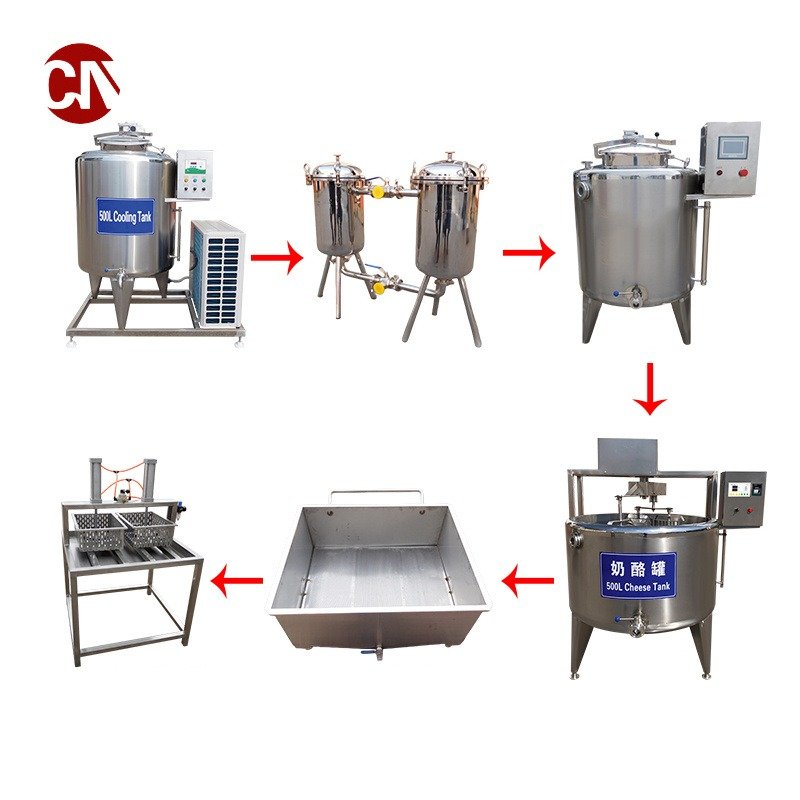
Production line and factory setup overview
A batch cheese line for receiving and releasing Afghan cow or goat milk, standardization, pasteurization where required, culture and rennet dosing, controlled coagulation, curd cutting, gentle stirring, whey drainage, molding, pressing where the selected cheese needs it, salting or brining, cold maturation and hygienic packing. Fresh white, brined and local cheeses require product-specific recipes.
Recommended lowest-entry line configuration For the lowest credible entry, use a 200-500 L jacketed cheese vat with curd knives, draining table, manual molds and press, small brine tank, vacuum sealer, basic CIP and cold room. Launch one fresh white or brined cheese recipe from one defined milk type; sell whey only after a safe outlet is confirmed.
Production process and implementation sequence
- Chilled milk receiving and release tests
- Standardization and required pasteurization
- Culture, calcium and rennet dosing
- Controlled coagulation and curd cutting
- Gentle stirring and whey drainage
- Molding and recipe-specific pressing
- Dry salting or controlled brining
- Cold holding, packing, coding and release
Products, capacity and market fit
- Afghan cow and goat milk can support familiar fresh and brined cheeses.
- Batch vats suit variable village milk volumes and local labor.
- Whey can feed a later beverage or feed project only after safety review.
- One validated cheese recipe limits starter, rennet and brine complexity.
- Fresh white cheese - Defined milk, moisture, salt, texture, microbiology and refrigerated shelf life - Retail, hospitality and food service
- Brined local cheese - Controlled brine strength, block size, salt uptake and cold maturation - Retail tubs and institutional buyers
Core production machinery and line specifications
| Machine / stage | Function / value | Production note |
|---|---|---|
| Milk receiving and pasteurizing tank | Receives released milk and applies required heat treatment | 200-500 L entry |
| Jacketed cheese vat with curd knives | Coagulates, cuts and stirs curd | 200-500 L/batch |
| Culture and rennet dosing tools | Controls batch formulation | Calibrated small-volume dosing |
| Draining table and whey screen | Separates curd from whey hygienically | Food-grade open handling zone |
| Molds and manual press | Shapes and presses the selected cheese | One launch block size |
| Brine tank and salinity tools | Controls brining where used | Recipe-specific concentration |
| Vacuum sealer or tub sealer | Protects the selected retail pack | One launch format |
| CIP and cold room | Supports sanitation and refrigerated storage | Logged cleaning and temperature |
Raw materials, utilities and factory requirements
- Released Afghan cow or goat milk, kept as separate products
- Approved starter culture, rennet, calcium and food-grade salt
- Food-contact molds, vacuum film or brine tubs and labels
- Approved dairy detergents and test reagents
- Stable electricity matched to motors, controls and refrigeration
- Potable process and cleaning water
- Washable food-grade rooms with drainage and pest control
- Segregated raw-milk, ingredients, packaging and finished-goods areas
- Steam or hot water, chilled water and compressed air only where specified
Indicative low-entry investment and implementation plan
These planning ranges prioritize economical machinery, local labor and local civil works. Final pricing follows confirmed capacity, product specification, delivery terms and site conditions.
| Scope | Indicative range | Entry-plan note |
|---|---|---|
| Receiving and cheese vat | US$8k-20k | 200-500 L/batch |
| Draining, molds, press and brine | US$4k-11k | One cheese recipe |
| Packing and quality tools | US$3k-8k | One launch format |
| CIP and cold room | US$5k-13k | Fresh or brined cheese |
| Freight, installation and spares | US$5k-12k | Sanitary commissioning |
| Indicative low-entry total | US$25k-64k | Building, vehicle, milk and culture stock excluded |
Detailed proposal and next step
The proposal contains the complete line flow, machinery scope, raw-material and utility requirements, implementation stages and indicative entry planning. Final configuration follows confirmed products, capacity, site and budget.