
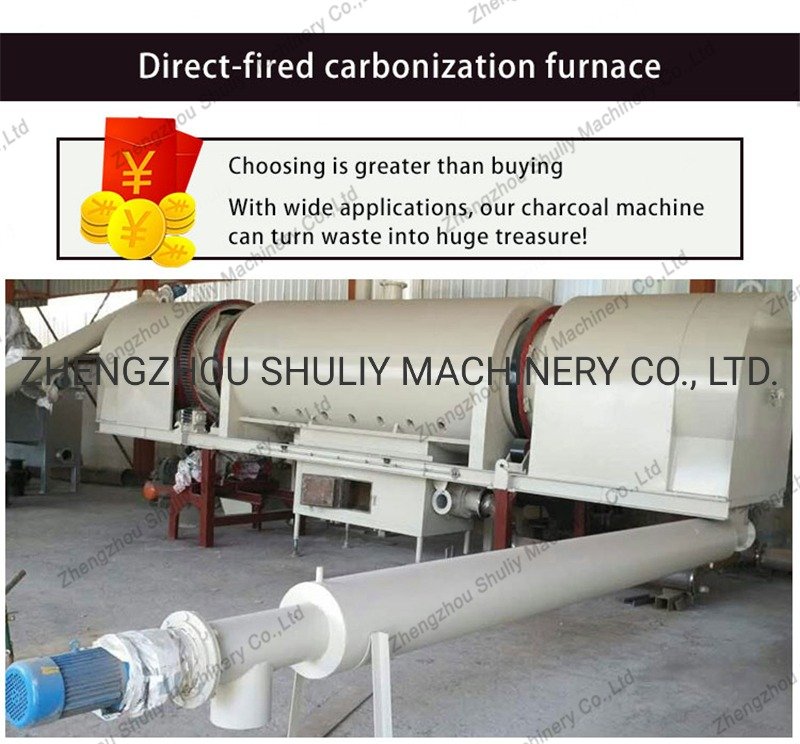
Production line and factory setup overview
A micro/small controlled-pyrolysis line converting one clean Afghan crop or wood residue into soil-grade biochar through feedstock identification, contaminant removal, size control and drying, oxygen-limited batch retort or small continuous carbonization, syngas afterburn and flue-gas treatment, sealed oxygen-free cooling, optional crushing and screening, safe conditioning, laboratory characterization and dust-controlled packing. It is distinct from activated carbon and fuel-briquette production.
Recommended lowest-entry line configuration Start with one naturally dry pruning or clean wood-residue feed and a sealed batch retort or 200-300 kg/h continuous reactor only if the supplier includes controlled feeding, gas-tight discharge, afterburner, particulate treatment, temperature logging and sealed cooling. Sell only after independent soil and contaminant tests; do not claim activated-carbon adsorption performance.
Production process and implementation sequence
- Feedstock identity and contaminant release
- Sizing and moisture control
- Metered oxygen-limited pyrolysis
- Syngas afterburn and flue-gas treatment
- Sealed oxygen-free cooling
- Crushing, screening and conditioning
- Biochar laboratory release
- Dust-controlled bagging and traceability
Products, capacity and market fit
- Orchard prunings and clean crop residues can become a stable soil-carbon product.
- A controlled retort prevents the smoke and fire risks of open pits.
- One feedstock produces more consistent carbon and ash results.
- Environmental approval, PAH testing and local soil trials are essential.
- Soil-grade biochar - Feedstock, production temperature, particle size, moisture, ash, fixed carbon, pH, EC, stability, metals and PAH limits - Soil amendment and compost blending only after local agronomic trials
Core production machinery and line specifications
| Machine / stage | Function / value | Production note |
|---|---|---|
| Feed cleaner, crusher and dryer interface | Prepares one residue safely | Moisture limit fixed |
| Sealed retort or continuous carbonizer | Runs oxygen-limited pyrolysis | Logged temperature |
| Afterburner and gas-cleaning train | Destroys vapors and controls particles | Environmental design |
| Gas-tight discharge and sealed cooler | Prevents re-ignition | No hot open discharge |
| Crusher, screen and dust extraction | Produces selected biochar size | One soil grade |
| Biochar laboratory and bagging | Releases safe traceable product | Named test methods |
Raw materials, utilities and factory requirements
- One clean documented pruning, shell or wood-residue feed
- Water only for validated conditioning after complete cooling
- Fire-safe bulk bags or moisture-resistant sacks
- Labels with feedstock, lot and application limitations
- Stable three-phase electricity with verified connected load
- Guarded machinery, lockout, ventilation and fire protection
- Covered segregated raw-material and finished-goods storage
- Maintenance tools, safe lifting and critical spare parts
- Environmental permit, chimney monitoring points and firefighting water
- Explosion/CO monitoring and restricted hot-process zone
Indicative low-entry investment and implementation plan
These planning ranges prioritize economical machinery, local labor and local civil works. Final pricing follows confirmed capacity, product specification, delivery terms and site conditions.
| Scope | Indicative range | Entry-plan note |
|---|---|---|
| Feed preparation and handling | US$12k-30k | One dry residue |
| Retort/carbonizer, afterburner and sealed cooler | US$45k-125k | Controlled emissions |
| Screening, fire safety and laboratory | US$18k-48k | Soil-grade release |
| Freight, installation and commissioning | US$18k-45k | Hot trials included |
| Indicative installed low-entry total | US$93k-248k | Building, dryer and permits excluded |
Detailed proposal and next step
The proposal contains the complete line flow, machinery scope, raw-material and utility requirements, implementation stages and indicative entry planning. Final configuration follows confirmed products, capacity, site and budget.