
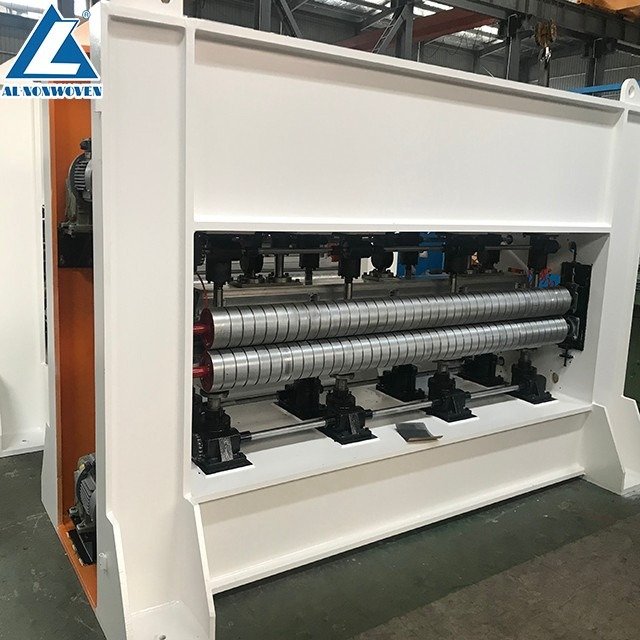
Production line and factory setup overview
A small/medium dry-laid needle-punch line converting specified clean wool, recovered textile fibre or a validated wool-synthetic blend into technical felt and carpet underlay through bale opening, metal removal, blending, fine opening, carding, cross-lapping, pre-needling, finish needling, optional thermal setting, edge trimming, thickness control, winding or sheet cutting, inspection and packing.
Recommended lowest-entry line configuration Launch one non-structural underlay or general-purpose felt specification. Screen a 100-250 kg/h line with one opener/blender, single card, cross-lapper, pre-needle loom, finish needle loom, simple calender only if required, edge trimmer and winder/cutter. Validate wool blend, binder fibre, odour, moth resistance and fire performance before promising building or automotive applications.
Production process and implementation sequence
- Fibre receiving, quarantine and metal removal
- Bale opening and recipe weighing
- Blending and fine opening
- Carding into an even web
- Cross-lapping to target basis weight
- Pre-needling and finish needling
- Trimming, optional calendering and thickness check
- Winding or sheet cutting, inspection and packing
Products, capacity and market fit
- Coarse wool and selected textile recovery streams can become useful cushioning and insulation products.
- Carpet underlay has simpler appearance requirements than apparel textiles but still needs density and thickness control.
- Needle-punch capacity can expand by adding needling width or speed after a stable product is sold.
- Claims for fire, acoustic, thermal or automotive use require laboratory evidence, not supplier advertising.
- Carpet underlay - Buyer-defined width, basis weight, thickness, density, compression recovery, odour and roll length - Carpet installers and floor-covering distributors
- General-purpose wool-blend felt - Approved blend, thickness, tensile, dimensional and shedding limits - Furniture, padding, craft and non-critical insulation users
Core production machinery and line specifications
| Machine / stage | Function / value | Production note |
|---|---|---|
| Bale opener, metal detector and blender | Meters and homogenizes the fibre recipe | Recipe traceability |
| Fine opener and feed chute | Separates fibre and feeds the card evenly | Wool-safe settings |
| Carding machine | Forms a uniform thin fibre web | Matched to 100-250 kg/h |
| Cross-lapper and web drafter | Builds width and basis weight | 2.0-3.2 m basis |
| Pre-needle loom | Consolidates the loose batt for handling | Low initial penetration |
| Finish needle loom | Develops strength and density | Needle board by product |
| Trimmer, winder and sheet cutter | Forms saleable rolls or sheets | Length and edge control |
| Dust extraction and felt laboratory | Controls workplace and product release | Density and compression tests |
Raw materials, utilities and factory requirements
- Clean graded wool, approved recycled textile fibre or specified blend
- Binder fibre only where product trials require thermal bonding
- Anti-moth treatment only with legal, buyer-approved chemistry
- Cores, wrap, labels, pallets, felting needles and card clothing
- Stable three-phase electricity and motor-starting study
- Dry covered fibre store and physically separated dusty opening zone
- Central fibre/dust extraction and fire detection/suppression
- Compressed air where controls and cleaning require it
- Optional controlled heat source and exhaust for thermal setting
Indicative low-entry investment and implementation plan
These planning ranges prioritize economical machinery, local labor and local civil works. Final pricing follows confirmed capacity, product specification, delivery terms and site conditions.
| Scope | Indicative range | Entry-plan note |
|---|---|---|
| Opening, blending, feeding and carding | US$55k-155k | One fibre recipe basis |
| Cross-lapper and two-stage needling | US$75k-230k | Width and needle density drive cost |
| Trimming, winding, laboratory and dust control | US$25k-80k | Essential finishing and safety |
| Freight, electrical, installation and spares | US$40k-125k | Needles and card clothing included |
| Indicative installed project total | US$195k-590k | Building, fibre stock and optional thermal oven excluded |
Detailed proposal and next step
The proposal contains the complete line flow, machinery scope, raw-material and utility requirements, implementation stages and indicative entry planning. Final configuration follows confirmed products, capacity, site and budget.