
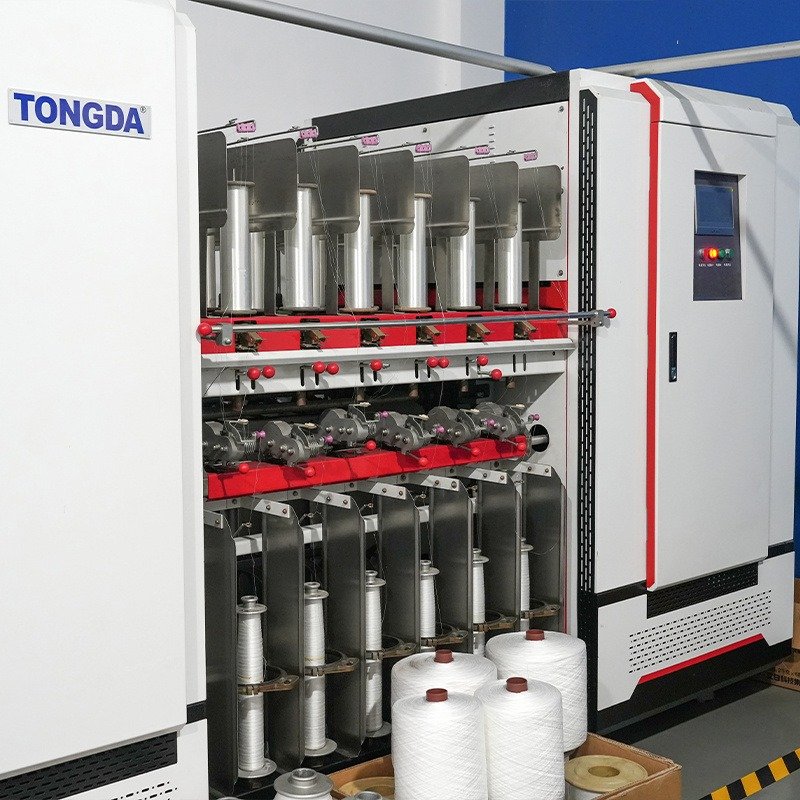
Production line and factory setup overview
A small/medium thread-conversion line turning released single cotton or polyester yarn into specified sewing thread through lot testing, doubling, controlled S or Z twisting, optional heat setting or lubrication appropriate to the fibre, precision winding onto cones, tubes or king spools, length control, inspection, labelling and packing. Dyeing is outside the launch scope unless a separate validated dyehouse is installed.
Recommended lowest-entry line configuration Launch one thread construction and two package sizes using one 12-24 spindle doubling winder, one 128-160 spindle two-for-one or ring twister selected by yarn trials, one 4-6 head precision final winder with length counters and a small strength/twist laboratory. Buy pre-dyed yarn initially instead of adding a dyehouse.
Production process and implementation sequence
- Yarn lot receiving and laboratory check
- Doubling and tension equalisation
- Controlled S or Z twisting
- Optional setting or lubrication
- Intermediate package inspection
- Precision final winding
- Length, weight and strength verification
- Labelling, batch coding and packing
Products, capacity and market fit
- Local garment workshops consume sewing thread in repeat colours and package sizes.
- Twisting and winding can add value without a full spinning or dyeing mill.
- Pre-dyed input avoids chemical and wastewater complexity at launch.
- Controlled twist, lubrication and length distinguish industrial thread from simple rewound yarn.
- Cotton sewing thread - Buyer-defined ticket size, ply, twist, strength, elongation, finish and package - Garment, tailoring and embroidery workshops
- Polyester sewing thread expansion - Separate yarn, lubrication and heat-setting specification - Industrial garment manufacturers after trials
Core production machinery and line specifications
| Machine / stage | Function / value | Production note |
|---|---|---|
| Doubling winder | Combines single yarns at equal tension | 12-24 spindle entry |
| Twisting machine | Applies the specified S or Z twist | 128-160 spindle screened core |
| Optional setting cabinet | Stabilizes twist where the fibre route requires | Recipe and ventilation controlled |
| Lubrication or finish applicator | Controls sewability and friction | Measured pickup |
| Precision final winder | Builds cones, tubes or king spools | Four to six heads at launch |
| Length counter and auto stop | Controls declared package length | Per-head calibration |
| Thread laboratory | Tests count, twist, strength and elongation | Buyer methods |
| Packing and coding station | Protects and identifies finished thread | Two launch package sizes |
Raw materials, utilities and factory requirements
- Released cotton or polyester single yarn by count, strength, colour and lot
- Buyer-approved cones, tubes or king spools
- Thread lubricant or finish compatible with fibre and sewing use
- Labels, shrink film, cartons and laboratory consumables
- Stable three-phase electricity with transformer, power-quality and motor-starting study
- Central dust or lint extraction with fire-safe collection and housekeeping
- Controlled temperature and humidity suited to the confirmed fibre, yarn or fabric
- Dry covered raw-material and finished-product storage with lot traceability
- Compressed air, process water, steam and wastewater treatment where the selected process requires them
Indicative low-entry investment and implementation plan
These planning ranges prioritize economical machinery, local labor and local civil works. Final pricing follows confirmed capacity, product specification, delivery terms and site conditions.
| Scope | Indicative range | Entry-plan note |
|---|---|---|
| Doubling and twisting equipment | US$18k-45k | One thread construction |
| Precision final winding heads | US$10k-28k | Two package formats |
| Setting/finish, compressor and laboratory | US$8k-22k | Fibre-specific scope |
| Freight, installation and initial spares | US$8k-20k | Spindles, guides and tension parts |
| Indicative low-entry total | US$44k-115k | Dyehouse, building and yarn stock excluded |
Detailed proposal and next step
The proposal contains the complete line flow, machinery scope, raw-material and utility requirements, implementation stages and indicative entry planning. Final configuration follows confirmed products, capacity, site and budget.