
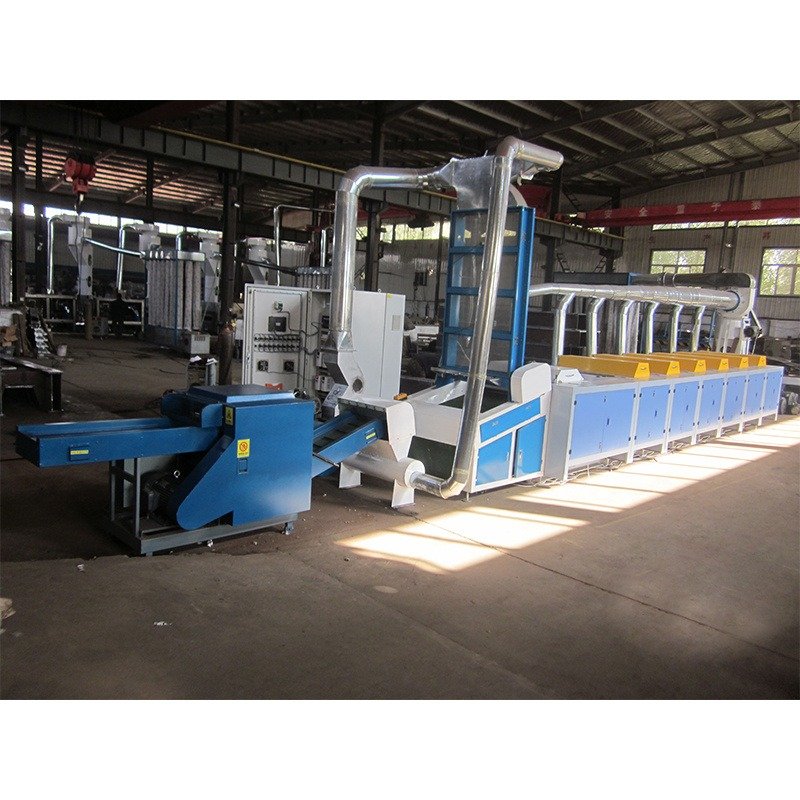
Production line and factory setup overview
A micro/small textile-recycling line sorting clean pre-consumer cotton waste, cutting oversized pieces, detecting metal, metering material through one coarse opener and trial-selected cleaning rollers, extracting dust, condensing recovered fibre and baling it by grade. It does not make finished yarn; it prepares a controlled recycled-fibre feedstock.
Recommended lowest-entry line configuration For the lowest entry, accept only clean, known-composition cotton yarn and cutting waste. Install a guarded cutter only where needed, one 600 mm opener, two or three 250 mm cleaning rollers rather than six, magnet, suction/cyclone, condenser and small press. Prove fibre length and buyer use before adding stages.
Production process and implementation sequence
- Waste receiving and source segregation
- Manual sorting and accessory removal
- Cutting oversized clean pieces
- Metal and spark-risk detection
- Controlled coarse opening
- Two or three cleaning stages
- Dust extraction and fibre condensation
- Grading, baling and coding
Products, capacity and market fit
- Afghan tailoring, knitting and textile workshops generate sortable cotton waste.
- Recovered fibre can supply wadding, nonwoven or trial low-count yarn buyers.
- A modular two- or three-cleaner launch lowers capital and fibre damage.
- Source segregation is more valuable than trying to clean mixed unknown waste.
- Recovered cotton fibre - Buyer-agreed composition, colour, fibre length, trash and moisture - Wadding, nonwoven and trial low-count spinning
- Separated textile rejects - Metal, zips, elastane-rich and contaminated fractions isolated - Approved recycling or disposal
Core production machinery and line specifications
| Machine / stage | Function / value | Production note |
|---|---|---|
| Sorting and inspection tables | Separates cotton by source, colour and contamination | No mixed municipal clothing |
| Guarded textile cutter | Reduces large clean offcuts | Install only if feed size requires |
| Magnet and spark-risk detector | Protects high-speed rollers and dust line | Before the first opener |
| 600 mm coarse opener | Releases entangled textile waste | 80-150 kg/h entry target |
| 250 mm cleaning rollers | Progressively removes thread and trash | Two or three launch modules |
| Suction, cyclone and dust filter | Moves fibre and captures dust | Fire-safe balanced system |
| Fibre condenser | Forms a consistent recovered-fibre batt | Matched to final airflow |
| Small hydraulic press | Bales released fibre by grade | Separate buyer-labelled lots |
Raw materials, utilities and factory requirements
- Clean pre-consumer cotton yarn waste and cutting offcuts by known composition
- Bale wrap, ties and lot labels
- Replacement card clothing, knives, bearings and filters
- Cleaning and fire-control consumables
- Stable three-phase electricity matched to the confirmed motor and starting loads
- High-volume dust extraction with fire-safe ducting, collection and housekeeping
- Dry covered raw-material and finished-product storage with lot separation
- Fire detection, suitable extinguishing equipment and controlled ignition sources
- Safe access, guarding, lifting aids and preventive-maintenance workspace
Indicative low-entry investment and implementation plan
These planning ranges prioritize economical machinery, local labor and local civil works. Final pricing follows confirmed capacity, product specification, delivery terms and site conditions.
| Scope | Indicative range | Entry-plan note |
|---|---|---|
| Cutter, feeder and one opener | US$8k-20k | Clean pre-consumer waste only |
| Two or three cleaning rollers | US$8k-22k | Add stages after fibre trials |
| Air, condenser and small press | US$6k-16k | Fire-safe dust collection |
| Electrical, guarding and installation | US$4k-10k | Local noncritical supports |
| Freight, clearance and wear spares | US$5k-12k | Wire and filter stock |
| Indicative low-entry total | US$31k-80k | Building and waste inventory excluded |
Detailed proposal and next step
The proposal contains the complete line flow, machinery scope, raw-material and utility requirements, implementation stages and indicative entry planning. Final configuration follows confirmed products, capacity, site and budget.