
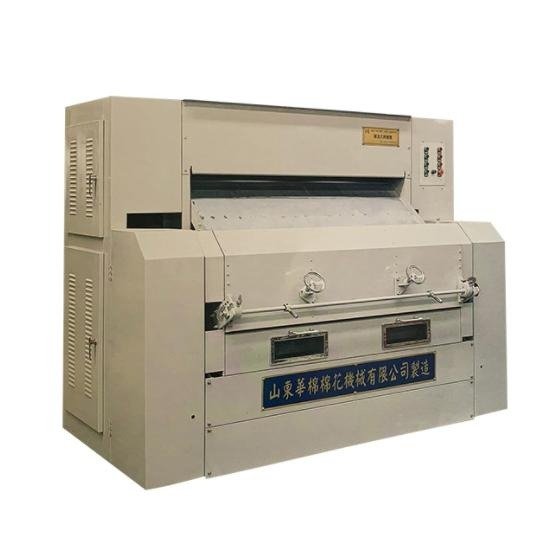
Production line and factory setup overview
A post-ginning lint-cleaning line that opens controlled cotton tufts, meters them through one or more gentle cleaners, removes dust and loose trash by grid and airflow, condenses the cleaned lint and prepares uniform feed for baling. It is intended to improve a measured lint grade without excessive cleaning that shortens fibre or reduces saleable yield.
Recommended lowest-entry line configuration For the lowest credible entry, first grade and test representative lint, then install one controlled feeder, one 100-150 kg/h multi-stage lint cleaner, balanced suction/cyclone, condenser and manual transfer to an existing or separate press. Add cleaning stages only when trials prove a higher buyer grade and acceptable fibre loss.
Production process and implementation sequence
- Lint lot receiving and grading
- Controlled tuft opening and feeding
- Coarse trash removal
- One or more gentle cleaning stages
- Air separation and dust collection
- Lint condensation
- Sampling and grade release
- Transfer to bale pressing
Products, capacity and market fit
- Afghan ginneries can improve selected lint lots before sale to spinners.
- A modular cleaner can serve several small gins through toll processing.
- Dust and trash removal can improve consistency when incoming lint is genuinely contaminated.
- Cleaning must be justified by buyer grade gain, not appearance alone.
- Cleaned cotton lint - Buyer-agreed staple length, micronaire, colour, trash, moisture and contamination - Spinning mills and cotton traders
- Separated cotton trash - Kept dry and segregated; recovery only after safety review - Approved low-grade recovery or disposal
Core production machinery and line specifications
| Machine / stage | Function / value | Production note |
|---|---|---|
| Bale opener or controlled feed lattice | Presents even tufts without surging | Matched to lint condition and cleaner width |
| Metal and fire-risk separation | Protects high-speed cleaning and ducting | Magnet plus supplier-approved detection |
| Primary lint cleaner | Opens lint and removes larger loose trash | Speed selected by fibre trial |
| Fine cleaning modules | Removes remaining small trash | Install only stages justified by grade gain |
| Suction fan and cyclone/filter | Controls transport air and dust | Balanced airflow and fire-safe discharge |
| Lint condenser | Separates transport air and forms a uniform batt | Capacity matched to cleaner |
| Sampling and test bench | Compares incoming and cleaned lint | Moisture, trash and fibre-quality methods |
| Transfer conveyor or bags | Moves released lint to the press | Prevent mixing and contamination |
Raw materials, utilities and factory requirements
- Ginned cotton lint separated by farm, variety, lot and initial grade
- Bale wrap, tags and identification materials
- Replacement wire/card clothing and supplier-approved lubricants
- Cleaning and fire-control consumables
- Stable three-phase electricity matched to the confirmed motor and starting loads
- High-volume dust extraction with fire-safe ducting, collection and housekeeping
- Dry covered raw-material and finished-product storage with lot separation
- Fire detection, suitable extinguishing equipment and controlled ignition sources
- Safe access, guarding, lifting aids and preventive-maintenance workspace
Indicative low-entry investment and implementation plan
These planning ranges prioritize economical machinery, local labor and local civil works. Final pricing follows confirmed capacity, product specification, delivery terms and site conditions.
| Scope | Indicative range | Entry-plan note |
|---|---|---|
| Feeding and lint-cleaning machinery | US$12k-32k | 100-150 kg/h screening basis |
| Air, condenser and dust collection | US$6k-16k | Fire-safe balanced system |
| Testing, electrical and local installation | US$4k-11k | Local supports where safe |
| Freight, clearance and initial spares | US$5k-13k | Wire and bearing kit |
| Indicative low-entry total | US$27k-72k | Baler, building and lint stock excluded |
Detailed proposal and next step
The proposal contains the complete line flow, machinery scope, raw-material and utility requirements, implementation stages and indicative entry planning. Final configuration follows confirmed products, capacity, site and budget.