
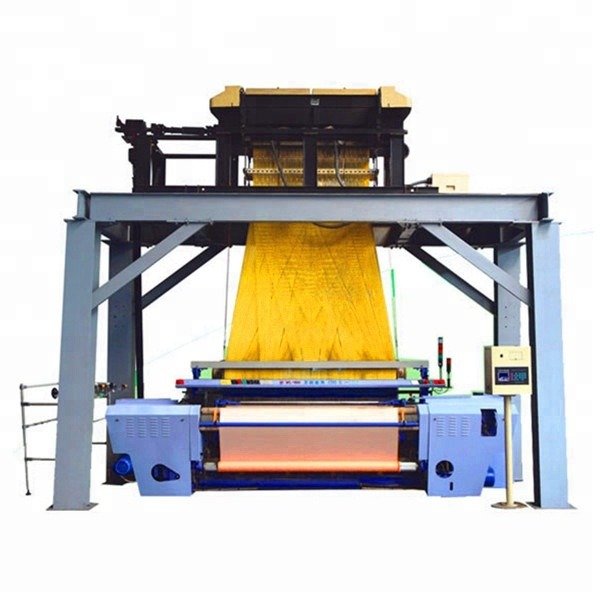
Production line and factory setup overview
A medium-industrial weaving plant converting released warp and weft cotton yarn into undyed greige fabric through yarn receiving, warp-package creeling, sectional or direct warping, sizing where required, beam drawing-in or tying, shuttleless rapier weaving, loom inspection, mending, fabric inspection, metering, rolling and bale packing. Wet finishing and dyeing are separate projects.
Recommended lowest-entry line configuration Start with one stable plain or twill construction and a contracted greige-fabric buyer. Screen one sectional warper, outsourced sizing initially where practical, four economical 180-230 cm rapier looms, drawing-in tools, compressor, loom humidification and one inspection/rolling machine. Add looms only after warp-break and efficiency data prove the preparation system.
Production process and implementation sequence
- Yarn receiving and lot release
- Warp creeling and sectional warping
- Sizing where required
- Drawing-in or warp tying
- Rapier weaving
- On-loom defect control
- Greige inspection and mending
- Metering, rolling, coding and packing
Products, capacity and market fit
- Local yarn can be converted into greige cloth for finishers and garment supply chains.
- Rapier looms accept a broader yarn and construction range than a single high-speed specialization.
- One fabric construction lowers warp preparation, reed and inventory complexity.
- Outsourced sizing can reduce wet-process investment at the first stage.
- Cotton greige fabric - One buyer-approved weave, width, ends/picks, GSM, tensile, defects and roll length - Dyeing/finishing mills and garment manufacturers
- Greige twill expansion - Separate reed, heald, warp and construction plan - Workwear or home-textile finishers after Phase 1
Core production machinery and line specifications
| Machine / stage | Function / value | Production note |
|---|---|---|
| Yarn creel and sectional warper | Builds controlled warp sections and beams | One launch construction |
| Sizing route | Strengthens warp for weaving where required | Outsource first or install after study |
| Drawing-in and tying tools | Prepares warp through drop wires, healds and reed | Manual entry system |
| Four rapier looms | Insert weft and form greige fabric | 180-230 cm selected width |
| Weft accumulators and compressor | Stabilize yarn delivery and pneumatic functions | Matched to loom configuration |
| Humidification and lint extraction | Controls yarn behavior and housekeeping | Room design by yarn trials |
| Fabric inspection and rolling machine | Grades, measures and forms dispatch rolls | Illuminated defect map |
| Weaving laboratory | Checks construction and physical properties | Buyer test methods |
Raw materials, utilities and factory requirements
- Released cotton warp and weft yarn by count, twist, strength and lot
- Warp beams, weaver beams and buyer-approved paper tubes
- Sizing material only if installed and approved
- Reeds, healds, drop wires, labels, wrap and loom spares
- Stable three-phase electricity with transformer, power-quality and motor-starting study
- Central dust or lint extraction with fire-safe collection and housekeeping
- Controlled temperature and humidity suited to the confirmed fibre, yarn or fabric
- Dry covered raw-material and finished-product storage with lot traceability
- Compressed air, process water, steam and wastewater treatment where the selected process requires them
Indicative low-entry investment and implementation plan
These planning ranges prioritize economical machinery, local labor and local civil works. Final pricing follows confirmed capacity, product specification, delivery terms and site conditions.
| Scope | Indicative range | Entry-plan note |
|---|---|---|
| Sectional warper and beam handling | US$35k-90k | One construction launch |
| Four economy rapier looms | US$45k-130k | Price varies greatly by speed and width |
| Inspection, compressor and humidification | US$20k-55k | Essential support systems |
| Electrical, installation, freight and spares | US$35k-90k | Reeds and loom wear parts |
| Indicative installed project total | US$135k-365k | Sizing plant, building and yarn excluded |
Detailed proposal and next step
The proposal contains the complete line flow, machinery scope, raw-material and utility requirements, implementation stages and indicative entry planning. Final configuration follows confirmed products, capacity, site and budget.