
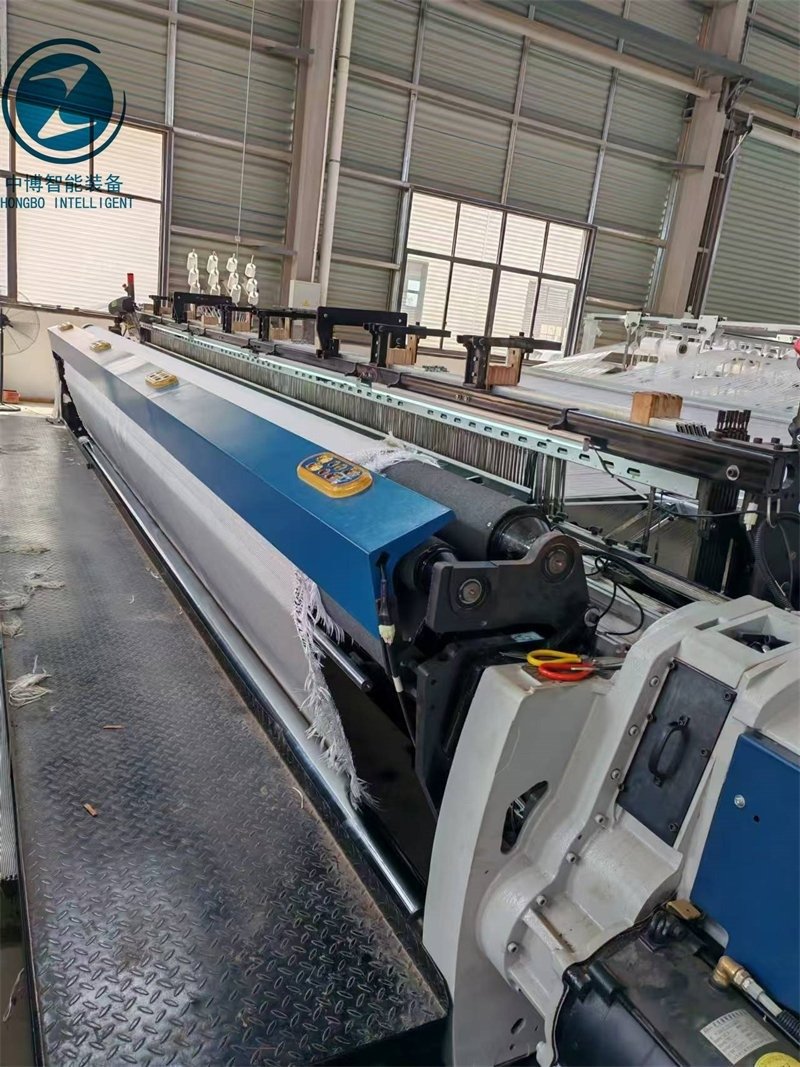
Production line and factory setup overview
A medium-industrial heavy-fabric weaving line converting specified coarse cotton or cotton-blend warp and weft yarn into canvas, tarpaulin base cloth or sackcloth through yarn receiving, sectional warping, warp sizing where required, drawing-in, heavy-duty rapier weaving, inspection, mending, metering, rolling or folding and bale packing. Coating, waterproofing, printing and bag sewing are separate downstream modules.
Recommended lowest-entry line configuration Launch one contracted plain-weave canvas or sackcloth construction. Screen one sectional warper, outsourced sizing at first where practical, four heavy-duty 190-280 cm rapier looms with suitable beams, reeds and dobby, one inspection/rolling machine, compressor and humidity control. Do not select a 5-6 m technical-textile loom unless the buyer actually needs that width.
Production process and implementation sequence
- Yarn receiving and lot release
- Sectional warping and beam preparation
- Warp sizing where specified
- Drawing-in or warp tying
- Heavy-duty rapier weaving
- On-loom defect monitoring
- Fabric inspection and mending
- Metering, rolling or folding and bale packing
Products, capacity and market fit
- Afghan tents, covers, workwear, transport and agricultural markets use robust woven fabrics.
- Coarse cotton yarn can enter a durable higher-value product rather than commodity yarn sales.
- A single weave and width simplify warp preparation and spare-part inventory.
- Bag conversion or waterproof coating can be added only after woven-cloth quality is stable.
- Cotton canvas or tarpaulin base cloth - One buyer-approved width, weave, yarn count, ends/picks, GSM, tensile and roll length - Tent, cover, transport and workwear converters
- Sackcloth expansion - Separate construction and air-permeability specification - Agricultural and industrial bag makers after trials
Core production machinery and line specifications
| Machine / stage | Function / value | Production note |
|---|---|---|
| Yarn creel and sectional warper | Builds controlled heavy-yarn warp sections | One launch construction |
| Sizing route and beam handling | Strengthens and transfers warp where required | Outsource first or install after study |
| Drawing-in and tying tools | Prepares healds, drop wires and reed | Manual entry scope |
| Four heavy-duty rapier looms | Forms dense canvas or sackcloth | 190-280 cm screened width |
| Dobby, weft feeders and compressor | Controls shed and heavy weft insertion | Matched to construction |
| Humidification and lint extraction | Stabilizes cotton yarn and housekeeping | Room-specific design |
| Inspection, metering and rolling machine | Grades and forms dispatch rolls | Illuminated inspection table |
| Fabric laboratory | Verifies construction and strength | Buyer test methods |
Raw materials, utilities and factory requirements
- Released coarse cotton or cotton-blend warp and weft yarn by count, ply, twist and strength
- Warp and cloth beams, paper tubes and roll wrap
- Sizing material only for an approved installed route
- Reeds, healds, drop wires, rapier tapes, labels and loom spares
- Stable three-phase electricity with transformer, power-quality and motor-starting study
- Central dust or lint extraction with fire-safe collection and housekeeping
- Controlled temperature and humidity suited to the confirmed fibre, yarn or fabric
- Dry covered raw-material and finished-product storage with lot traceability
- Compressed air, process water, steam and wastewater treatment where the selected process requires them
Indicative low-entry investment and implementation plan
These planning ranges prioritize economical machinery, local labor and local civil works. Final pricing follows confirmed capacity, product specification, delivery terms and site conditions.
| Scope | Indicative range | Entry-plan note |
|---|---|---|
| Sectional warper and beam handling | US$40k-105k | One construction launch |
| Four heavy-duty rapier looms | US$70k-210k | Selected width and beat-up force |
| Inspection, compressor, humidity and laboratory | US$25k-70k | Essential support scope |
| Freight, electrical, installation and spares | US$45k-135k | Reeds and rapier wear parts |
| Indicative installed project total | US$180k-520k | Sizing plant, coating, building and yarn excluded |
Detailed proposal and next step
The proposal contains the complete line flow, machinery scope, raw-material and utility requirements, implementation stages and indicative entry planning. Final configuration follows confirmed products, capacity, site and budget.