
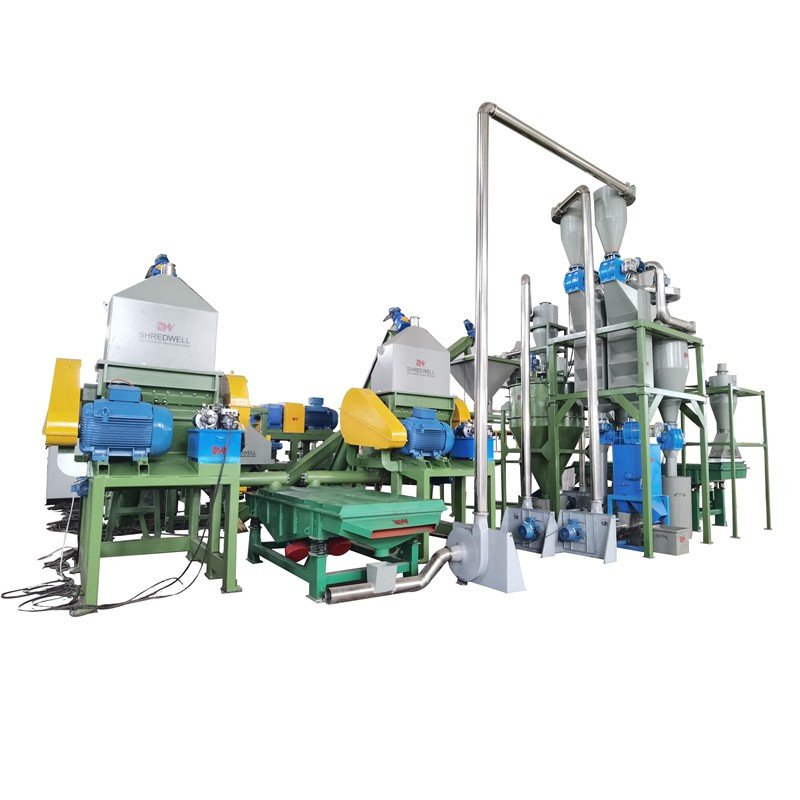
Production line and factory setup overview
A medium industrial ambient tire-recycling line converting controlled passenger and truck tires into clean graded rubber crumb, recovered steel and separated textile through receiving and fire-safe storage, bead removal or primary cutting, low-speed shredding, rasping and steel liberation, magnetic separation, granulation, fibre air separation, screening and recirculation, dust collection, bagging and purity, size, moisture and bulk-density tests.
Recommended lowest-entry line configuration Launch a 300-500 kg/h ambient line producing one 1-4 mm crumb grade from passenger and light-truck tires, with pre-shred inspection, shredder, rasper, granulator, multi-stage magnets, fibre classifier, screens, return loop and dust/fire controls. Confirm a tile, sports-surface or modifier buyer before purchase. Pyrolysis, devulcanization and OTR tire processing are separate projects.
Production process and implementation sequence
- Tire receiving and controlled storage
- Bead removal or primary cutting
- Low-speed primary shredding
- Rasping and steel liberation
- Magnetic steel separation
- Granulation and recirculation
- Fibre air separation and screening
- Crumb/steel testing and packing
Products, capacity and market fit
- Waste tires are a visible local environmental and fire hazard.
- Recovered steel and crumb create two saleable streams.
- A 1-4 mm grade can supply a separate rubber-tile plant after qualification.
- Buyer purity and size specifications must be secured before machinery selection.
- Clean tire-derived rubber crumb - 1-4 mm distribution, steel and textile contamination, moisture, bulk density, rubber content and packaging - Rubber tile and approved surface-product manufacturers
- Recovered tire steel - Buyer-defined rubber contamination and bale/container format - Licensed steel recyclers
Core production machinery and line specifications
| Machine / stage | Function / value | Production note |
|---|---|---|
| Bead remover/cutter and infeed | Prepares safe controlled tire feed | Passenger/light truck |
| Low-speed twin-shaft shredder | Reduces whole tires to chips | 300-500 kg/h |
| Rasper and magnetic separators | Liberates and removes steel | Multi-stage magnets |
| Granulator and return loop | Produces 1-4 mm crumb | Screen controlled |
| Fibre classifier and dust collection | Removes textile and airborne fines | Fire-safe system |
| Crumb laboratory and packing | Releases purity and size | Buyer protocol |
Raw materials, utilities and factory requirements
- Controlled passenger and light-truck waste tires
- Bags, liners, labels and steel collection containers
- Replacement knives, screens, magnets, bearings and dust filters
- Stable three-phase electricity with verified connected load
- Ventilation, fire protection, guarded drives and lockout procedures
- Dry segregated raw-material and finished-goods storage
- Maintenance workshop, lifting tools and critical spares
- Isolated fire-zoned tire yard with drainage and firefighting water
- Central dust extraction, spark control and housekeeping
- Licensed route for textile fluff, dust and nonconforming waste
Indicative low-entry investment and implementation plan
These planning ranges prioritize economical machinery, local labor and local civil works. Final pricing follows confirmed capacity, product specification, delivery terms and site conditions.
| Scope | Indicative range | Entry-plan note |
|---|---|---|
| Cutting, shredder and conveyors | US$75k-165k | 300-500 kg/h entry |
| Rasper, magnets, granulator and screens | US$95k-230k | 1-4 mm route |
| Fibre/dust, fire and laboratory systems | US$45k-125k | Mandatory controls |
| Freight, installation and spares | US$55k-140k | Knife/screen package |
| Indicative installed project total | US$270k-660k | Land, building and tire inventory excluded |
Detailed proposal and next step
The proposal contains the complete line flow, machinery scope, raw-material and utility requirements, implementation stages and indicative entry planning. Final configuration follows confirmed products, capacity, site and budget.