
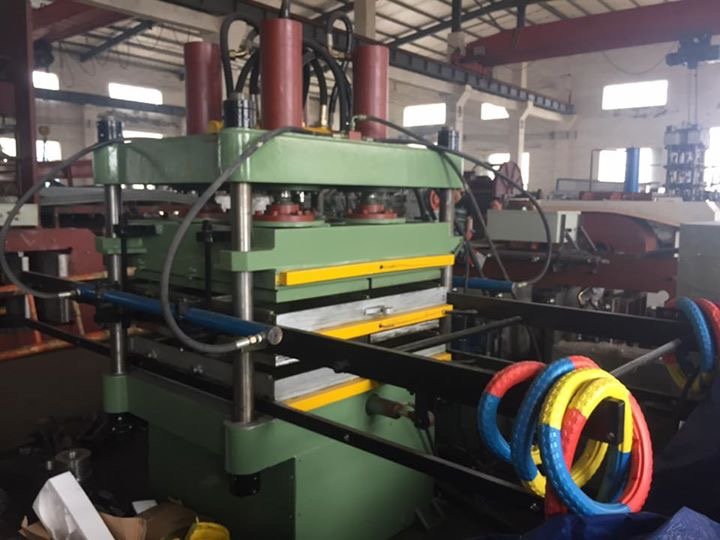
Production line and factory setup overview
A small downstream moulding line producing thick rubber pavers or livestock mats from purchased qualified tire crumb through size screening, controlled binder and pigment weighing, high-shear coating, mould filling, levelling, heated hydraulic compression or controlled ambient curing, demoulding, conditioning, trimming and application-specific load, abrasion, slip, drainage, compression, odour and ageing tests.
Recommended lowest-entry line configuration Launch only one product: either a 500 x 500 mm interlocking outdoor paver or one livestock-mat panel and thickness. Buy clean 1-4 mm crumb, use one metered mixer, one guarded multi-daylight 100-160 t heated press, dedicated moulds, conditioning racks and product tests. Do not combine playground-tile, paver and animal-mat claims without separate formulations and validation.
Production process and implementation sequence
- Crumb lot release and screening
- Binder/pigment recipe weighing
- Timed high-shear coating
- Mould filling and levelling
- Heated compression or controlled curing
- Demoulding and conditioning
- Trimming and dimensional inspection
- End-use performance release
Products, capacity and market fit
- Purchased crumb permits a low-entry plant without tire shredding.
- Pavers serve walkways and compounds; livestock mats serve dairy and stable floors.
- Thicker products need higher mould charge and press force than ordinary tiles.
- Slip, drainage, compression recovery, odour and cleanability must match the chosen end use.
- Rubber outdoor paver or livestock mat - One approved geometry, thickness, density, hardness, slip, abrasion, compression, drainage, odour and ageing specification - Walkways and compounds or livestock facilities—not both without separate validation
Core production machinery and line specifications
| Machine / stage | Function / value | Production note |
|---|---|---|
| Crumb screen and scales | Controls particle and recipe | 1-4 mm qualified crumb |
| Metered binder mixer | Coats crumb uniformly | Timed batch |
| Dedicated paver or mat mould set | Defines one launch product | One thickness |
| Guarded heated hydraulic press | Consolidates and cures product | 100-160 t |
| Conditioning and trim station | Completes cure and edges | Ventilated racks |
| End-use laboratory | Tests slip, abrasion, compression and ageing | Paver or livestock protocol |
Raw materials, utilities and factory requirements
- Qualified clean tire-derived rubber crumb
- Approved polyurethane binder with SDS and cure data
- Pigment or optional EPDM surface granule only after validation
- Release media, wrap, labels and pallets
- Stable three-phase electricity with verified connected load
- Guarded machinery, lockout, ventilation and fire protection
- Dry segregated raw-material and finished-goods storage
- Maintenance tools, safe lifting and critical spare parts
- Local exhaust and controlled cure/conditioning zone
- Binder spill containment and chemical PPE
Indicative low-entry investment and implementation plan
These planning ranges prioritize economical machinery, local labor and local civil works. Final pricing follows confirmed capacity, product specification, delivery terms and site conditions.
| Scope | Indicative range | Entry-plan note |
|---|---|---|
| Screening, weighing and mixer | US$8k-20k | Purchased-crumb entry |
| Press, one mould family and racks | US$22k-58k | One thick product |
| Laboratory, ventilation and trim | US$10k-28k | End-use release |
| Freight, installation and spares | US$10k-25k | Cure trials included |
| Indicative installed low-entry total | US$50k-131k | Tire recycling, building and materials excluded |
Detailed proposal and next step
The proposal contains the complete line flow, machinery scope, raw-material and utility requirements, implementation stages and indicative entry planning. Final configuration follows confirmed products, capacity, site and budget.