
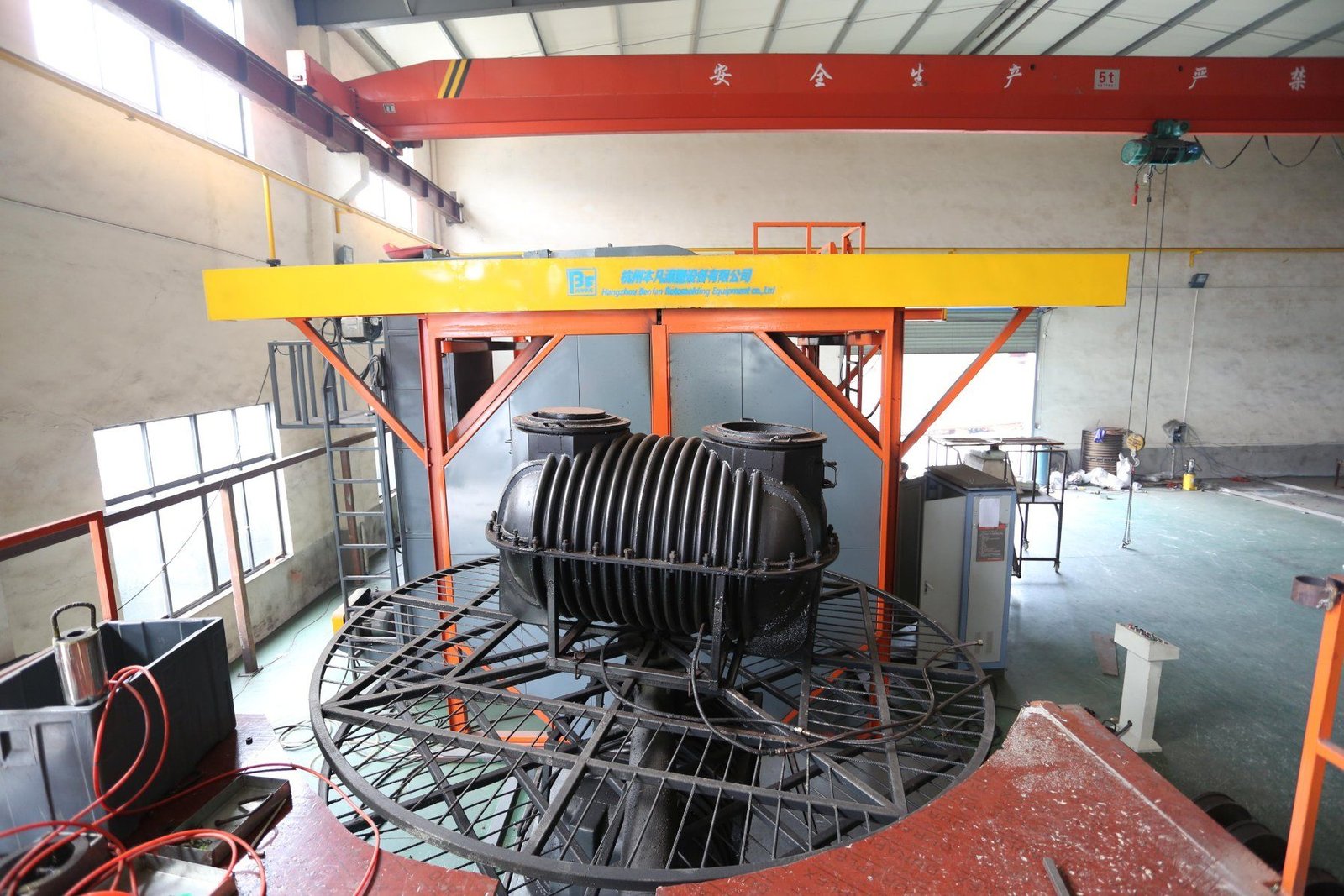
Production line and factory setup overview
A small/medium rotational-moulding plant producing seamless vertical LLDPE water tanks through certified resin receiving, controlled pulverizing or purchased powder, weighing and dry blending, mould charging, biaxial oven rotation, controlled heating, indexed cooling, safe demoulding, trimming and fitting installation, leak, wall-thickness, impact and UV testing, cleaning and dispatch.
Recommended lowest-entry line configuration Launch one 500-2,000 L vertical tank family on a two-arm shuttle rotomoulder sized for the heaviest mould. Buy qualified compounded LLDPE powder initially; add a pulverizer and blending room only when dust control and recipe testing are ready. Include one tank mould, oven/fuel safety, cooling, lifting, trimming, fittings and leak/impact/UV tests. Potable-water claims require approved resin, pigments and hygienic handling.
Production process and implementation sequence
- Powder and additive lot release
- Weighing and mould charging
- Biaxial oven rotation
- Temperature/time profile control
- Indexed cooling and demoulding
- Trimming and fitting installation
- Wall, leak, impact and UV tests
- Cleaning, marking and dispatch
Products, capacity and market fit
- Water storage is essential for homes, farms and institutions.
- A shuttle machine permits one mould to heat while another cools.
- Purchased compounded powder lowers the entry risk of grinding and formulation.
- Potable-water safety, wall uniformity, UV life and leak performance are non-negotiable.
- Vertical polyethylene water tank - Nominal/brimful volume, dimensions, mass, layers, wall map, lid, fittings, leak, impact, UV class and potable approval - Homes, farms, shops and institutions
- Non-potable utility tank - Separate resin, colour, fittings and use limitation - Construction and agricultural utility storage
Core production machinery and line specifications
| Machine / stage | Function / value | Production note |
|---|---|---|
| Two-arm shuttle rotomoulder | Heats and biaxially rotates tank moulds | Mould/load selected |
| Insulated oven and burner train | Provides repeatable safe heating | Fuel interlocks |
| One vertical-tank mould | Defines the launch tank geometry | 500-2,000 L family |
| Cooling station and lifting system | Cools and removes tanks safely | Rated mould handling |
| Trim, drill and fitting station | Completes ports and closures | Jig controlled |
| Tank performance laboratory | Maps wall and tests leak, impact and UV | Potable protocol where claimed |
Raw materials, utilities and factory requirements
- Qualified compounded LLDPE rotomoulding powder
- Approved UV stabilizer and potable-compatible pigment where applicable
- Certified lids, gaskets, outlets and threaded fittings
- Labels, protective wrap and critical burner/drive spares
- Stable three-phase electricity with verified connected load
- Closed-loop cooling water sized for the contracted process
- Dry covered material and finished-goods storage
- Ventilation, fire protection, safe lifting and guarded machinery
- Safe LPG, diesel or gas installation with burner interlocks, exhaust and emissions control
- Large clean outdoor cooling/handling area and rated mould crane
Indicative low-entry investment and implementation plan
These planning ranges prioritize economical machinery, local labor and local civil works. Final pricing follows confirmed capacity, product specification, delivery terms and site conditions.
| Scope | Indicative range | Entry-plan note |
|---|---|---|
| Two-arm shuttle machine and oven | US$85k-185k | Mould/load-selected basis |
| One tank mould, lifting and finishing | US$28k-82k | 500-2,000 L family |
| Fuel, cooling and test systems | US$24k-65k | Safety and product release |
| Freight, installation and spares | US$28k-75k | Burner and mould trials |
| Indicative installed low-entry total | US$165k-407k | Building, pulverizer, resin and extra moulds excluded |
Detailed proposal and next step
The proposal contains the complete line flow, machinery scope, raw-material and utility requirements, implementation stages and indicative entry planning. Final configuration follows confirmed products, capacity, site and budget.