
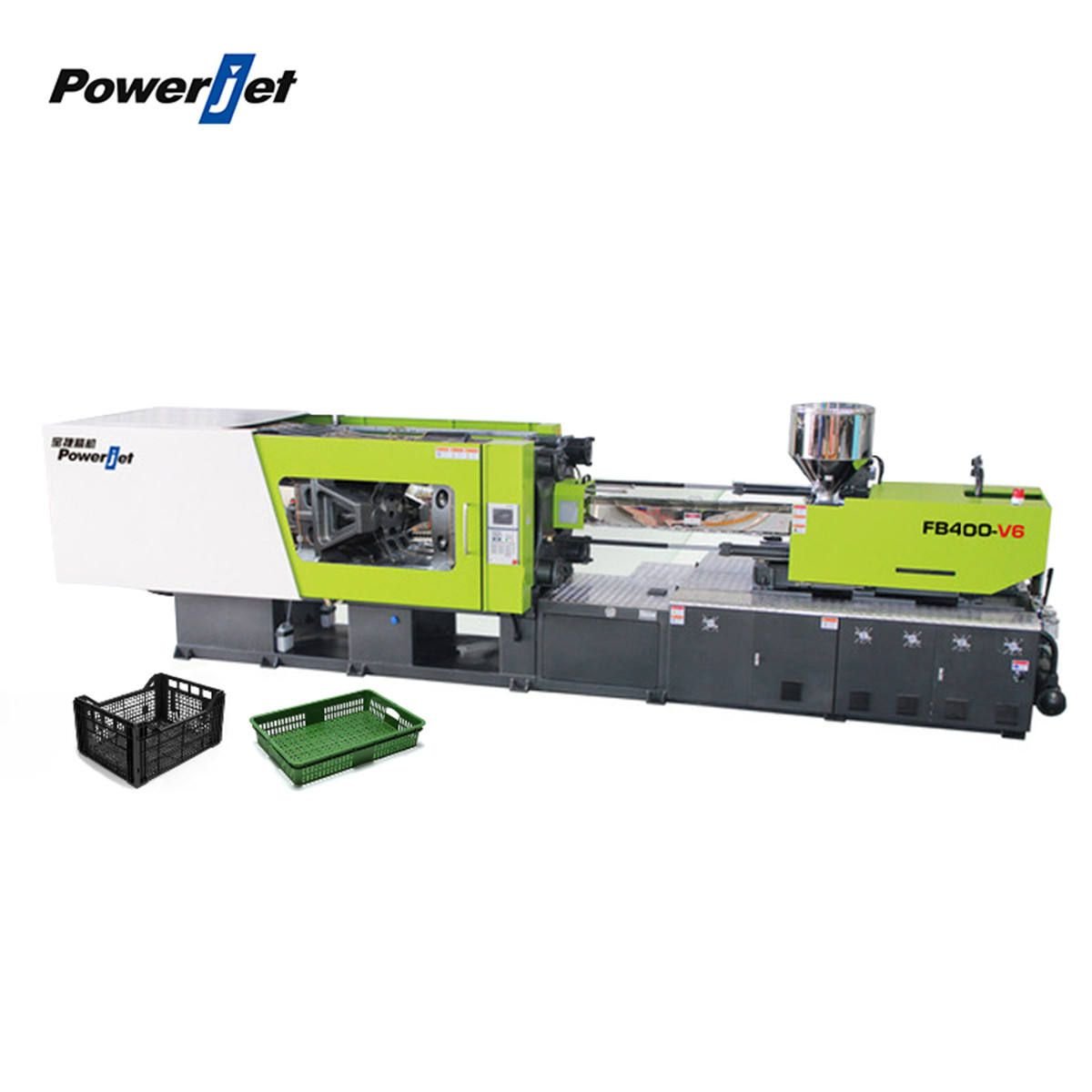
Production line and factory setup overview
A medium injection-moulding cell producing one nestable or stackable reusable HDPE fruit-and-vegetable crate through resin lot release and controlled blending, drying only where specified, servo injection moulding in a dedicated high-flow crate mould, robot or guarded part removal, gate trimming, cooling/conditioning, visual and dimensional inspection, handle/stack tests, drop and compression testing, hot-stamp or moulded identification and palletized dispatch.
Recommended lowest-entry line configuration Launch one 15-25 kg produce crate geometry in virgin or tightly controlled qualified HDPE using a roughly 400-550 t servo injection machine selected by mould-flow analysis, shot weight, tie-bar spacing and clamp force. Include one hardened crate mould, robot, granulator for clean in-house runners, cooling system and drop/compression/stack laboratory. Mixed post-consumer waste is not acceptable without washing, sorting, compounding, odour and food-chain risk validation.
Production process and implementation sequence
- Crate/stack system and mould-flow design
- Resin qualification and blending
- Servo injection and controlled cooling
- Robot/guarded ejection and gate trim
- Conditioning and dimensional inspection
- Handle, stack and nesting checks
- Drop, compression and creep tests
- Identification, palletizing and dispatch
Products, capacity and market fit
- Reusable crates reduce bruising compared with weak one-way packaging.
- Local crate pooling can serve orchards, wholesale markets and cold chains.
- One geometry controls mould investment and stack compatibility.
- Impact, compression, hygiene and nest/stack fit determine useful life.
- Reusable produce crate - Outer/inner dimensions, load, mass, material, ventilation, handles, stack/nest interface, drop/compression and washability - Orchards, traders, markets and cold chains
- Pool-identifiable crate - Same approved geometry with durable owner/lot marking or RFID provision - Managed returnable packaging systems
Core production machinery and line specifications
| Machine / stage | Function / value | Production note |
|---|---|---|
| 400-550 t servo injection machine | Moulds one large crate geometry | Mould-flow selected |
| Hardened crate mould | Defines vents, handles and stack system | One cavity |
| Robot and guarded trim station | Removes parts safely and repeatably | Cycle matched |
| Chiller/cooling tower and mould controller | Controls cycle and warpage | Mould circuit balanced |
| Clean-runner granulator and blender | Recovers documented in-house runners | Controlled percentage |
| Crate performance laboratory | Tests dimensions, drop, stack and compression | Buyer protocol |
Raw materials, utilities and factory requirements
- Virgin HDPE injection grade or qualified controlled recycled compound
- Approved pigment/masterbatch and only clean internal runner regrind to validated limit
- Mould release only if buyer-approved
- Pallets, labels and identification inserts
- Stable three-phase electricity with verified connected load
- Closed-loop cooling water with chiller or cooling tower
- Dry covered resin/additive storage and segregated finished goods
- Ventilation, fire protection, safe lifting and guarded machinery
- Rated mould crane and safe heavy-mould storage
Indicative low-entry investment and implementation plan
These planning ranges prioritize economical machinery, local labor and local civil works. Final pricing follows confirmed capacity, product specification, delivery terms and site conditions.
| Scope | Indicative range | Entry-plan note |
|---|---|---|
| 400-550 t servo injection machine | US$75k-165k | Mould-selected press |
| One hardened crate mould and robot | US$45k-120k | Geometry drives cost |
| Cooling, handling, granulator and laboratory | US$28k-75k | Complete cell |
| Freight, installation, crane interface and spares | US$30k-80k | Sustained mould trial |
| Indicative installed project total | US$178k-440k | Building, resin and recycling wash line excluded |
Detailed proposal and next step
The proposal contains the complete line flow, machinery scope, raw-material and utility requirements, implementation stages and indicative entry planning. Final configuration follows confirmed products, capacity, site and budget.