
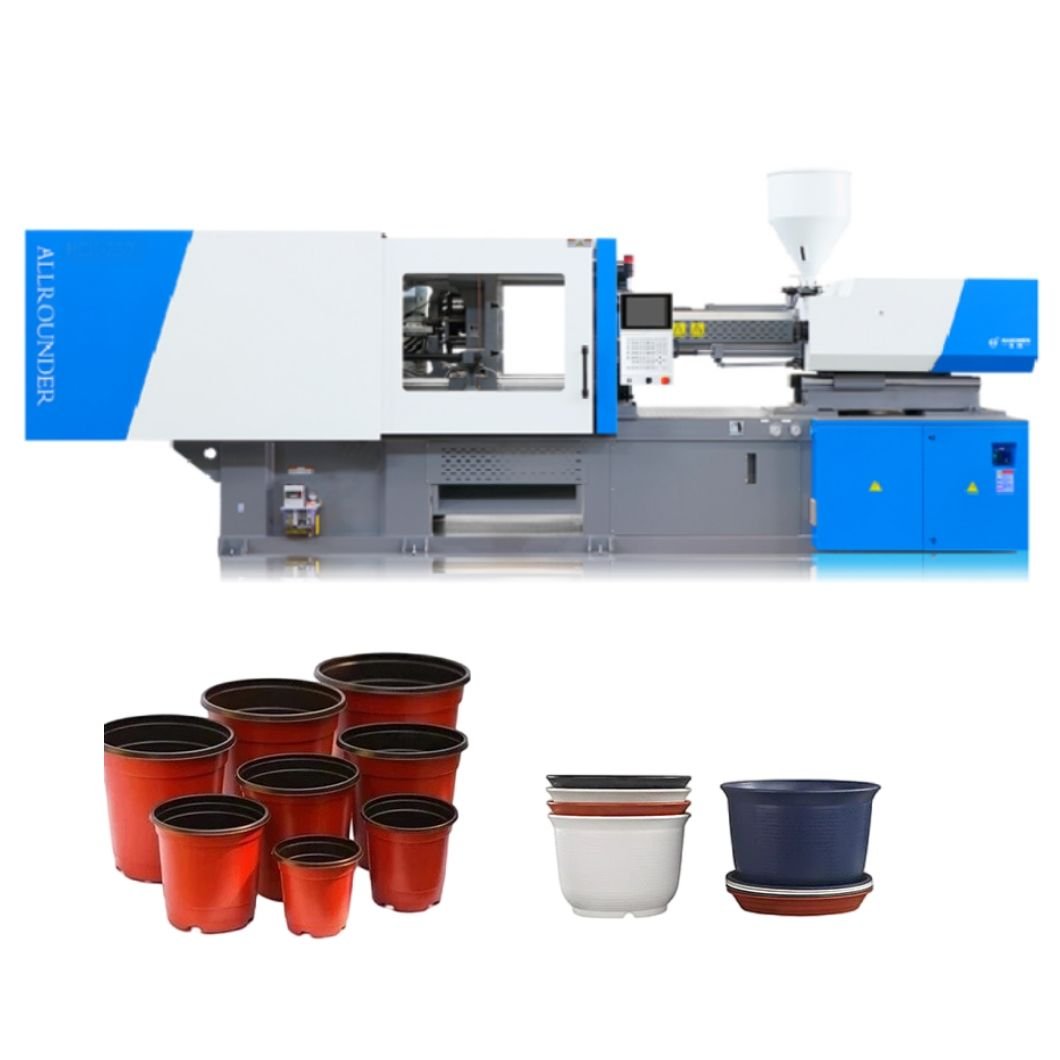
Production line and factory setup overview
A small injection-moulding cell producing one durable nestable PP flowerpot family through resin release, controlled blending, servo injection into a vented pot mould, guarded or robotic removal, gate trimming, cooling, drainage finishing where required, decoration or marking, nesting, dimensional and load testing and packing.
Recommended lowest-entry line configuration Launch one 15-25 cm durable pot with integrated drainage on a roughly 150-220 t servo press selected from the final mould-flow analysis, shot weight, projected area and tie-bar spacing. Include one hardened mould, robot or guarded take-out, cooling, clean-runner granulator and load/UV tests. Thin thermoformed nursery pots are a separate process.
Production process and implementation sequence
- Product and mould-flow approval
- Resin release and blending
- Servo injection and cooling
- Guarded or robotic demoulding
- Gate trim and drainage finishing
- Decoration and nesting
- Dimension and load tests
- Packing and dispatch
Products, capacity and market fit
- Urban landscaping, nurseries and household gardening create repeat demand.
- One nesting geometry minimizes mould cost and transport volume.
- Controlled clean recycled PP can be evaluated for non-food outdoor pots.
- UV retention, rim strength, drainage and colour consistency determine useful life.
- Durable nestable flowerpot - Top diameter, height, volume, wall, drainage, rim load, nesting pitch, colour and UV class - Nurseries, landscapers and households
- Matching saucer expansion - Separate mould and watertightness/fit specification - Indoor and retail pot sets
Core production machinery and line specifications
| Machine / stage | Function / value | Production note |
|---|---|---|
| 150-220 t servo injection machine | Moulds one pot family | Mould-flow selected |
| Hardened flowerpot mould | Defines wall, rim, drainage and texture | One cavity family |
| Robot or guarded take-out | Removes hot parts safely | Cycle matched |
| Chiller and mould-temperature control | Controls shrinkage and cycle | Balanced circuits |
| Clean-runner granulator and blender | Returns documented runners | Validated percentage |
| Pot test fixtures | Checks nesting, load, drop and UV basis | Buyer protocol |
Raw materials, utilities and factory requirements
- Virgin PP impact grade or qualified controlled recycled PP compound
- UV stabilizer and approved colour masterbatch
- Only clean documented internal runner regrind to validated limit
- Bags, cartons, labels and pallets
- Stable three-phase electricity with verified connected load
- Closed-loop cooling water sized for the contracted process
- Dry covered material and finished-goods storage
- Ventilation, fire protection, safe lifting and guarded machinery
Indicative low-entry investment and implementation plan
These planning ranges prioritize economical machinery, local labor and local civil works. Final pricing follows confirmed capacity, product specification, delivery terms and site conditions.
| Scope | Indicative range | Entry-plan note |
|---|---|---|
| Servo injection press | US$28k-62k | 150-220 t mould-selected basis |
| One hardened pot mould and take-out | US$14k-38k | One durable geometry |
| Cooling, granulator and test fixtures | US$9k-24k | Complete cell auxiliaries |
| Freight, installation and spares | US$11k-28k | Sustained mould trial |
| Indicative installed low-entry total | US$62k-152k | Building, resin and second mould excluded |
Detailed proposal and next step
The proposal contains the complete line flow, machinery scope, raw-material and utility requirements, implementation stages and indicative entry planning. Final configuration follows confirmed products, capacity, site and budget.