
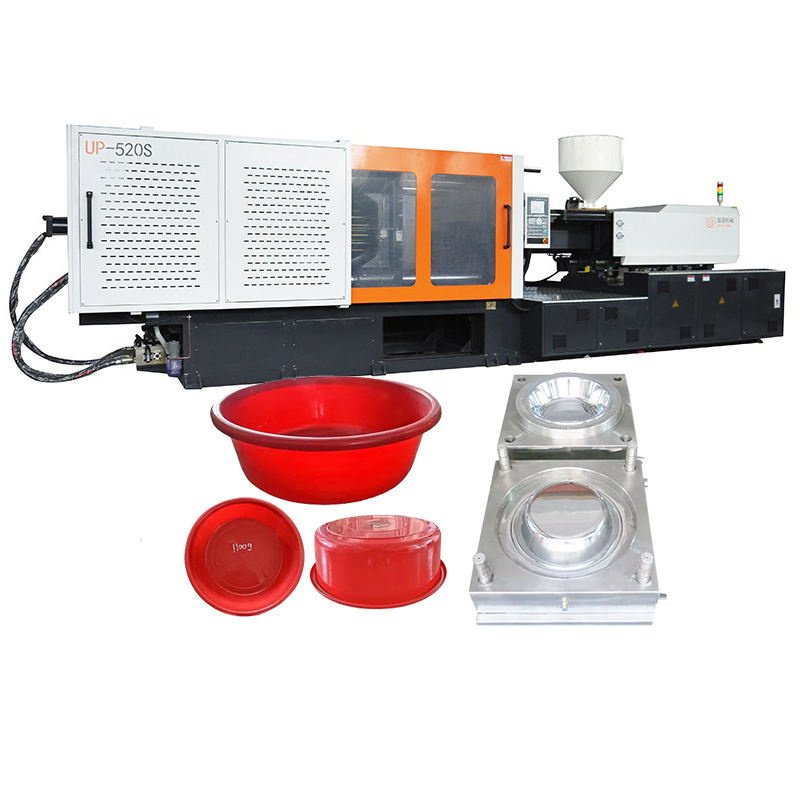
Production line and factory setup overview
A medium injection-moulding cell producing one non-food household bucket or basin family through polymer release and blending, mould-specific servo injection, robotic or guarded ejection, cooling and gate trimming, separate handle or lid fitting where specified, printing or in-mould labelling, dimensional, volume, leak, drop and handle-load tests, nesting and packing.
Recommended lowest-entry line configuration Launch either one 10-20 L bucket with a separate qualified handle or one nestable basin—not both—on a roughly 300-450 t servo press chosen from the finished mould. Include one hardened mould, take-out, cooling, trim/assembly fixtures, clean-runner recycling and performance tests. Food-contact pails require virgin compliant resin and a separate hygienic approval route.
Production process and implementation sequence
- Product/mould design and load targets
- Polymer qualification and blending
- Servo injection and cooling
- Part removal and gate trim
- Handle or lid assembly
- Printing or durable marking
- Leak, drop, load and nesting tests
- Packing and dispatch
Products, capacity and market fit
- Household ware has broad retail and institutional demand.
- One high-volume geometry controls mould capital and resin stock.
- Nesting reduces inland transport and warehouse volume.
- Handle pull, drop, leak and creep tests protect reputation better than a low unit weight alone.
- Non-food household bucket - Nominal volume, brimful volume, mass, wall, handle pull, leak, drop, creep, lid fit and colour - Households, cleaning and construction users
- Nestable household basin - Diameter, depth, volume, rim stiffness, stack release, drop and load - Household and institutional retail after separate mould
Core production machinery and line specifications
| Machine / stage | Function / value | Production note |
|---|---|---|
| 300-450 t servo injection machine | Moulds one large household item | Final-mould selected |
| Hardened bucket or basin mould | Defines one launch geometry | One cavity |
| Robot or guarded take-out | Controls removal and cycle | Part-specific |
| Cooling and mould controller | Limits warpage and cycle variation | Balanced circuits |
| Handle/lid fixtures and printer | Completes the chosen product | Only contracted options |
| Household-ware test bench | Tests volume, leak, drop, handle and creep | Buyer protocol |
Raw materials, utilities and factory requirements
- Virgin PP/HDPE or qualified controlled recycled compound for non-food ware
- Qualified handle wire or plastic handle and grip
- Approved pigment and print/label consumables
- Clean internal runner regrind only to validated limit
- Stable three-phase electricity with verified connected load
- Closed-loop cooling water sized for the contracted process
- Dry covered material and finished-goods storage
- Ventilation, fire protection, safe lifting and guarded machinery
- Rated mould lifting and protected heavy-mould storage
Indicative low-entry investment and implementation plan
These planning ranges prioritize economical machinery, local labor and local civil works. Final pricing follows confirmed capacity, product specification, delivery terms and site conditions.
| Scope | Indicative range | Entry-plan note |
|---|---|---|
| Servo injection press | US$55k-125k | 300-450 t mould-selected basis |
| One hardened mould and take-out | US$28k-85k | Bucket or basin, not both |
| Cooling, assembly and laboratory | US$18k-48k | Performance release |
| Freight, installation and spares | US$22k-58k | Sustained mould trial |
| Indicative installed low-entry total | US$123k-316k | Building, resin, lid and second mould excluded |
Detailed proposal and next step
The proposal contains the complete line flow, machinery scope, raw-material and utility requirements, implementation stages and indicative entry planning. Final configuration follows confirmed products, capacity, site and budget.