Production line and factory setup overview
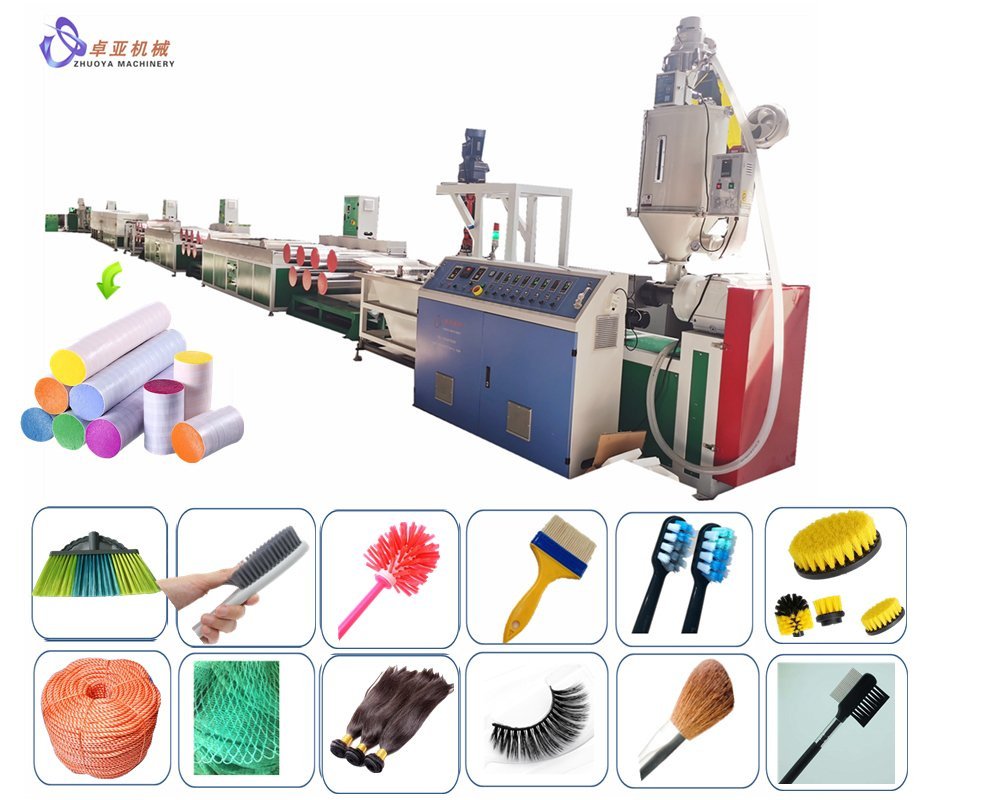
A small/medium monofilament line producing one PET or PP broom-bristle family through polymer drying and blending, melt extrusion and fine filtration, spinneret forming, water quench, multi-stage hot drawing, heat setting and relaxation, optional crimping or flagging, oil finish, tension-controlled winding or bundle cutting, diameter and tensile inspection and packing.
Recommended lowest-entry line configuration Launch one straight or lightly crimped household-broom filament in one polymer and diameter at 80-150 kg/day. Include dryer, single-screw extruder, filter/spinneret, quench, draw rollers and hot tanks/ovens, annealing, finish applicator, winding/cutting and bristle laboratory. Do not claim paintbrush, toothbrush or cosmetic filament from a broom-grade line without separate precision trials.
Production process and implementation sequence
- Polymer release and drying
- Extrusion and melt filtration
- Spinneret forming and quench
- Multi-stage hot drawing
- Heat setting and relaxation
- Optional crimping or flagging
- Winding or bundle cutting
- Diameter, tensile and recovery tests
Products, capacity and market fit
- Broom and brush workshops need consistent local bristle bundles.
- One polymer and diameter simplify draw and heat-setting recipes.
- Qualified PET bottle flake may be used only after washing, drying and colour control.
- Diameter, straightness, recovery and bundle consistency affect broom quality.
- Household-broom monofilament - Polymer, diameter, profile, colour, straight/crimped form, cut length, stiffness, tensile and bend recovery - Local broom and cleaning-brush assemblers
Core production machinery and line specifications
| Machine / stage | Function / value | Production note |
|---|---|---|
| Dryer, loader and blender | Prepares stable polymer feed | PET or PP route |
| Monofilament extruder and melt filter | Forms clean stable melt | Entry output |
| Spinneret and quench tank | Defines filament count and profile | One diameter family |
| Draw rollers and hot tanks/ovens | Orients filament and develops strength | Controlled draw ratio |
| Anneal, finish and winding/cutting | Stabilizes and packages bristle | Broom bundle format |
| Filament laboratory | Tests diameter, tensile, shrinkage and recovery | Buyer sample basis |
Raw materials, utilities and factory requirements
- Qualified PET, PP or PBT grade—one route at launch
- Approved colour, UV and finish package
- Clean controlled same-polymer rework only after validation
- Wrap, straps, labels and cartons
- Stable three-phase electricity with verified connected load
- Ventilation, fire protection, guarded drives and lockout procedures
- Dry segregated raw-material and finished-goods storage
- Maintenance workshop, lifting tools and critical spares
- Clean process water and temperature-controlled hot drawing baths
Indicative low-entry investment and implementation plan
These planning ranges prioritize economical machinery, local labor and local civil works. Final pricing follows confirmed capacity, product specification, delivery terms and site conditions.
| Scope | Indicative range | Entry-plan note |
|---|---|---|
| Drying, extrusion, spinneret and quench | US$22k-52k | One polymer/diameter |
| Drawing, heat set, winding and cutting | US$16k-38k | Broom-grade route |
| Laboratory and utilities | US$7k-18k | Bristle performance |
| Freight, installation and spares | US$9k-22k | Polymer trial included |
| Indicative installed low-entry total | US$54k-130k | Building and polymer stock excluded |
Detailed proposal and next step
The proposal contains the complete line flow, machinery scope, raw-material and utility requirements, implementation stages and indicative entry planning. Final configuration follows confirmed products, capacity, site and budget.