
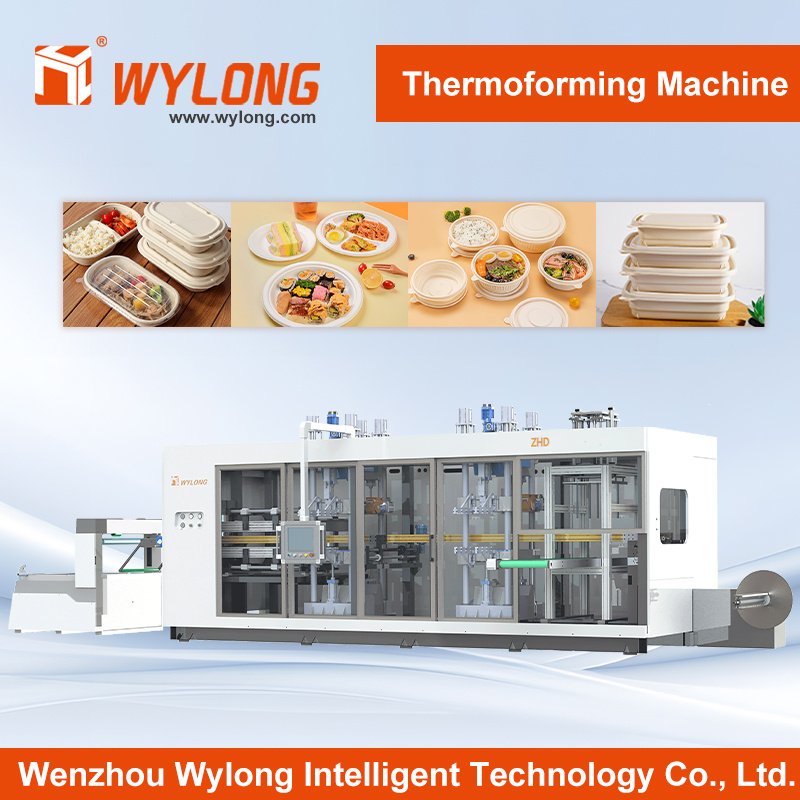
Production line and factory setup overview
A small thermoforming line producing rigid multi-cell nursery seedling trays from purchased PP or HIPS sheet through sheet conditioning, indexed heating, plug-assisted vacuum/pressure forming, in-mould or downstream cutting, hole punching, rim trimming, stacking, dimensional inspection and planting-performance trials.
Recommended lowest-entry line configuration Launch one 50-72 cell tray family on a four-station thermoformer using purchased sheet. Include one proven forming/cutting tool, drainage-hole tooling, chiller, air compressor, scrap granulator and tray/planting tests. Add a separate sheet extruder only after stable volume; a thermoformer alone cannot process loose resin.
Production process and implementation sequence
- Sheet receiving and lot release
- Heating and indexed sheet transport
- Plug-assisted forming
- Cooling and tool release
- Profile cutting and drainage punching
- Scrap separation and controlled grinding
- Counting and stacking
- Dimension, de-nesting and planting trial
Products, capacity and market fit
- Afghan vegetable, orchard and greenhouse nurseries need uniform transplant trays.
- Purchased sheet gives the lowest credible entry without a second extrusion plant.
- One cell geometry controls tooling and planting trials.
- Drainage, de-nesting, rigidity and root-ball release determine field usefulness.
- Reusable nursery seedling tray - Cell count, cell volume, depth, drainage, rim stiffness, nesting pitch, mass and colour - Commercial nurseries and greenhouse growers
- Crop-specific plug tray - Separate approved cell geometry and root-release trial - Vegetable or forestry propagation after validation
Core production machinery and line specifications
| Machine / stage | Function / value | Production note |
|---|---|---|
| Four-station thermoformer | Heats, forms and indexes sheet | PP/HIPS sheet duty |
| Forming and cutting mould | Creates one cell family | 50-72 cell basis |
| Drainage punch and stacker | Finishes and counts trays | Registered holes |
| Chiller and air compressor | Supports forming cycle | Duty/standby plan |
| Clean-scrap granulator | Reduces trim for controlled recycling | Segregated material |
| Tray test fixtures | Checks dimensions, load and de-nesting | Planting trial included |
Raw materials, utilities and factory requirements
- Qualified PP or HIPS sheet with thickness certificate
- Approved colour and UV package where outdoor life is claimed
- Clean same-grade trim only within validated recycle limit
- Bags, cartons or straps and labels
- Stable three-phase electricity with verified connected load
- Closed-loop cooling water sized for the contracted process
- Dry covered material and finished-goods storage
- Ventilation, fire protection, safe lifting and guarded machinery
Indicative low-entry investment and implementation plan
These planning ranges prioritize economical machinery, local labor and local civil works. Final pricing follows confirmed capacity, product specification, delivery terms and site conditions.
| Scope | Indicative range | Entry-plan note |
|---|---|---|
| Four-station thermoformer and sheet handling | US$28k-65k | Purchased-sheet entry route |
| One tray mould, punch and stacker | US$12k-32k | 50-72 cell family |
| Cooling, air, granulator and tests | US$8k-22k | Essential auxiliaries |
| Freight, installation and spares | US$10k-28k | Mould trial included |
| Indicative installed low-entry total | US$58k-147k | Sheet extruder, building and stock excluded |
Detailed proposal and next step
The proposal contains the complete line flow, machinery scope, raw-material and utility requirements, implementation stages and indicative entry planning. Final configuration follows confirmed products, capacity, site and budget.