
Production line and factory setup overview
A medium precision line producing 16-22 mm flat emitter drip tape from qualified virgin LLDPE/LDPE blend through controlled dosing, single-screw extrusion, high-speed emitter sorting and servo insertion, cross-die forming and bonding, vacuum calibration and cooling, camera-tracked outlet perforation, synchronized haul-off, leak/flow inspection, tension-controlled winding and hydraulic performance testing.
Recommended lowest-entry line configuration Launch one 16 mm tape with one emitter spacing and wall class on an 80 m/min line. Include certified emitters, servo sorting/insertion, camera-registered perforation, automatic winding and a bench measuring discharge, coefficient of variation, burst and pressure-loss over representative roll length. Thin seasonal tape and thicker multi-season dripline are not the same product.
Production process and implementation sequence
- Resin and emitter release
- Dosing and melt extrusion
- Emitter sorting and servo insertion
- Tape forming, bonding and calibration
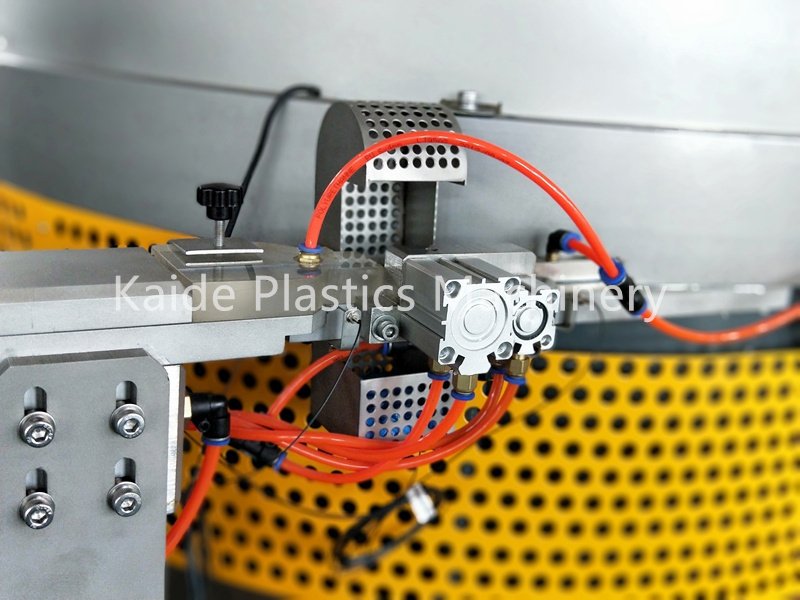
- Camera registration and outlet perforation
- Haul-off and tension winding
- Roll leak and dimensional inspection
- Emitter-flow and hydraulic release
Products, capacity and market fit
- Drip irrigation can improve water productivity in Afghan horticulture.
- A single spacing and wall class controls emitter inventory and field expectations.
- Local coils reduce bulky import logistics.
- Emitter flow uniformity and filtration compatibility determine field performance.
- Inline-emitter drip tape - Diameter, wall, emitter spacing, nominal flow, operating pressure, CV, roll length and filtration - Orchards, vegetables and irrigation projects
- Seasonal thin-wall tape - Explicit life/handling class and compatible connector system - One-season crops after field validation
Core production machinery and line specifications
| Machine / stage | Function / value | Production note |
|---|---|---|
| Resin dosing and single-screw extruder | Produces stable tape melt | One blend |
| Emitter sorter and servo inserter | Positions flat emitters | One pitch family |
| Cross die and calibration tanks | Forms and bonds 16 mm tape | 80 m/min entry |
| Vision perforator and haul-off | Registers outlet to emitter | Camera verified |
| Tension-controlled winder | Builds undamaged sale rolls | Length counter |
| Drip hydraulic laboratory | Measures flow uniformity and strength | Representative roll |
Raw materials, utilities and factory requirements
- Qualified virgin LLDPE/LDPE formulation
- Approved flat emitters by flow path and nominal discharge
- Compatible masterbatch and processing aid
- Cores, labels, connectors and test filters
- Stable three-phase electricity with verified connected load
- Closed-loop cooling water with chiller or cooling tower
- Dry covered resin/additive storage and segregated finished goods
- Ventilation, fire protection, safe lifting and guarded machinery
Indicative low-entry investment and implementation plan
These planning ranges prioritize economical machinery, local labor and local civil works. Final pricing follows confirmed capacity, product specification, delivery terms and site conditions.
| Scope | Indicative range | Entry-plan note |
|---|---|---|
| Extrusion, die and calibration route | US$55k-110k | 16 mm / 80 m/min |
| Emitter insertion, vision perforation and winding | US$48k-105k | Precision synchronized scope |
| Hydraulic laboratory and utilities | US$18k-42k | Flow-uniformity release |
| Freight, installation and spares | US$22k-55k | Emitter trials included |
| Indicative installed low-entry total | US$143k-312k | Building, resin and emitters excluded |
Detailed proposal and next step
The proposal contains the complete line flow, machinery scope, raw-material and utility requirements, implementation stages and indicative entry planning. Final configuration follows confirmed products, capacity, site and budget.