
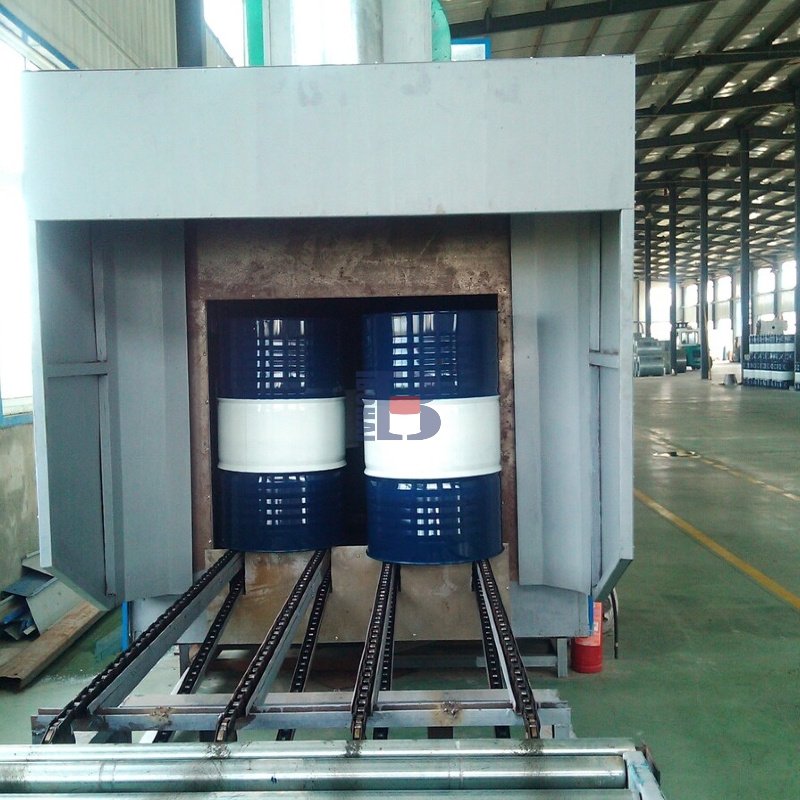
Production line and factory setup overview
A medium industrial line producing one 200-litre tight-head steel drum family from certified cold-rolled sheet through blank preparation, shell rolling, longitudinal resistance seam welding, weld planishing, body beading and corrugating, end blanking and deep drawing, flange and bung fitting, body/end seaming, 100% leak testing, surface pretreatment, controlled coating and curing, marking, dimensional inspection and palletized dispatch.
Recommended lowest-entry line configuration Launch one 200 L tight-head general-industrial drum at 1-2 drums/min using 0.8-1.2 mm certified cold-rolled sheet. Contract a balanced shell route, end presses/dies, flange/bung tools, beader/corrugator, seamer, 100% leak tester and contained pretreatment/paint oven. Food-contact, fuels and UN dangerous-goods drums are excluded until the exact design passes their separate coating, closure, drop, leak, hydraulic and stacking certifications.
Production process and implementation sequence
- Sheet release and body/end blanking
- Shell rolling and longitudinal seam welding
- Weld planishing, beading and corrugating
- End drawing, flange and bung fitting
- Body flanging and end seaming
- One-hundred-percent leak testing
- Pretreatment, painting, curing and marking
- Dimensional, closure and pallet release
Products, capacity and market fit
- Afghan oils, lubricants, chemicals and construction supply chains use industrial drums.
- One tight-head design limits tooling and closure complexity.
- Local manufacture reduces empty-container transport volume.
- Leak integrity, coating compatibility and dangerous-goods certification are application-specific.
- 200 L tight-head industrial steel drum - Nominal capacity, sheet BMT/grade, body profile, bung/closure, internal/external coating, leak limit and stacking duty - Lubricants, non-food chemicals and industrial users
- Certified dangerous-goods drum - Exact design type with verified closure, coating and UN performance tests - Regulated shippers only after independent certification
Core production machinery and line specifications
| Machine / stage | Function / value | Production note |
|---|---|---|
| Sheet shear/blanking and shell roller | Prepares body and end blanks | 200 L design |
| Resistance seam welder and planisher | Closes shell longitudinal seam | 0.8-1.2 mm |
| Beader/corrugator and body flanger | Stiffens and prepares shell ends | 1-2 drums/min |
| End presses, dies and bung tools | Forms heads and closures | Tight-head family |
| End seamer and leak tester | Closes and tests every drum | 100% test |
| Pretreatment, paint and cure line | Applies compatible controlled finish | Contained emissions route |
Raw materials, utilities and factory requirements
- Certified cold-rolled sheet by grade, BMT and surface
- Approved flanges, bungs, gaskets and closures
- Product-compatible internal lining and external coating
- Pretreatment chemicals, labels, pallets and critical seam tooling
- Stable three-phase electricity with protected distribution
- Covered sheet store and safe lifting/handling routes
- Guarded presses, interlocked tooling and emergency stops
- Welding/fume extraction, fire protection and disciplined housekeeping
- Compressed air for 100% leak testing and contained wash/paint effluent and exhaust treatment
Indicative low-entry investment and implementation plan
These planning ranges prioritize economical machinery, local labor and local civil works. Final pricing follows confirmed capacity, product specification, delivery terms and site conditions.
| Scope | Indicative range | Entry-plan note |
|---|---|---|
| Shell forming and seam-welding route | US$70k-185k | Low-speed supported line |
| End presses, tools, seaming and leak test | US$65k-175k | One tight-head family |
| Pretreatment, coating and cure system | US$55k-160k | Contained environmental scope |
| Freight, installation, laboratory and spares | US$45k-125k | Balanced commissioning |
| Indicative installed project total | US$235k-645k | Building, sheet stock and certification excluded |
Detailed proposal and next step
The proposal contains the complete line flow, machinery scope, raw-material and utility requirements, implementation stages and indicative entry planning. Final configuration follows confirmed products, capacity, site and budget.