
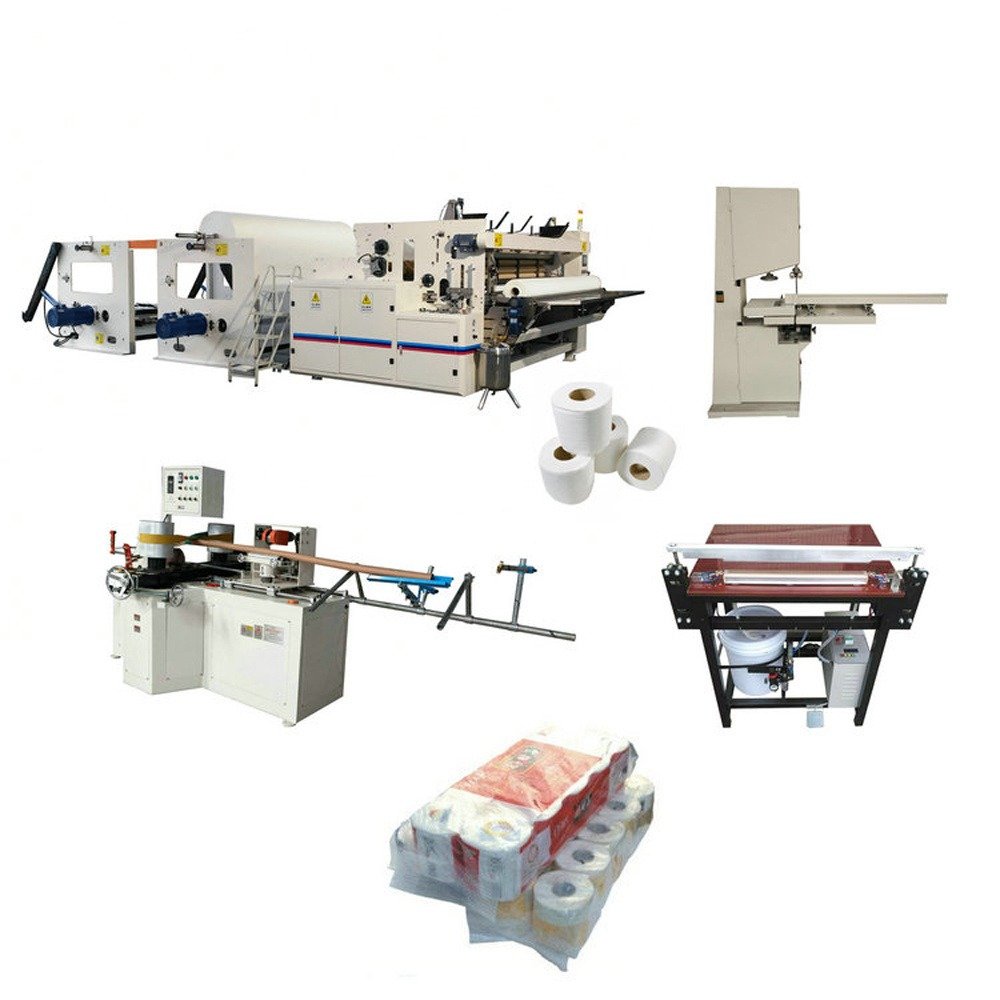
Production line and factory setup overview
A micro/small converting line turning purchased jumbo tissue reels into perforated toilet rolls through reel receiving, multi-ply unwinding, web tension control, optional embossing or lamination, perforation, core feeding or coreless winding, log rewinding, tail sealing, log cutting, roll inspection and manual or semi-automatic bag packing. It converts tissue; it does not manufacture base paper.
Recommended lowest-entry line configuration Start with one 2-ply cored roll and one retail pack. Screen a supported 1,575-1,880 mm rewinder with embossing and perforation, a simple core maker or purchased cores, semi-automatic band saw or single-channel log saw, tail sealer, inspection scale and manual bag sealer. Fully automatic accumulation and packing should wait until sales volume and jumbo-reel supply are stable.
Production process and implementation sequence
- Jumbo-reel receiving and hygiene release
- Multi-ply unwinding and tension control
- Embossing or ply bonding
- Perforation and core feeding
- Log rewinding and tail sealing
- Band-saw or log-saw cutting
- Roll mass, diameter and sheet-count inspection
- Bag sealing, coding and dry storage
Products, capacity and market fit
- Toilet tissue has repeat household, hotel, restaurant and institutional demand.
- Buying jumbo reels avoids the capital and utilities of tissue papermaking.
- A semi-automatic cutting and packing route lowers entry cost and maintenance risk.
- Roll weight, perforation and pack count must be consistent to protect customer trust.
- Two-ply cored toilet roll - Buyer-approved gsm, sheet size/count, perforation, diameter, firmness, core and pack count - Households, hotels, offices and institutions
- Coreless economy roll - Separate rewinding recipe, winding firmness and dispenser trial - Price-sensitive institutional buyers after validation
Core production machinery and line specifications
| Machine / stage | Function / value | Production note |
|---|---|---|
| Jumbo-reel stands and tension controls | Feeds one or two tissue webs evenly | 1,575-1,880 mm entry |
| Embosser/laminator and perforator | Bonds plies and defines sheet tear | One 2-ply recipe |
| Automatic toilet-log rewinder | Builds cored or coreless logs | One roll diameter |
| Core maker or purchased-core station | Supplies dimensionally stable cores | Optional local conversion |
| Band saw or single-channel log saw | Cuts logs into retail rolls | Guarded, dust extracted |
| Tail sealer and inspection bench | Closes and releases each roll | Mass/diameter/count checks |
| Manual or semi-auto bag sealer | Forms one retail pack | Lowest-entry packing |
Raw materials, utilities and factory requirements
- Qualified jumbo tissue reels by gsm, ply, width, strength and moisture
- Paper cores or core-board reels and approved ply/tail adhesive
- Printed PE bags or other buyer-approved wrap
- Cartons, labels, ink ribbon, blades and critical spares
- Stable three-phase power and clean compressed air
- Dry clean reel and finished-goods storage
- Dust extraction, housekeeping and fire protection
- Guarded cutting room and ergonomic reel/log handling
- Hygienic changing and pest-control programme
Indicative low-entry investment and implementation plan
These planning ranges prioritize economical machinery, local labor and local civil works. Final pricing follows confirmed capacity, product specification, delivery terms and site conditions.
| Scope | Indicative range | Entry-plan note |
|---|---|---|
| Rewinder, embossing and perforation | US$14k-36k | 1,575-1,880 mm semi-auto entry |
| Core route, saw and tail sealing | US$6k-18k | Purchased cores can reduce entry |
| Inspection, manual packing and handling | US$3k-9k | One retail pack |
| Freight, extraction, installation and spares | US$6k-16k | Guarding and dust control included |
| Indicative installed low-entry total | US$29k-79k | Automatic packing, building and reel stock excluded |
Detailed proposal and next step
The proposal contains the complete line flow, machinery scope, raw-material and utility requirements, implementation stages and indicative entry planning. Final configuration follows confirmed products, capacity, site and budget.