
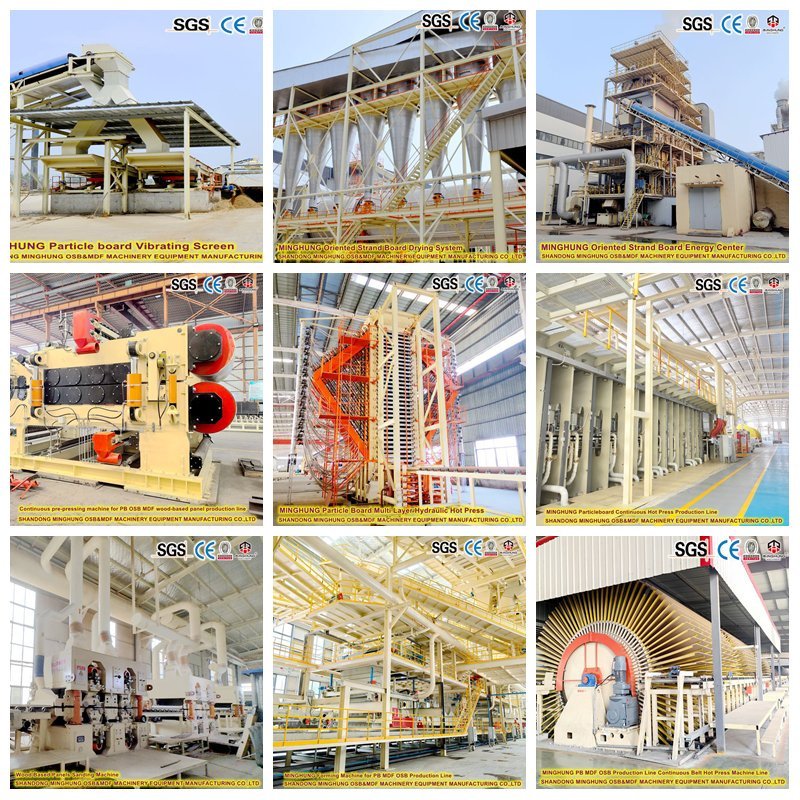
Production line and factory setup overview
A medium industrial wood-panel plant converting a validated wood-residue recipe—and only specifically qualified agricultural fibres—into sanded particleboard through feedstock receiving and cleaning, chipping/flaking or fibre preparation, screening, controlled drying, surface/core classification, resin and wax preparation, precision blending, multi-layer mat forming, pre-pressing, hot pressing, cooling and conditioning, trimming, sanding, laboratory release and dust/emission control. Agricultural residues are not a drop-in substitute for wood flakes.
Recommended lowest-entry line configuration Treat this as a full industrial project, not a hot-press purchase. Base screening on roughly 30,000 m3/year of one board size and thickness family using secured wood-processing residues. Include metal/mineral removal, ring flaker or qualified milling, dryer with fire protection, screening and surface/core bins, resin/wax kitchen, separate blenders, mechanical forming, pre-press, multi-daylight hot press, cooling/conditioning, trim and sanding, laboratory, dust collection and emissions treatment. Qualify straw, cotton stalk or rice husk in pilot pressing before any equipment commitment.
Production process and implementation sequence
- Feedstock survey, receiving, cleaning and lot control
- Chipping/flaking or residue-specific size reduction
- Drying, screening and surface/core classification
- Resin, wax and additive preparation
- Controlled blending and multi-layer mat forming
- Pre-pressing and multi-daylight hot pressing
- Cooling, conditioning, trimming and sanding
- Panel testing, grading, packing and dispatch
Products, capacity and market fit
- Furniture, doors, cabinetry and fit-out projects consume standard boards that Afghanistan largely imports.
- Wood-processing residues can become a consistent feedstock only after volume, moisture, contamination and particle-geometry surveys.
- A 30,000 m3/year plant needs committed regional buyers and a resin, energy and logistics plan before procurement.
- Board emissions, internal bond, bending, thickness swelling and fire/dust risks require industrial controls and a real laboratory.
- Interior-grade particleboard - One board size, thickness family, density, emission class, internal bond, bending and swelling specification - Furniture, doors, cabinetry and fit-out factories
- Agricultural-residue board - Separate fibre preparation, resin chemistry and full pilot-tested performance approval - Only after residue-specific technical and market qualification
Core production machinery and line specifications
| Machine / stage | Function / value | Production note |
|---|---|---|
| Receiving, cleaning, chipper/flaker and screens | Creates clean controlled particles | Feedstock-specific preparation |
| Rotary dryer and fire/explosion protection | Controls particle moisture safely | About 3-5% after drying |
| Surface/core classifiers and storage bins | Separates fine faces from coarse core | Three-layer board recipe |
| Resin/wax kitchen and precision blenders | Meters and coats each particle fraction | Emission-class recipe |
| Mat former and continuous pre-press | Builds uniform multi-layer mat | Density profile controlled |
| Multi-daylight hot press and handling | Cures resin under heat and pressure | 30,000 m3/year basis |
| Cooling, trim, sanding and panel laboratory | Finishes and releases boards | EN/ISO or buyer methods |
| Dust, thermal and formaldehyde controls | Protects workers and environment | Site-permitted system |
Raw materials, utilities and factory requirements
- Secured clean wood chips, shavings and residues by species and moisture
- Only pilot-qualified straw, cotton stalk, rice husk or other agricultural fibre
- Specified UF/MUF/MDI or other validated resin, wax and hardener
- Sanding belts, press cauls/screens, release agents, wrap and pallets
- High-capacity three-phase power; supplier references show roughly 600 kW and above depending on scope
- Thermal-energy plant and dryer exhaust/fire protection
- Large covered raw-material and finished-board warehouses
- Dust extraction, spark detection, explosion isolation and fire water
- Resin storage, process-water, effluent and permitted air-emission systems
Indicative low-entry investment and implementation plan
These planning ranges prioritize economical machinery, local labor and local civil works. Final pricing follows confirmed capacity, product specification, delivery terms and site conditions.
| Scope | Indicative range | Entry-plan note |
|---|---|---|
| Feedstock preparation, drying and classification | US$650k-1.55m | Fire-safe complete preparation |
| Resin, forming, pre-press and hot press | US$900k-2.10m | 30,000 m3/year basis |
| Cooling, trimming, sanding and laboratory | US$350k-900k | Saleable finished board |
| Thermal plant, emissions, civil, freight and erection | US$750k-2.20m | Site-specific industrial scope |
| Indicative installed entry project total | US$2.65m-6.75m | Land, feedstock/resin stock and working capital excluded |
Detailed proposal and next step
The proposal contains the complete line flow, machinery scope, raw-material and utility requirements, implementation stages and indicative entry planning. Final configuration follows confirmed products, capacity, site and budget.