
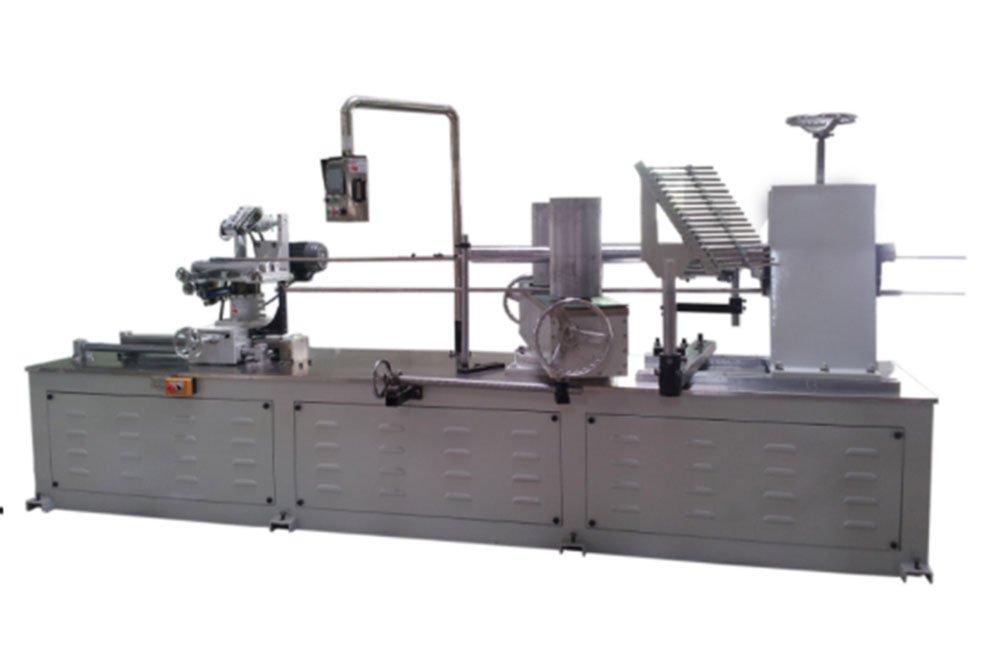
Production line and factory setup overview
A small spiral-winding line converting slit kraft or recycled paper reels into industrial paper tubes and textile cores through paper conditioning, multi-reel pay-off, controlled ply gluing, spiral winding around a fixed mandrel, online length cutting, curing, optional recutting, edge finishing, dimensional and crush testing, bundling and dry storage. Product diameter, wall thickness and end use determine the mandrel, ply build and adhesive.
Recommended lowest-entry line configuration Launch one confirmed textile-yarn or film core, not a broad tube catalogue. Screen a two-head spiral winder covering roughly 20-200 mm internal diameter and 1-10 mm wall thickness, with 8-16 reel stands, stainless glue system, one contracted mandrel and belt, synchronized flying cutter, curing racks, precision recutter and crush/dimensional test tools. Buy pre-slit paper initially unless a slitter is justified by volume.
Production process and implementation sequence
- Paper-strip receiving and moisture conditioning
- Multi-reel loading and ply sequencing
- Adhesive preparation and controlled coating
- Spiral winding around the selected mandrel
- Synchronized online cutting
- Rack curing and moisture equalisation
- Precision recutting and edge finishing
- Dimension, straightness, crush and bundle release
Products, capacity and market fit
- Textile, tissue, film, tape and paper converters need dimensionally consistent winding cores.
- One buyer-approved diameter and crush strength keep mandrel and paper inventory low.
- Pre-slit paper permits a smaller entry before an industrial slitter is justified.
- Moisture, ply bond and straightness determine whether the core runs safely at speed.
- Textile-yarn winding core - Buyer spindle/chuck fit, internal diameter, wall, length, moisture, straightness and radial crush - Yarn, carpet and textile processors
- Film or paper converting core - Separate diameter, surface, crush and dynamic winding approval - Flexible packaging, tissue and adhesive-tape converters
Core production machinery and line specifications
| Machine / stage | Function / value | Production note |
|---|---|---|
| Paper-strip reel stands | Feeds multiple plies in controlled order | 8-16 plies entry |
| Glue preparation and coating frame | Applies consistent adhesive to each ply | Viscosity/temperature controlled |
| Two-head spiral tube winder | Builds tube around fixed mandrel | 20-200 mm supplier range |
| Mandrel, winding belts and guides | Defines diameter and winding geometry | One launch core |
| Synchronized flying cutter | Cuts continuous tube without stopping | Length tolerance contracted |
| Curing racks and precision recutter | Stabilizes and finishes core length | Moisture-equilibrated cutting |
| Core laboratory | Measures geometry, bond and crush | Buyer-approved methods |
Raw materials, utilities and factory requirements
- Pre-slit kraft/recycled core paper by ply, gsm, moisture and strength
- Buyer-approved water-based dextrin/PVA adhesive
- Optional surface paper, release coating or printed identification
- Straps, pallets, labels, blades, belts and critical spares
- Stable three-phase power and clean compressed air
- Dry humidity-controlled paper and curing areas
- Glue kitchen with washable floor and drainage control
- Guarded winding/cutting and safe reel handling
- Trim collection, fire protection and dry finished store
Indicative low-entry investment and implementation plan
These planning ranges prioritize economical machinery, local labor and local civil works. Final pricing follows confirmed capacity, product specification, delivery terms and site conditions.
| Scope | Indicative range | Entry-plan note |
|---|---|---|
| Reel stands, glue and spiral winder | US$14k-34k | One core family |
| Mandrel, cutter, racks and recutter | US$6k-17k | One launch diameter |
| Laboratory, handling and packing | US$3k-9k | Crush and dimensional control |
| Freight, installation and spares | US$5k-14k | Compact workshop |
| Indicative installed low-entry total | US$28k-74k | Paper slitter, building and stock excluded |
Detailed proposal and next step
The proposal contains the complete line flow, machinery scope, raw-material and utility requirements, implementation stages and indicative entry planning. Final configuration follows confirmed products, capacity, site and budget.