
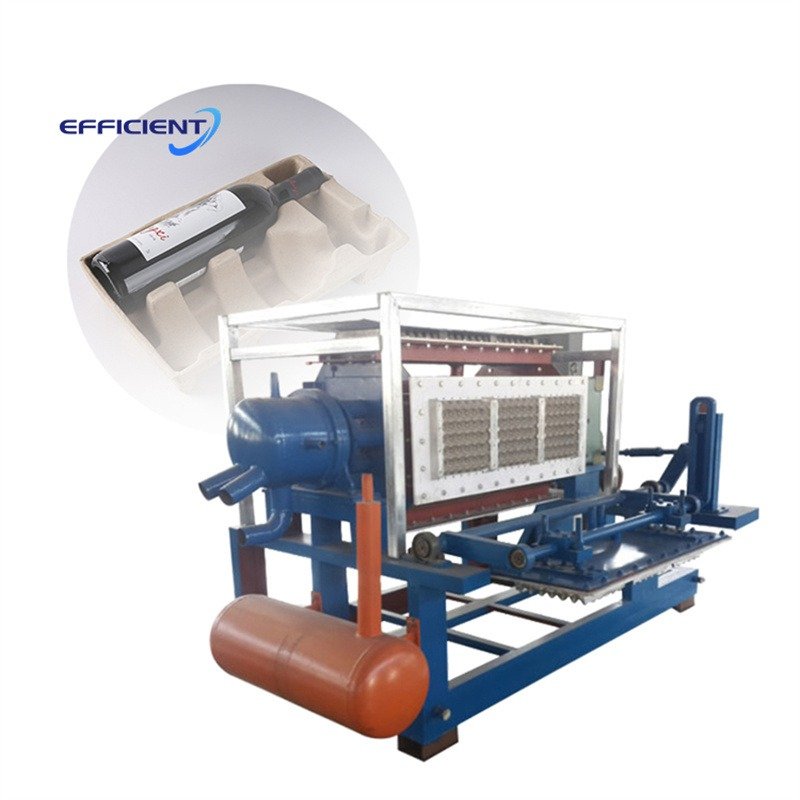
Production line and factory setup overview
A small/medium moulded-fibre line converting sorted local wastepaper into 30-egg trays through wastepaper receiving, contaminant removal, hydropulping, screening, refining and consistency control, recycled-water chest mixing, vacuum forming on dedicated moulds, compressed-air transfer, controlled drying, hot pressing only if required, nesting, counting, compression and moisture testing, strapping and dry storage. Water is recirculated and dirty reject streams require treatment.
Recommended lowest-entry line configuration Begin with one 30-egg tray and confirmed poultry buyers. Screen a 1,000 tray/h reciprocating or small rotary former consuming about 80 kg/h paper, with hydropulper, screen, mixing chests, pumps, vacuum/air systems and mould set. Use sun/covered-rack drying only after seasonal trials prove capacity and hygiene; otherwise install a fuel-efficient metal or brick dryer sized to the wet output.
Production process and implementation sequence
- Wastepaper receiving, sorting and contaminant removal
- Hydropulping, screening and refining
- Pulp consistency and additive control
- Vacuum forming and water recovery
- Compressed-air transfer to carriers
- Controlled rack, brick or metal drying
- Optional hot press, nesting and counting
- Moisture, compression, stack and packing release
Products, capacity and market fit
- Local wastepaper becomes a needed poultry-packaging product.
- One common 30-egg format simplifies moulds, stacking and customer trials.
- Water recirculation reduces demand and fibre loss.
- Drying capacity, tray moisture and compression—not former speed alone—set saleable output.
- Thirty-egg moulded-pulp tray - Buyer-approved dimensions, pocket fit, dry mass, moisture, compression, drop and nesting - Poultry farms, egg graders and wholesalers
- Alternative produce tray - Separate mould, fibre recipe, drying and load validation - Fruit packers only after egg-tray demand is stable
Core production machinery and line specifications
| Machine / stage | Function / value | Production note |
|---|---|---|
| Sorting conveyor and hydropulper | Removes debris and disintegrates wastepaper | About 80 kg/h paper basis |
| Screen, refiner and pulp chests | Cleans and controls furnish consistency | Closed water loop |
| Pumps, vacuum and air systems | Forms and transfers wet trays | Duty matched to former |
| 1,000 tray/h forming machine | Vacuum moulds one tray geometry | One 30-egg mould set |
| Rack, brick or metal dryer | Removes water to storage moisture | Season and fuel sized |
| Optional hot press and stacker | Improves nesting and appearance | Only if buyer requires |
| Tray laboratory and strapper | Tests and bundles dry trays | Moisture/compression control |
Raw materials, utilities and factory requirements
- Sorted local wastepaper with controlled plastic, metal and sand
- Clean process makeup water and approved strength/sizing aids
- Drying fuel where forced drying is installed
- Straps, pallets, wrap, labels, mould mesh and pump/vacuum spares
- Three-phase power, vacuum and compressed air
- Reliable water with settling and high-recycle process loop
- Covered dirty-paper and clean dry-product zones
- Drying yard or insulated dryer with safe fuel system
- Reject, sludge, drainage, odour and fire-control plan
Indicative low-entry investment and implementation plan
These planning ranges prioritize economical machinery, local labor and local civil works. Final pricing follows confirmed capacity, product specification, delivery terms and site conditions.
| Scope | Indicative range | Entry-plan note |
|---|---|---|
| Pulping, screening, chests and pumps | US$8k-20k | 1,000 trays/h furnish system |
| Former, vacuum, air and one mould | US$12k-30k | Small reciprocating/rotary entry |
| Rack/compact dryer, laboratory and packing | US$8k-24k | Climate and fuel dependent |
| Water loop, freight, installation and spares | US$8k-22k | Local tanks/civil works |
| Indicative installed low-entry total | US$36k-96k | Large metal dryer, building and paper stock excluded |
Detailed proposal and next step
The proposal contains the complete line flow, machinery scope, raw-material and utility requirements, implementation stages and indicative entry planning. Final configuration follows confirmed products, capacity, site and budget.