
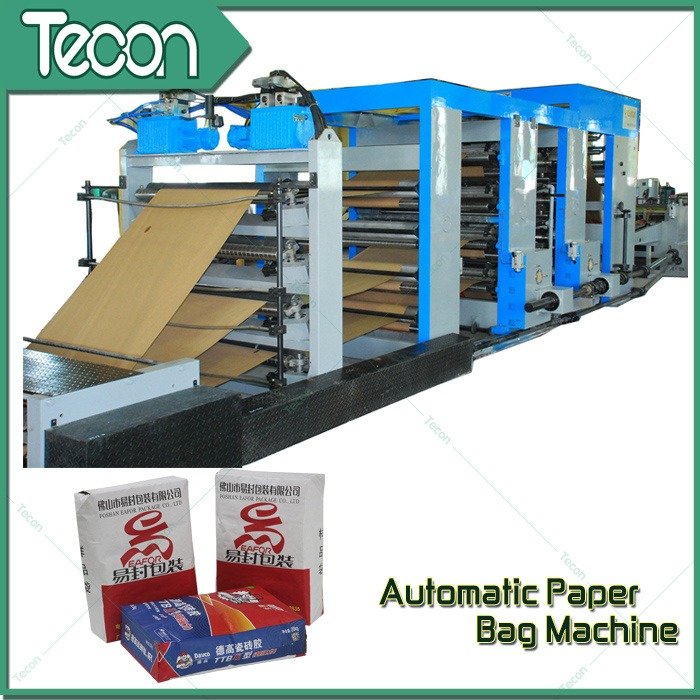
Production line and factory setup overview
A medium industrial paper-sack plant converting two to four kraft-paper webs, with an optional moisture barrier, into pasted open-mouth or valve sacks through reel stands, web tension control, ply alignment, longitudinal and cross gluing, stepped-end tube forming and cutting, perforation, valve-patch preparation where specified, bottom folding and pasting, pressing, drying/conditioning, printing, inspection and bundling. Food flour sacks and cement sacks are separate validated products.
Recommended lowest-entry line configuration Select one market first. For cement, screen a 2-3 ply valve-sack tuber plus bottomer for one 25 or 50 kg filling system. For flour, use food-contact kraft, approved barrier/ink/glue and an open-mouth or valve closure validated with the mill. A complete entry line needs reel handling, tuber, bottomer, printer, compressor, glue kitchen, conditioning and sack/drop/porosity tests—not a tuber alone.
Production process and implementation sequence
- Kraft-reel receiving and conditioning
- Multi-reel loading, alignment and tension
- Ply gluing, perforation and barrier insertion
- Tube forming and stepped-end cutting
- Valve patch preparation where required
- Bottom folding, pasting and pressing
- Printing, conditioning and bundle formation
- Porosity, drop, seam and filling trials
Products, capacity and market fit
- Afghan flour mills and cement plants consume large repetitive sack volumes.
- Multiwall paper can deliver printability and controlled filling-air release.
- One customer and one sack size are essential before investing in specialised bottoming tooling.
- Imported kraft reels create large working-capital and quality exposure.
- Cement valve paper sack - Customer filler, nominal mass, plies, valve, porosity, strength and drop test - Cement and dry construction-material plants
- Food-contact flour paper sack - Separate approved kraft, barrier, ink, glue, closure and migration documentation - Flour mills after food-safety validation
Core production machinery and line specifications
| Machine / stage | Function / value | Production note |
|---|---|---|
| Multi-reel stands and tension system | Feeds two to four kraft plies | Roll mass and width rated |
| Multiwall tuber | Glues, forms and cuts stepped tubes | Customer sack dimensions |
| Perforation and optional barrier unit | Controls air release and moisture protection | Product-specific |
| Valve patch and bottomer | Forms valve and pasted bottoms | One launch sack |
| Flexographic printer | Applies compliant customer markings | One/two colours entry |
| Glue kitchen, press and conditioning | Develops reliable bonds | Temperature and viscosity controlled |
| Sack laboratory | Tests paper, porosity, seam and drop | Filling-line validation |
Raw materials, utilities and factory requirements
- Specified sack-kraft reels for each ply
- Approved barrier film or coated paper only where designed
- Product-approved adhesive and printing ink
- Valve patches, pallets, wrap, plates, knives and spares
- Large stable three-phase supply and compressed air
- Dry conditioned kraft-roll warehouse
- Rated reel handling and long clear production bay
- Glue/ink preparation and controlled wastewater
- Finished-sack conditioning and customer filling-test area
Indicative low-entry investment and implementation plan
These planning ranges prioritize economical machinery, local labor and local civil works. Final pricing follows confirmed capacity, product specification, delivery terms and site conditions.
| Scope | Indicative range | Entry-plan note |
|---|---|---|
| Multiwall tuber and reel systems | US$140k-330k | 2-4 ply industrial machine |
| Bottomer, valve, printer and glue systems | US$110k-280k | One sack design |
| Handling, laboratory and utilities | US$45k-130k | Reels, air and quality |
| Freight, installation, training and spares | US$80k-220k | Specialist commissioning |
| Indicative installed project total | US$375k-960k | Building and kraft working stock excluded |
Detailed proposal and next step
The proposal contains the complete line flow, machinery scope, raw-material and utility requirements, implementation stages and indicative entry planning. Final configuration follows confirmed products, capacity, site and budget.