
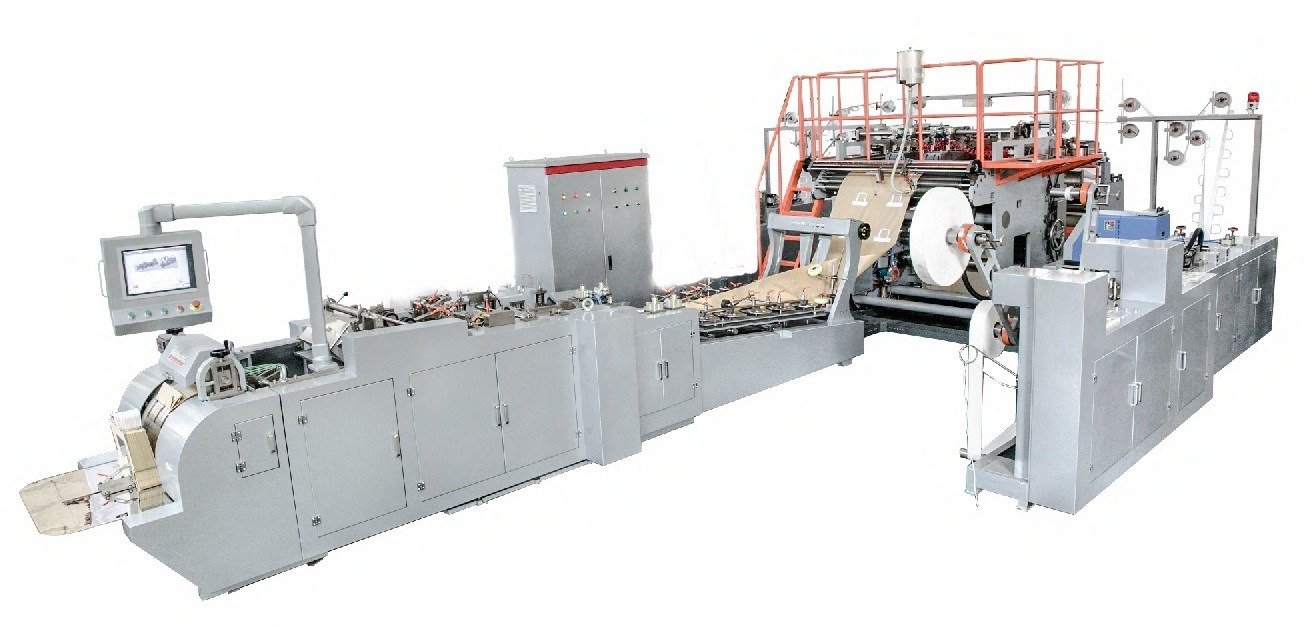
Production line and factory setup overview
A small paper-converting line producing square-bottom kraft shopping bags from specified paper rolls through reel loading, tension and edge guidance, optional inline flexographic printing, side gluing, tube forming, servo cutting, bottom creasing, gluing and forming, bag collection, handle manufacture or purchased-handle insertion, handle patching, count packing and quality release. Food-contact and non-food bags require separate paper, ink and adhesive approval.
Recommended lowest-entry line configuration For the lowest entry, make one SOS square-bottom bag without a handle, or one flat-handle shopping bag only when a buyer confirms volume. Screen a roll-fed 60-100 bag/min former for 70-150 gsm paper, one-colour inline print where needed, water-based glue system, inspection table and counter/packer. Purchased handles and a semi-automatic handle patcher can cost less than an integrated handle unit.
Production process and implementation sequence
- Kraft-roll receiving and conditioning
- Reel loading, tension and web guiding
- Optional one-colour flexographic printing
- Side gluing and tube forming
- Servo length cutting
- Bottom creasing, gluing and forming
- Optional handle patching and pull test
- Counting, inspection and carton packing
Products, capacity and market fit
- Retail, bakery, pharmacy and food-service users need locally branded paper bags.
- One size and print colour reduce reel, plate and changeover waste.
- Purchased handles permit a lower-risk entry before integrated automation.
- Paper and handle cost, not headline machine speed, dominate unit economics.
- Square-bottom SOS kraft bag - One approved size, paper gsm, bottom, glue, print and load rating - Bakery, takeaway, pharmacy and retail counters
- Flat-handle shopping bag - Approved handle patch, pull strength and customer print - Clothing, gifts and higher-load retail
Core production machinery and line specifications
| Machine / stage | Function / value | Production note |
|---|---|---|
| Unwinder and web guide | Feeds and aligns kraft roll | Roll mass and width rated |
| Optional one-colour flexo unit | Prints simple branding inline | Water-based ink |
| Square-bottom bag former | Forms tube, cuts and builds bottom | 60-100 bags/min entry |
| Glue preparation and delivery | Controls side and bottom bonds | Viscosity monitored |
| Optional handle patcher | Applies purchased flat handles | Phase selected by buyer |
| Inspection counter and packer | Counts and protects finished bags | One pack quantity |
| Bag test tools | Checks dimensions, seams and load | Customer specification |
Raw materials, utilities and factory requirements
- Specified kraft paper rolls by gsm, strength and food-contact status
- Water-based printing ink and approved cold/hot-melt glue
- Purchased flat handles and reinforcement patches where used
- Cores, cartons, wrap, labels, plates and critical spares
- Stable three-phase power and clean compressed air
- Dry humidity-controlled paper-roll store
- Ink/glue preparation and controlled wash area
- Safe roll handling, guarding and finished-bag packing space
Indicative low-entry investment and implementation plan
These planning ranges prioritize economical machinery, local labor and local civil works. Final pricing follows confirmed capacity, product specification, delivery terms and site conditions.
| Scope | Indicative range | Entry-plan note |
|---|---|---|
| Roll-fed square-bottom bag former | US$18k-48k | No-handle or basic model |
| Print, glue and optional handle patching | US$8k-28k | One colour and purchased handles |
| Inspection, packing and roll handling | US$5k-14k | One size basis |
| Freight, installation, tooling and spares | US$8k-22k | Supplier commissioning |
| Indicative installed low-entry total | US$39k-112k | Fully integrated handle line and paper stock excluded |
Detailed proposal and next step
The proposal contains the complete line flow, machinery scope, raw-material and utility requirements, implementation stages and indicative entry planning. Final configuration follows confirmed products, capacity, site and budget.