
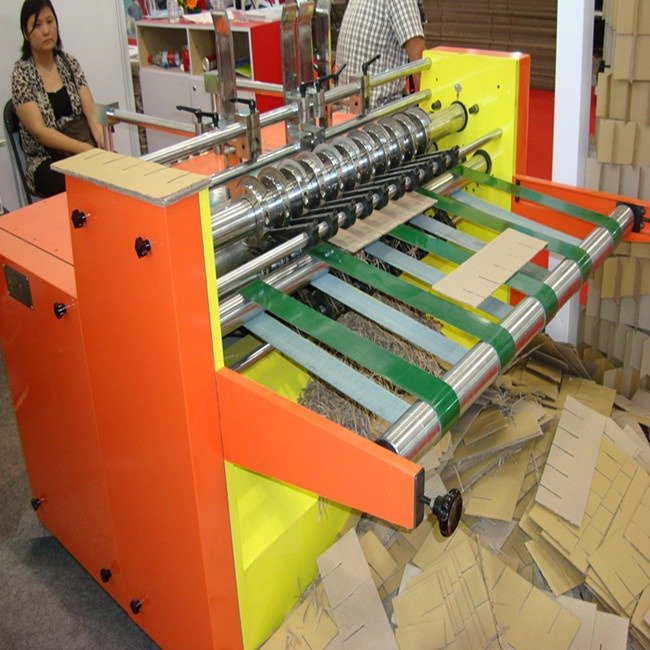
Production line and factory setup overview
A micro/small paperboard-converting line producing slotted corrugated partitions, dividers and simple fruit-carton trays from purchased three- or five-ply corrugated sheets or recycled paperboard. The route covers sheet receiving, moisture conditioning, strip slitting or die cutting, accurate cross-slotting, manual or automatic partition assembly, tray folding or gluing, dimensional inspection, compression trials, bundling and dry dispatch. It does not manufacture corrugated board.
Recommended lowest-entry line configuration Launch two partition cell sizes for one confirmed fruit carton using purchased sheets. Screen a 400-1,200 mm automatic partition slotter, guillotine or strip slitter, adjustable assembly jigs and manual insertion; add an automatic partition assembler only after volume is proven. Include sample dies for one tray, glue station, bundle press and box/partition compression tests.
Production process and implementation sequence
- Sheet receiving and moisture conditioning
- Order cutting plan and strip slitting
- Partition blank alignment and feeding
- Accurate cross-slotting
- Manual or automatic grid assembly
- Tray die cutting, folding and gluing
- Fit, dimensions and compression testing
- Flat bundling, coding and dry dispatch
Products, capacity and market fit
- Fruit exporters need separators that reduce bruising and movement during transport.
- Purchased corrugated sheets keep machinery and working capital low.
- Adjustable slotting supports several cell layouts without a full carton plant.
- Fit must be validated in the exact carton with actual fruit and transport trials.
- Corrugated fruit-carton partition - Customer carton, cell count, slot width/depth, board grade, fit and compression - Fresh-fruit packhouses and exporters
- Simple corrugated fruit tray - Approved die, dimensions, ventilation, fold and stacking performance - Produce distributors and retail packers
Core production machinery and line specifications
| Machine / stage | Function / value | Production note |
|---|---|---|
| Sheet guillotine or strip slitter | Cuts board into controlled partition strips | Customer sheet sizes |
| Automatic partition slotter | Cuts opposing interlock slots accurately | 3-5 ply board, 400-1,200 mm |
| Adjustable assembly jigs | Squares manual partition grids | Two launch layouts |
| Optional automatic assembler | Interlocks strips at higher volume | Phase 2 only |
| Tray die cutter and creaser | Forms one simple tray blank | One launch die |
| Glue and bundle stations | Closes trays and packs flat partitions | Water-based approved glue |
| Packaging laboratory | Checks dimensions and compression | Loaded transport trials |
Raw materials, utilities and factory requirements
- Purchased three- or five-ply corrugated sheets or approved paperboard
- Buyer-approved water-based glue and optional food-safe ink
- Cutting/slotting knives, one tray die and wear spares
- Straps, wrap, pallets, labels and sample cartons
- Small three-phase power and compressed air where required
- Dry humidity-controlled sheet and finished-goods store
- Safe sheet lifting, guarded knives and dust extraction
- Sample packing and compression-test area
Indicative low-entry investment and implementation plan
These planning ranges prioritize economical machinery, local labor and local civil works. Final pricing follows confirmed capacity, product specification, delivery terms and site conditions.
| Scope | Indicative range | Entry-plan note |
|---|---|---|
| Slitter/guillotine and partition slotter | US$6k-16k | Manual assembly entry |
| Jigs, tray die cutter and glue tools | US$4k-11k | Two grids and one tray |
| Laboratory, handling and bundles | US$3k-8k | Customer-carton validation |
| Freight, installation and spares | US$3k-9k | Compact workshop |
| Indicative installed low-entry total | US$16k-44k | Automatic assembler and board stock excluded |
Detailed proposal and next step
The proposal contains the complete line flow, machinery scope, raw-material and utility requirements, implementation stages and indicative entry planning. Final configuration follows confirmed products, capacity, site and budget.