
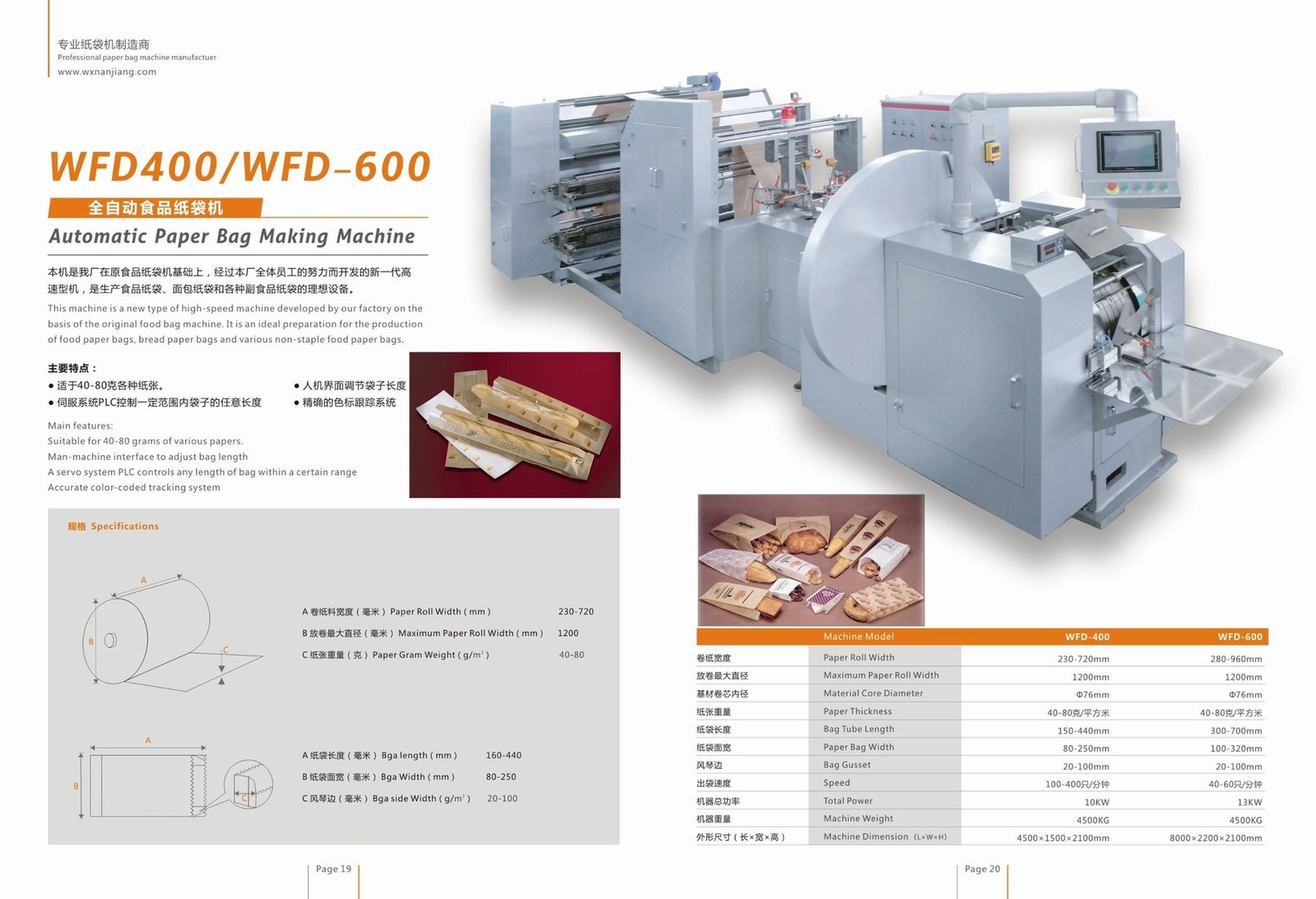
Production line and factory setup overview
A small roll-fed paper-converting line producing handle-free flat and gusseted satchel bags with a sharp or V bottom from specified paper through reel loading, web guiding, optional one-colour flexographic printing, photocell registration, perforation where required, side gluing, tube forming, length cutting, bottom folding and gluing, counting, inspection and carton packing. It is distinct from a square-bottom shopping-bag line.
Recommended lowest-entry line configuration Launch one unprinted or one-colour flat/satchel bag for bakery, pharmacy or dry-food use. Screen a 230-720 mm roll-fed machine rated for roughly 40-90 gsm paper, with reliable web guide, photocell registration, water-based glue and counter. Confirm whether the buyer needs a flat bag, gusseted satchel, grease-resistant paper or food-contact documentation before ordering tooling.
Production process and implementation sequence
- Paper-reel receiving and conditioning
- Reel loading, tension and web guiding
- Optional one-colour flexographic printing
- Photocell register and optional perforation
- Side gluing and tube forming
- Length cutting and V-bottom formation
- Counting and dimensional inspection
- Carton packing and dry dispatch
Products, capacity and market fit
- Bakeries, pharmacies, snack makers and retailers use simple low-cost paper bags.
- No handle and a V bottom reduce paper, tooling and machine complexity.
- One bag size and print colour support short local runs.
- Food and grease-resistant applications require approved paper, ink and glue.
- Flat bakery or pharmacy paper bag - One width/length, paper gsm, V-bottom, glue, print and pack count - Bakeries, pharmacies, hardware and retail counters
- Gusseted satchel bag - Approved gusset, grease resistance and food-contact construction - Dry foods, snacks and takeaway products
Core production machinery and line specifications
| Machine / stage | Function / value | Production note |
|---|---|---|
| Unwinder, tension and edge guide | Feeds and aligns the paper web | 230-720 mm roll width |
| Optional one-colour flexo printer | Adds simple registered branding | Water-based food-safe ink if needed |
| Flat/satchel bag former | Forms tube, gusset, cut and V bottom | 40-90 gsm paper |
| Photocell and register control | Aligns printed repeat to bag cut | Printed-bag option |
| Glue preparation and dosing | Controls side and bottom seams | Viscosity monitored |
| Counter and inspection conveyor | Counts and releases bag bundles | One pack quantity |
| Bag test tools | Checks dimensions, seam and capacity | Customer sample basis |
Raw materials, utilities and factory requirements
- Specified kraft, white, greaseproof or other approved paper reels
- Water-based adhesive and optional food-safe printing ink
- Cores, cartons, wrap, labels and printing plates
- Knives, belts, glue parts and critical spares
- Stable three-phase power and clean compressed air
- Dry humidity-controlled paper-roll store
- Controlled ink/glue preparation and wash area
- Safe roll handling, guarding and waste collection
- Clean packing and finished-goods area
Indicative low-entry investment and implementation plan
These planning ranges prioritize economical machinery, local labor and local civil works. Final pricing follows confirmed capacity, product specification, delivery terms and site conditions.
| Scope | Indicative range | Entry-plan note |
|---|---|---|
| Roll-fed flat/satchel bag machine | US$16k-42k | One V-bottom format family |
| Optional flexo, glue and register package | US$5k-15k | One-colour print |
| Handling, inspection and packing | US$3k-8k | Manual carton packing |
| Freight, installation, tooling and spares | US$6k-17k | Supplier commissioning |
| Indicative installed low-entry total | US$30k-82k | Square-bottom/handle machinery and paper stock excluded |
Detailed proposal and next step
The proposal contains the complete line flow, machinery scope, raw-material and utility requirements, implementation stages and indicative entry planning. Final configuration follows confirmed products, capacity, site and budget.