
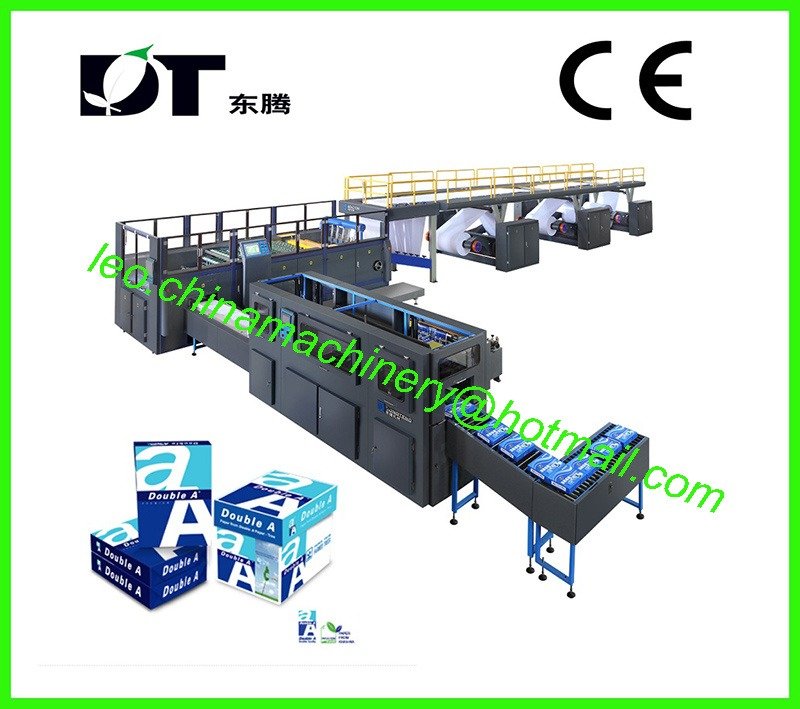
Production line and factory setup overview
A small industrial converting line turning certified copy-paper reels into A4 reams through reel receiving and conditioned storage, shaftless unwinding, tension and decurl control, longitudinal slitting, precision rotary cross-cutting, sheet transport and reject removal, exact counting, ream stacking, moisture-barrier wrapping, carton packing, palletising and printer-runnability release. It does not manufacture copy paper.
Recommended lowest-entry line configuration Screen a supported two-roll cut-size sheeter for one 70 or 80 gsm grade and A4 only, at a realistic entry output near 2-4 wrapped reams/min after rejects. Include reel clamp/handling, decurler, slitter/cross-cutter, automatic 500-sheet counting and stacking, semi-automatic or automatic ream wrapper, carton sealing, conditioning room and paper laboratory. Require a trial with the exact reel grade.
Production process and implementation sequence
- Copy-paper reel receiving and conditioning
- Shaftless unwind, tension and decurl
- Longitudinal slitting to web lanes
- Precision rotary cross-cutting
- Sheet transport, alignment and reject removal
- Automatic 500-sheet counting and stacking
- Moisture-barrier ream wrapping and coding
- Carton, pallet and printer-runnability release
Products, capacity and market fit
- Schools, offices, banks and government users consume large volumes of A4 paper.
- Reel converting can reduce packaging and freight cost versus imported finished reams.
- One gsm and one size simplify cutting, wrapping and inventory.
- Paper moisture, curl, dust and edge quality determine copier performance and customer acceptance.
- A4 office copy paper ream - 210×297 mm, one 70 or 80 gsm grade, 500 sheets, squareness, curl, dust and print runnability - Schools, offices, government, printers and stationery trade
- A3 cut-size expansion - Separate cutting layout, wrapper and confirmed buyer specification - Print shops only after A4 operation is stable
Core production machinery and line specifications
| Machine / stage | Function / value | Production note |
|---|---|---|
| Reel clamp, stands and shaftless unwind | Handles heavy reels and feeds stable webs | Two-roll entry basis |
| Tension control and decurler | Minimises curl and web instability | Paper-grade recipe |
| Slitter and rotary cross-cutter | Cuts exact A4 sheet geometry | 210×297 mm |
| Sheet conveyor, reject and counter | Aligns and forms 500-sheet reams | Exact count control |
| Ream wrapper and coder | Seals paper from moisture | 2-4 reams/min basis |
| Carton sealer and pallet tools | Protects reams in distribution | Buyer carton count |
| Paper laboratory and test printers | Releases paper and runnability | Moisture/curl/dust/size tests |
Raw materials, utilities and factory requirements
- Certified copy-paper reels by gsm, width, moisture, brightness and opacity
- Moisture-barrier ream wrap and printing ink
- Corrugated cartons, labels, straps and pallets
- Knives, belts, sensors, seals and critical spares
- Stable three-phase power and clean compressed air
- Temperature and humidity conditioned reel/converting rooms
- Rated reel clamp, crane or forklift with safe aisles
- Clean low-dust cutting, wrapping and finished store
- Fire protection and paper-trim baling/recycling route
Indicative low-entry investment and implementation plan
These planning ranges prioritize economical machinery, local labor and local civil works. Final pricing follows confirmed capacity, product specification, delivery terms and site conditions.
| Scope | Indicative range | Entry-plan note |
|---|---|---|
| Two-roll A4 sheeter and counting stacker | US$60k-145k | Precision cut-size conversion |
| Ream wrapper, coder and carton tools | US$25k-75k | 2-4 reams/min entry |
| Reel handling, conditioning and laboratory | US$18k-48k | Runnability controls |
| Freight, installation, blades and spares | US$25k-70k | Supplier commissioning |
| Indicative installed low-entry total | US$128k-338k | Paper mill, building and reel stock excluded |
Detailed proposal and next step
The proposal contains the complete line flow, machinery scope, raw-material and utility requirements, implementation stages and indicative entry planning. Final configuration follows confirmed products, capacity, site and budget.