
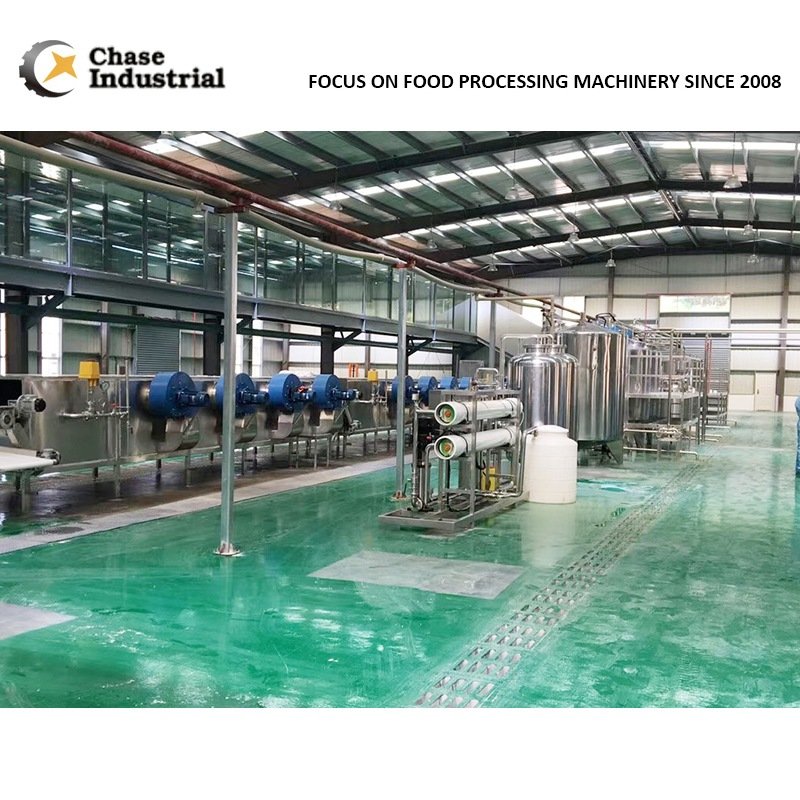
Production line and factory setup overview
This line makes stable tomato powder from sound ripe tomatoes through washing, crushing and pulping, concentration, thin-layer drying, milling and packing. Tomato color and flavor are heat-sensitive, so the entry plant must validate puree thickness, dryer temperature, residence time and final water activity rather than simply reuse tomato-paste settings.
Recommended lowest-entry line configuration For the lowest credible entry, select a 300-500 kg/h tomato intake with washer, crusher-pulper, finisher, small vacuum concentrator, drum or vacuum-belt dryer sized by trials, low-heat mill, sieve and semi-automatic powder packer.
Production process and implementation sequence
- Tomato receiving, ripeness and defect sorting
- Washing and potable rinsing
- Crushing, hot break and pulping
- Seed and skin finishing
- Vacuum pre-concentration
- Controlled thin-layer drying
- Cooling, low-heat milling and sieving
- Moisture-barrier packing and release
Products, capacity and market fit
- Tomato powder preserves seasonal surplus and reduces transport and storage weight.
- Powder supplies soup, seasoning, snack and sauce manufacturers with concentrated tomato solids.
- A puree-based route gives more uniform powder than uncontrolled drying of thick tomato pieces.
- A compact batch or small continuous dryer can scale after buyer trials.
- Tomato powder - Buyer-approved color, mesh, moisture, acidity and microbiology - Seasoning, soup, snack and sauce processors
- Tomato granules - Coarser released fraction with controlled moisture - Instant-food and ingredient buyers
Core production machinery and line specifications
| Machine / stage | Function / value | Production note |
|---|---|---|
| Tomato washer and sorting conveyor | Cleans fruit and removes defects | 300-500 kg/h intake |
| Crusher and hot-break unit | Creates mash and controls enzymes | Recorded time-temperature treatment |
| Pulper-finisher | Separates puree from skins and seeds | Interchangeable food-grade screens |
| Vacuum concentrator | Raises solids before drying | Small batch or continuous effect |
| Drum or vacuum-belt dryer | Converts concentrate into dry sheet or flakes | Selected through product trials |
| Cooling and flake breaker | Prevents condensation and prepares feed | Dry filtered air |
| Low-heat mill and sieve | Produces controlled powder mesh | Dust-controlled closed transfer |
| Powder weigher and sealer | Packs released powder | High-barrier pouch or liner |
Raw materials, utilities and factory requirements
- Sound ripe Afghan tomatoes
- Potable process water
- Only buyer-approved processing aids
- High-barrier pouches or bulk liners
- Labels and cartons
- Stable three-phase electricity
- Potable process water and hygienic drainage
- Food-grade heat source where required
- Ventilated washable processing room
- Clean dry packing and finished-goods storage
Indicative low-entry investment and implementation plan
These planning ranges prioritize economical machinery, local labor and local civil works. Final pricing follows confirmed capacity, product specification, delivery terms and site conditions.
| Scope | Indicative range | Entry-plan note |
|---|---|---|
| Washing, crushing and pulping | US$12k-26k | 300-500 kg/h intake |
| Vacuum pre-concentration | US$12k-28k | Small product-contact system |
| Entry drying system | US$22k-55k | Trial-selected technology |
| Milling, packing and QC tools | US$7k-16k | One powder format |
| Freight, installation and spares | US$8k-20k | Dryer footprint and heat source matter |
| Indicative low-entry total | US$61k-145k | Building, tomato and working capital excluded |
Detailed proposal and next step
The proposal contains the complete line flow, machinery scope, raw-material and utility requirements, implementation stages and indicative entry planning. Final configuration follows confirmed products, capacity, site and budget.