
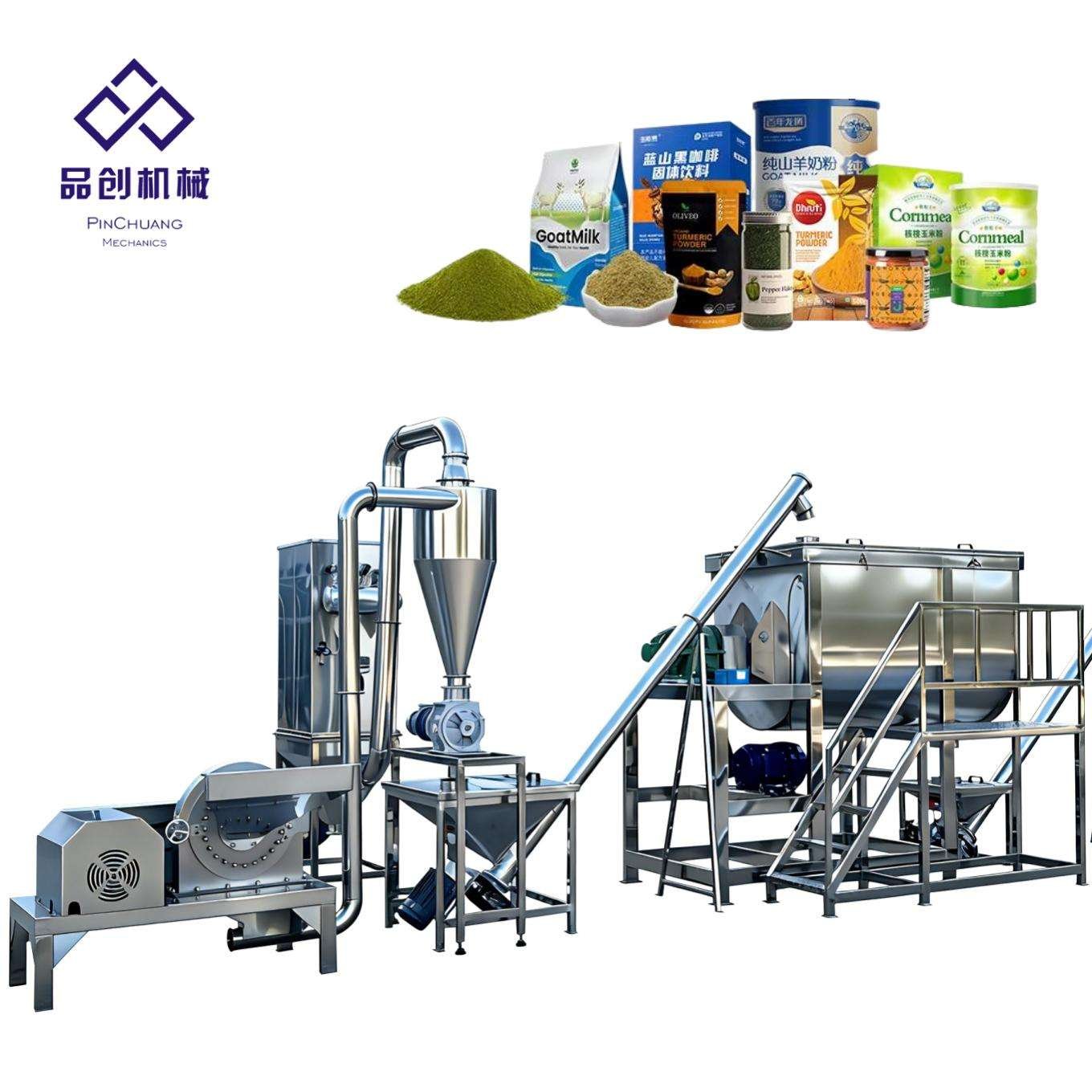
Production line and factory setup overview
A dry line for separately receiving released whole spices, final cleaning, controlled-temperature pre-crushing and grinding, sieving, optional recipe blending, metal detection and powder packing. Dust collection, heat control and strict allergen or recipe changeover are central to safe operation.
Recommended lowest-entry line configuration For the lowest credible entry, use a 50-100 kg/h pre-crusher and pin or hammer mill with cyclone and pulse dust collector, two interchangeable sieves, 50-100 kg ribbon blender and semi-automatic auger packer. Launch with three separately validated spices.
Production process and implementation sequence
- Released whole-spice receiving
- Final cleaning and magnetic protection
- Controlled pre-crushing
- Low-heat grinding with dust capture
- Sieve classification and rework
- Optional validated recipe blending
- Metal detection and powder inspection
- Auger dosing, sealing, coding and dry storage
Products, capacity and market fit
- Locally packed spices can replace imported retail powders.
- Separate validation protects aroma, color and particle-size targets.
- Small blending capacity supports branded seasoning recipes.
- Dust-controlled equipment improves hygiene and worker conditions.
- Single ground spices - Declared species, particle size, moisture, color and microbiology - Retail, food-service and food manufacturers
- Blended seasonings - Controlled recipe, salt declaration and allergen label - Retail, restaurants and processors
Core production machinery and line specifications
| Machine / stage | Function / value | Production note |
|---|---|---|
| Final cleaner and magnet | Protects the mill from foreign matter and metal | Released whole-spice feed |
| Pre-crusher | Reduces large spices to stable mill feed | Interchangeable cutter or screen |
| Pin or hammer mill | Produces controlled spice powder | 50-100 kg/h product-dependent |
| Cyclone and pulse dust collector | Recovers powder and controls airborne dust | Closed conductive ducting |
| Vibratory sieve | Classifies powder and returns oversize | Two launch mesh sizes |
| Ribbon blender | Produces validated seasoning recipes | 50-100 kg/batch |
| Metal detector | Checks released powder before packing | Validated test pieces |
| Auger pouch packer | Doses, seals and codes spice powder | Two or three launch pack sizes |
Raw materials, utilities and factory requirements
- Released dry whole spices by separate lot
- Only declared food-grade blend ingredients
- Barrier pouches, labels and cartons
- Validated cleaning and changeover materials
- Stable three-phase electricity
- Clean compressed air where specified
- Potable process water where required
- Washable food-grade processing room with dust control
- Dry segregated raw-material and finished-goods storage
Indicative low-entry investment and implementation plan
These planning ranges prioritize economical machinery, local labor and local civil works. Final pricing follows confirmed capacity, product specification, delivery terms and site conditions.
| Scope | Indicative range | Entry-plan note |
|---|---|---|
| Cleaning and pre-crushing | US$3k-8k | 50-100 kg/h preparation |
| Mill, cyclone and dust collection | US$6k-15k | Product-specific grinding trials |
| Sieving and optional blending | US$4k-10k | Three launch spices |
| Packing and quality tools | US$4k-10k | Semi-automatic retail launch |
| Freight, installation and spares | US$4k-9k | Conductive ducting confirmed |
| Indicative low-entry total | US$21k-52k | Building, spice stock and sterilisation excluded |
Detailed proposal and next step
The proposal contains the complete line flow, machinery scope, raw-material and utility requirements, implementation stages and indicative entry planning. Final configuration follows confirmed products, capacity, site and budget.