
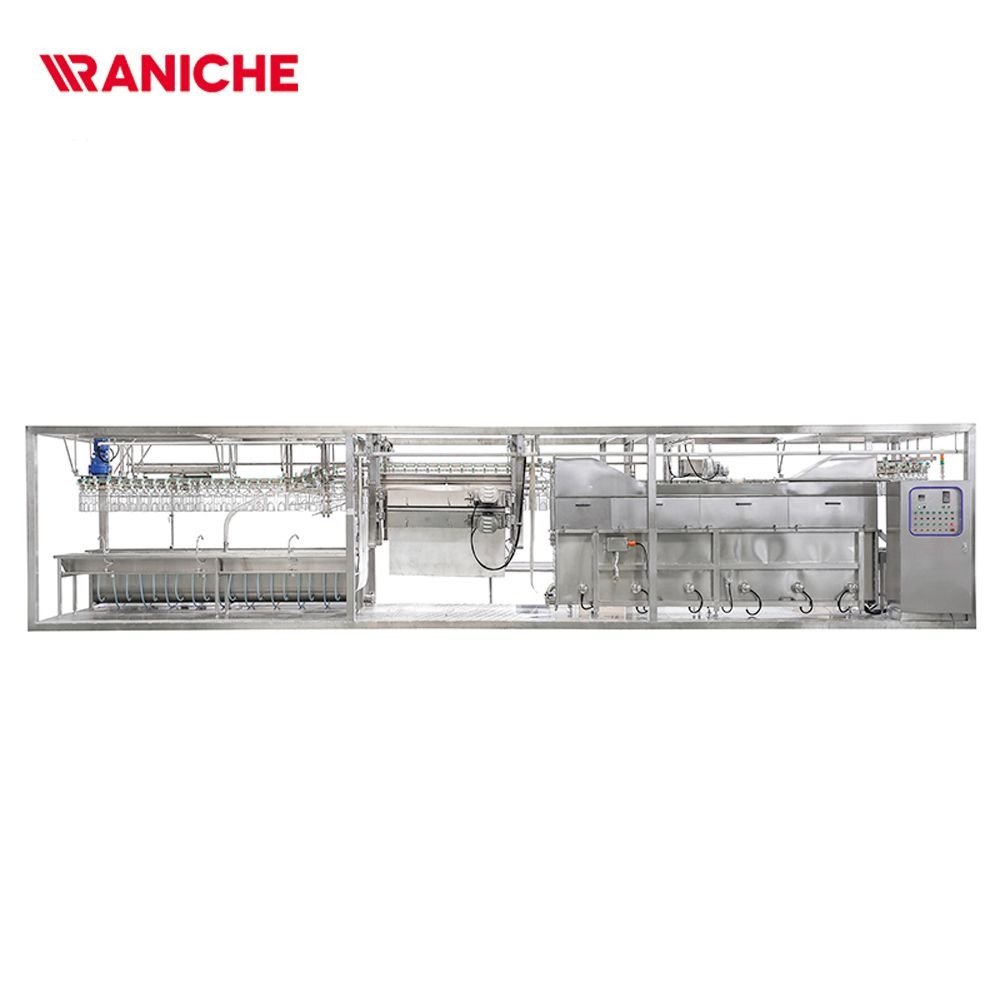
Production line and factory setup overview
A hygienic small poultry line covering live-bird receiving, humane handling, approved halal slaughter, bleeding, controlled scalding, mechanical plucking, head/feet removal, manual evisceration with inspection, carcass washing, rapid immersion or air chilling, drip control, whole-bird packing and cold storage.
Recommended lowest-entry line configuration For the lowest credible entry, use a 300-500 bird/h overhead shackle line with water-bath stunner if approved, bleed trough, scalder, two-stage plucking, manual evisceration tables, carcass washer, screw pre-chiller, drip line, bag sealer and cold room. Launch whole chilled birds only.
Production process and implementation sequence
- Live-bird receiving and welfare check
- Approved stunning and halal slaughter
- Bleeding and controlled scalding
- Two-stage plucking and finishing
- Head/feet removal and evisceration
- Inspection and carcass washing
- Rapid chilling and drip control
- Bagging, coding, cold storage and dispatch
Products, capacity and market fit
- Afghan livestock or poultry can support formal hygienic meat markets.
- Rapid chilling protects product quality and extends usable distribution time.
- A phased semi-automatic line uses local labor while controlling critical hygiene steps.
- By-products and wastewater need confirmed legal, safe and economical routes.
- Whole chilled chicken - Inspected carcass, controlled chill, declared weight and sealed food-contact bag - Butchers, groceries, restaurants and institutions
- Giblets expansion - Separately cleaned, chilled and packed edible giblets - Add only after inspection and cold-chain validation
Core production machinery and line specifications
| Machine / stage | Function / value | Production note |
|---|---|---|
| Live-bird receiving and shackles | Controls handling and feeds the line | 300-500 birds/h |
| Stunner, halal station and bleed trough | Supports approved slaughter and bleeding | Authority and halal-body approved |
| Scalder and two pluckers | Loosens and removes feathers | Recorded water temperature |
| Evisceration tables and tools | Removes viscera under inspection | Manual low-entry layout |
| Carcass washer | Removes visible contamination after trimming | Potable controlled spray |
| Screw pre-chiller and drip line | Rapidly reduces carcass temperature | Maximum-load chilling trial |
| Bag sealer, scale and coder | Packs one whole-bird format | Manual or semi-automatic |
| Cold room and effluent/by-product system | Protects product and manages waste | Sized by mass balance |
Raw materials, utilities and factory requirements
- Healthy animals or chilled carcasses from approved traceable suppliers
- Potable process water, ice or refrigeration as specified
- Food-contact bags, labels, cartons and clean reusable crates
- Approved cleaners, sanitizers and laboratory consumables
- Stable electricity matched to motors, controls, refrigeration and lighting
- Potable process and sanitation water with adequate pressure
- Washable food-grade rooms, drainage, pest control and hygiene barriers
- Segregated live/dirty, edible-process, packaging and finished-product zones
- Cold rooms, wastewater and by-product systems sized to the confirmed process
Indicative low-entry investment and implementation plan
These planning ranges prioritize economical machinery, local labor and local civil works. Final pricing follows confirmed capacity, product specification, delivery terms and site conditions.
| Scope | Indicative range | Entry-plan note |
|---|---|---|
| Slaughter, bleed, scald and pluck section | US$18k-45k | 300-500 birds/h |
| Evisceration, washing and tools | US$8k-20k | Manual inspected entry |
| Chilling, packing and cold room | US$18k-45k | Whole chilled birds |
| Water, hygiene and effluent systems | US$10k-28k | Site-specific mandatory scope |
| Freight, installation and spares | US$10k-25k | Commissioned hygienic flow |
| Indicative low-entry total | US$64k-163k | Building, vehicle and birds excluded |
Detailed proposal and next step
The proposal contains the complete line flow, machinery scope, raw-material and utility requirements, implementation stages and indicative entry planning. Final configuration follows confirmed products, capacity, site and budget.