
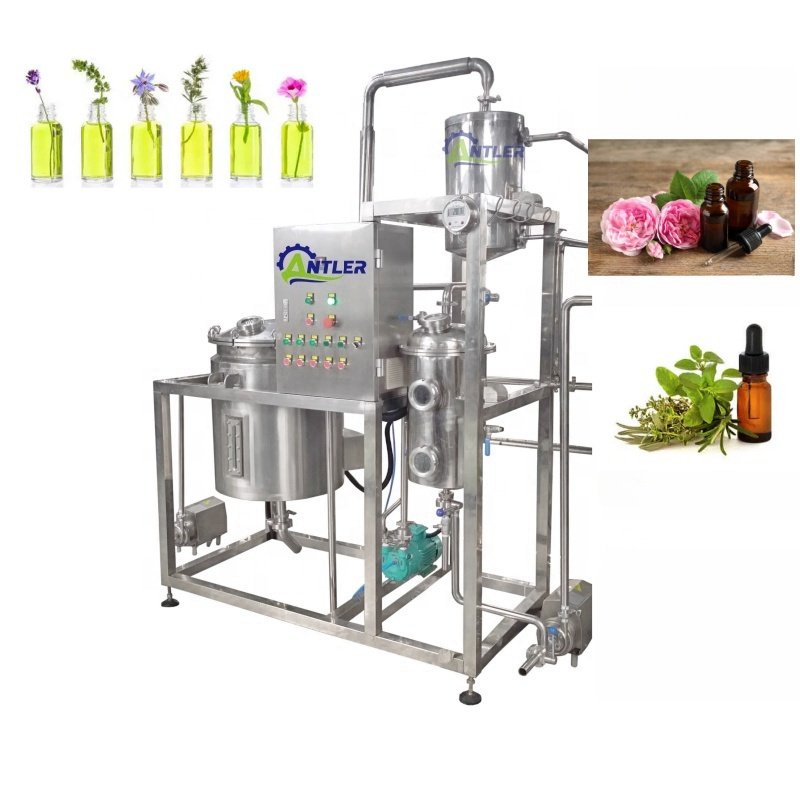
Production line and factory setup overview
A seasonal line for receiving fresh Afghan roses, rapid loading, steam or hydrodistillation, vapor condensation, hydrosol collection, filtration, protected holding, hygienic bottle filling, capping, coding and labeling. The proposal treats rosewater as the main product and separately recovers any essential-oil fraction.
Recommended lowest-entry line configuration For the lowest credible entry, use a 100-200 L stainless batch still with condenser and oil-water separator, small treated-water system, covered hydrosol tank, cartridge filtration and two-head semi-automatic filler/capper for one or two bottle sizes. Locate near rose supply and process the same day.
Production process and implementation sequence
- Fresh rose receiving and same-day inspection
- Treated-water and vessel preparation
- Controlled flower loading
- Steam or hydrodistillation
- Vapor condensation and oil-water separation
- Rosewater filtration and protected holding
- Bottle inspection, filling and capping
- Coding, labeling, case packing and cool storage
Products, capacity and market fit
- Afghan roses can support local culinary, hospitality and personal-care rosewater.
- Same-day processing protects aroma and reduces flower deterioration.
- Hydrosol bottling needs less oil yield than an essential-oil-only business.
- A small seasonal still can buy from nearby growers and expand by adding vessels.
- Food-grade rosewater - Buyer-approved aroma, clarity, microbiology, fill volume and sealed bottle - Retail, bakeries, beverages, hospitality and food service
- Cosmetic-grade rose hydrosol - Declared process, filtration, microbiology and compatible package - Personal-care formulators subject to applicable rules
Core production machinery and line specifications
| Machine / stage | Function / value | Production note |
|---|---|---|
| Rose receiving and sorting tables | Rejects decayed flowers and records source | Same-day coded batches |
| Treated-water unit | Supplies consistent low-odor process water | Sized to still and cleaning demand |
| Stainless batch still | Extracts rose volatiles into vapor | 100-200 L working vessel entry |
| Condenser and cooling loop | Condenses aromatic vapor efficiently | Cooling water sized for peak steam |
| Oil-water separator | Separates trace essential oil from hydrosol | Visible controllable fraction cut |
| Covered hydrosol tank and filter | Holds and clarifies released rosewater | Closed food-grade path |
| Two-head liquid filler and capper | Fills and closes selected bottles | One or two launch sizes |
| Coder and label station | Applies lot, date and product identity | Readable moisture-resistant code |
Raw materials, utilities and factory requirements
- Fresh traceable Afghan roses processed promptly
- Treated potable process water
- Food-grade bottles, caps, labels and cartons
- Approved filtration and cleaning materials
- Stable electricity matched to the selected equipment
- Potable process water where product contact occurs
- Washable food-grade rooms with pest and dust control
- Segregated raw-material, packaging and finished-goods storage
- Compressed air, steam or cooling water only where specified
Indicative low-entry investment and implementation plan
These planning ranges prioritize economical machinery, local labor and local civil works. Final pricing follows confirmed capacity, product specification, delivery terms and site conditions.
| Scope | Indicative range | Entry-plan note |
|---|---|---|
| 100-200 L still, condenser and separator | US$7k-18k | One seasonal batch vessel |
| Water, cooling and hydrosol holding | US$3k-8k | Closed product path |
| Filtration, filling and capping | US$4k-11k | Two-head semi-automatic entry |
| Coding and quality tools | US$2k-5k | One or two bottle sizes |
| Freight, installation and spares | US$4k-9k | Steam and cooling interfaces |
| Indicative low-entry total | US$20k-51k | Building, roses, bottles and certification excluded |
Detailed proposal and next step
The proposal contains the complete line flow, machinery scope, raw-material and utility requirements, implementation stages and indicative entry planning. Final configuration follows confirmed products, capacity, site and budget.