
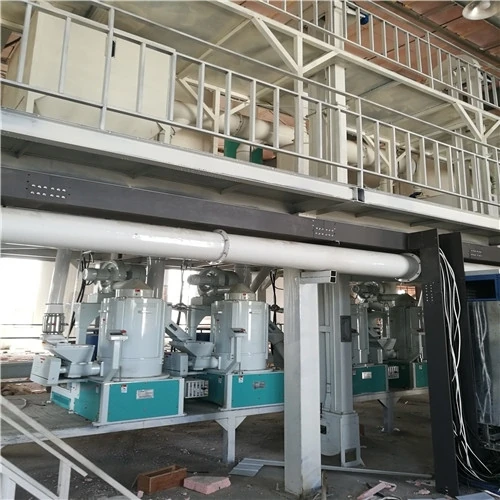
Production line and factory setup overview
A dry line for cleaning, destoning, optional conditioning, abrasive dehulling, splitting, aspiration, polishing and packing split lentils.
Recommended lowest-entry line configuration For the lowest credible entry, select a 300-500 kg/h line with cleaning and destoning, an adjustable dry dehuller, splitter, hull aspiration, polisher, grader and semi-manual packing.
Production process and implementation sequence
- Clean-lentil receiving and variety segregation
- Final screening, destoning and magnetic protection
- Moisture check and optional controlled conditioning
- Adjustable dry abrasive dehulling
- Hull and powder aspiration
- Kernel splitting with controlled breakage
- Polishing and finished-product grading
- Weighing, sealing and lot coding
Products, capacity and market fit
- Split lentils are a familiar retail and institutional staple with higher value than unprocessed grain.
- A dry process reduces water use and simplifies wastewater control.
- Adjustable passes allow processors to balance bright appearance against edible-yield loss.
- Separated hull and fines can enter approved feed channels when kept clean and traceable.
- Polished split lentils - Buyer-approved dehulling, split uniformity, color and low powder - Retail, wholesale and institutional food buyers
- Dehulled whole kernels - Separated whole cotyledon product where demanded - Specialty food processors
- Hull and fine fraction - Dry, separately collected and safety-checked - Approved feed or further milling users
Core production machinery and line specifications
| Machine / stage | Function / value | Production note |
|---|---|---|
| Final cleaner, destoner and magnet | Protects the dehuller and removes remaining impurities | Screens matched to the selected lentil variety |
| Conditioning bin and micro-doser | Equalizes moisture or applies approved minimal conditioning when trials require it | Bypass for validated fully dry processing |
| Abrasive dehuller | Removes the lentil seed coat by controlled friction | Adjustable feed, pressure and residence time |
| Hull aspiration system | Separates loosened hull and fine powder | Cyclone or filter with sealed reject collection |
| Lentil splitter | Separates dehulled kernels into two cotyledons | Low-impact adjustable splitting gap |
| Polisher | Removes adhering powder and improves surface appearance | Gentle dry polish with controllable loss |
| Finished-product grader | Separates accepted splits, whole kernels and fines | Interchangeable food-grade screens |
| Bagging scale and closer | Packs released split-lentil grades | Semi-manual 1-25 kg starter scope |
Raw materials, utilities and factory requirements
- Clean, variety-segregated Afghan lentils suitable for splitting
- Potable water only if the validated conditioning recipe requires it
- Food-grade pouches or lined bags
- Labels, coding and sealing consumables
- Stable three-phase electricity
- High-efficiency aspiration and safe dust collection
- Dry conditioned-lentil and finished-product storage
- Calibrated moisture meter, scales and laboratory sieves
- Food-grade compressed air only where specified
Indicative low-entry investment and implementation plan
These planning ranges prioritize economical machinery, local labor and local civil works. Final pricing follows confirmed capacity, product specification, delivery terms and site conditions.
| Scope | Indicative range | Entry-plan note |
|---|---|---|
| Final cleaning, destoning and conditioning | US$4k-9k | Reuse existing cleaner where available |
| Dry dehulling, aspiration and splitting | US$8k-18k | Core product-forming section |
| Polishing, grading and semi-manual packing | US$4k-10k | Optical sorter excluded |
| Electrical, dust control, installation and spares | US$3k-7k | Include abrasive parts, screens and belts |
| Freight and clearance | US$4k-8k | Confirm blower and duct shipment |
| Indicative low-entry total | US$23k-52k | Building, lentil stock and color sorter excluded |
Detailed proposal and next step
The proposal contains the complete line flow, machinery scope, raw-material and utility requirements, implementation stages and indicative entry planning. Final configuration follows confirmed products, capacity, site and budget.