
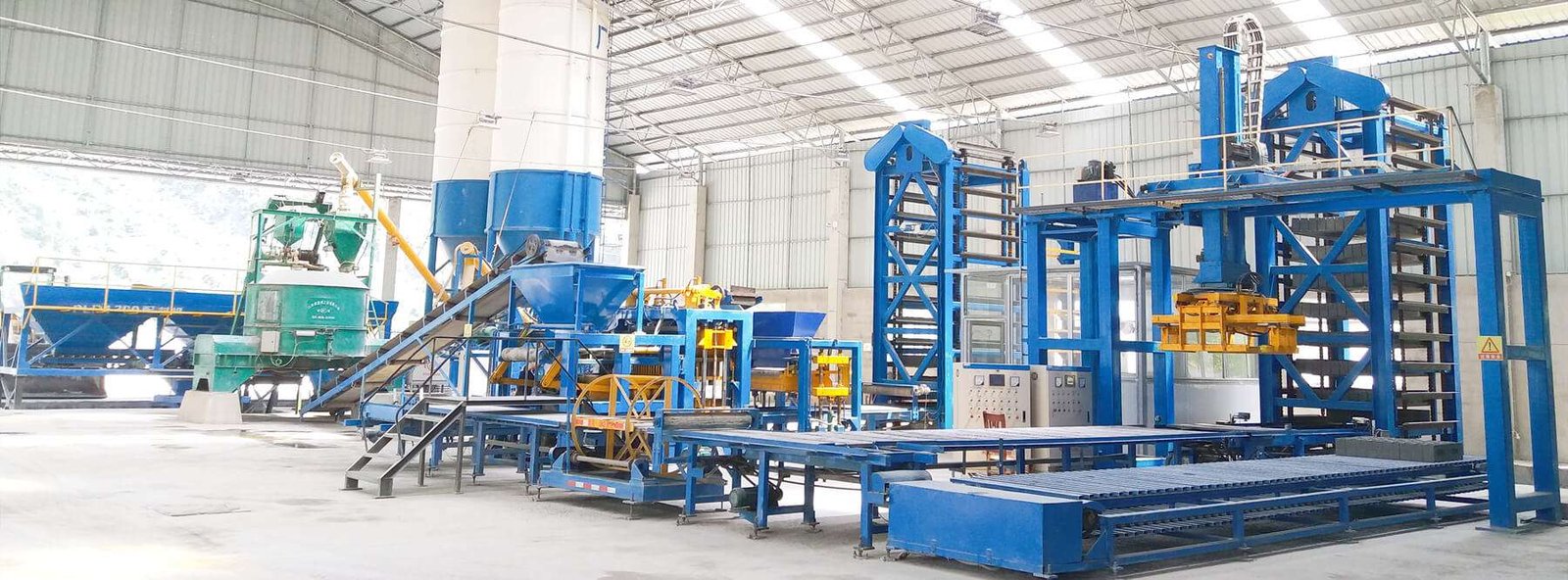
Production line and factory setup overview
This proposal covers a fully automatic vibration-molded concrete block plant with aggregate dosing, intensive mixing, block forming, elevator and finger-car handling, controlled curing, cubing and pallet return. Interchangeable molds allow hollow blocks, solid blocks, pavers and curbstones, giving one plant several construction-market channels.
Recommended lowest-entry line configuration QT9-15 class automated line with 15-18 second molding cycle, 1,400 x 750 mm pallet, automatic curing transfer and cuber; approximately 17,000 standard blocks per 8-hour shift depending on mold.
Production process and implementation sequence
- Aggregate dosing
- Mixing
- Vibro-pressing
- Wet-block lift
- Curing
- Lowering
- Cubing
- Dispatch
Products, capacity and market fit
- Urban housing and infrastructure require consistent masonry products.
- Local aggregates and cement support domestic value addition.
- Multiple molds diversify revenue without replacing the core press.
- Automation improves dimensions, density, labor productivity and curing discipline.
- Hollow block - Typical 400 x 200 x 200 mm - Wall construction
- Solid block - Custom thickness and strength - Foundations and heavy walls
- Paving stone - Colored face-mix option - Roads and landscaping
- Curbstone - Replaceable heavy-duty mold - Municipal infrastructure
Core production machinery and line specifications
| Machine / stage | Function / value | Production note |
|---|---|---|
| Aggregate bins | Store and dose sand and stone fractions | 3-4 bins |
| Cement silo and screw | Store and meter cement | 50-100 t typical |
| Planetary mixer | Produce low-slump concrete | Automatic water correction |
| Block forming machine | Vibration and hydraulic compaction | 15-18 s cycle |
| Face-mix unit | Apply colored wearing layer | Optional |
| Pallet conveyor | Transfer fresh products | Servo indexed |
| Elevator and finger car | Load curing racks | Programmed handling |
| Curing chamber | Control moisture and temperature | Ambient or steam assisted |
| Lowerator and cuber | Unload and stack cured blocks | Automatic |
| Pallet return | Clean and recirculate pallets | Integrated loop |
Raw materials, utilities and factory requirements
- Washed sand and graded aggregates
- Portland or blended cement
- Clean mixing water
- Pigments for colored products
- Plasticizers or performance admixtures
- Wood, bamboo-composite or steel production pallets
- Three-phase electrical service and control room
- Water storage with moisture-compensation system
- Covered aggregate bins and cement silo foundation
- Curing chambers and drainage
Indicative low-entry investment and implementation plan
These planning ranges prioritize economical machinery, local labor and local civil works. Final pricing follows confirmed capacity, product specification, delivery terms and site conditions.
| Scope | Indicative range | Entry-plan note |
|---|---|---|
| Entry machinery | US$120k-350k | Semi-automatic or basic automatic Chinese line |
| Local curing and civil works | US$45k-140k | Simple chambers, local shed, foundations and yard |
| Freight and commissioning | US$35k-100k | Containerized shipment and local installation labor |
| Molds, pallets and spares | US$25k-80k | Start with the highest-demand product molds |
| Working capital | US$25k-70k | Cement, aggregates, labor and launch stock |
| Low-entry project total | US$250k-740k | Land excluded; add cubing automation later |
Detailed proposal and next step
The proposal contains the complete line flow, machinery scope, raw-material and utility requirements, implementation stages and indicative entry planning. Final configuration follows confirmed products, capacity, site and budget.