
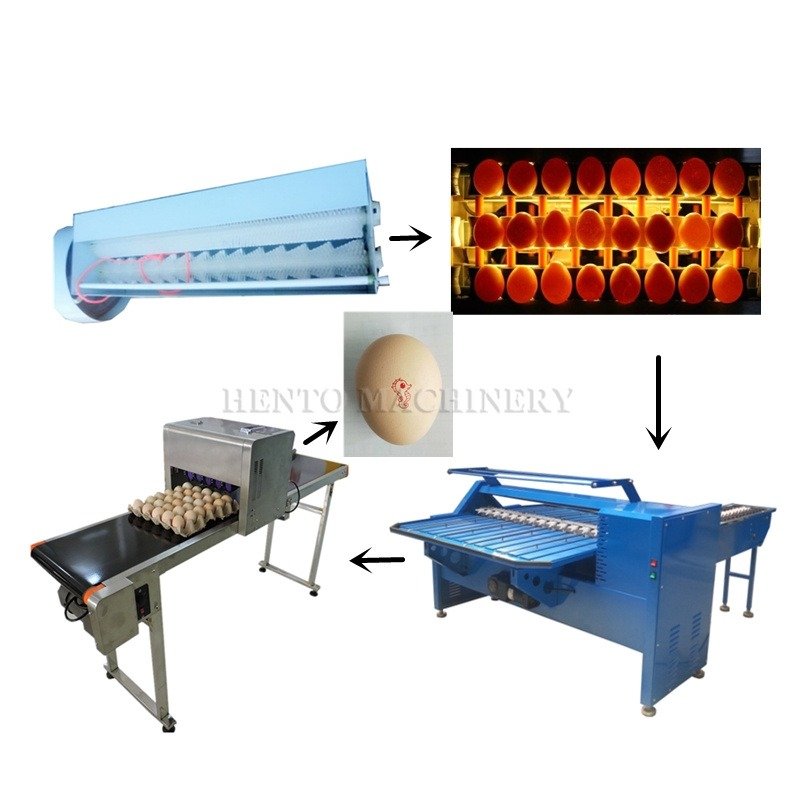
Production line and factory setup overview
A shell-egg packing line for receiving traceable Afghan eggs, dry pre-cleaning or controlled washing only where the selected market permits it, candling for internal defects and cracks, weight grading, manual defect removal, date or farm coding, tray loading, case packing and cool clean storage. Washing policy, shell treatment and storage temperature must follow the target buyer and local food rules.
Recommended lowest-entry line configuration For the lowest credible entry, use a 3,000-6,000 egg/h infeed, LED candling hood and six- or seven-grade weight sorter with manual tray packing and coder. Launch dry-cleaned eggs from registered farms in two retail grades; add washing only after a validated legal and shelf-life study.
Production process and implementation sequence
- Registered-farm lot receiving
- Visual check and controlled pre-cleaning
- Egg alignment and crack inspection
- LED candling and defect removal
- Automatic weight grading
- Manual tray loading and count check
- Farm/date coding and case packing
- Clean cool storage and dispatch
Products, capacity and market fit
- Egg grading creates consistent retail sizes and improves farm traceability.
- Candling removes visible cracks and internal defects before packing.
- Manual tray packing keeps entry cost and breakage risk low.
- Registered farm lots support recalls and buyer confidence.
- Retail table eggs - Two declared weight grades, intact clean shells, traceable farm/date code - Grocers, supermarkets and institutions
- Food-service egg trays - Buyer-selected grade and count in protected transport trays - Bakeries, hotels and caterers
Core production machinery and line specifications
| Machine / stage | Function / value | Production note |
|---|---|---|
| Egg infeed and accumulation table | Receives trays and gently aligns eggs | 3,000-6,000 eggs/h |
| Dry brush or approved washer/dryer | Controls visible shell soil under the chosen policy | Washing optional after validation |
| LED candling and crack-check hood | Reveals cracks and internal defects | Manual rejection stations |
| Weight grading machine | Sorts eggs into declared weight classes | Six or seven outputs |
| Manual tray-packing tables | Loads and verifies retail or wholesale trays | Two launch grades |
| Egg coder | Prints farm, lot and date information | Food-contact approved ink |
| Case sealing and label station | Protects and identifies transport cases | Manual entry scope |
| Clean cool store | Holds eggs under the chosen temperature policy | Logged conditions |
Raw materials, utilities and factory requirements
- Traceable shell eggs from registered Afghan farms
- Clean egg trays, cartons, labels and cases
- Approved dry-cleaning or wash/sanitizer consumables
- Food-contact coding ink and calibration weights
- Stable electricity matched to motors, controls, refrigeration and lighting
- Potable process and sanitation water with adequate pressure
- Washable food-grade rooms, drainage, pest control and hygiene barriers
- Segregated live/dirty, edible-process, packaging and finished-product zones
- Cold rooms, wastewater and by-product systems sized to the confirmed process
Indicative low-entry investment and implementation plan
These planning ranges prioritize economical machinery, local labor and local civil works. Final pricing follows confirmed capacity, product specification, delivery terms and site conditions.
| Scope | Indicative range | Entry-plan note |
|---|---|---|
| Infeed, candling and grading | US$5k-14k | 3,000-6,000 eggs/h |
| Cleaning module and inspection tools | US$2k-7k | Dry-clean entry; washer optional |
| Packing tables, coder and case tools | US$2k-6k | Manual tray loading |
| Cool storage and hygiene setup | US$3k-8k | Buyer-defined conditions |
| Freight, installation and spares | US$3k-8k | Rollers and grading parts |
| Indicative low-entry total | US$15k-43k | Building, vehicle and egg working stock excluded |
Detailed proposal and next step
The proposal contains the complete line flow, machinery scope, raw-material and utility requirements, implementation stages and indicative entry planning. Final configuration follows confirmed products, capacity, site and budget.