
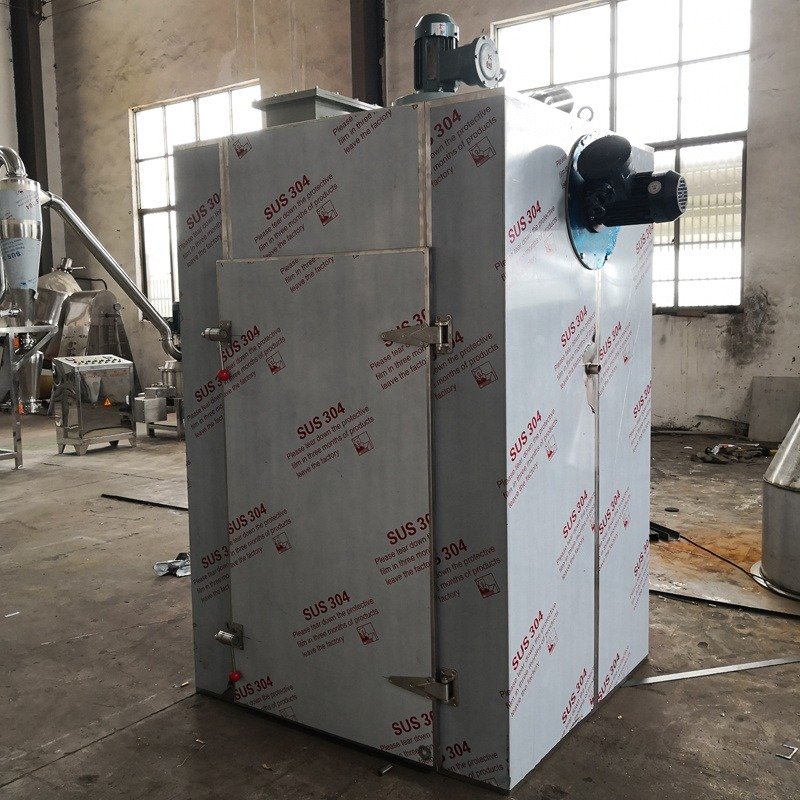
Production line and factory setup overview
A small hygienic line converting inspected lean Afghan beef, lamb or goat meat into shelf-stable dried slices through chilled receiving, trimming, controlled slicing, measured curing or marination, refrigerated equilibration, rack loading, validated hot-air drying, cooling, water-activity release, portioning and high-barrier packing. The product must be validated for pathogen reduction and shelf stability; drying by appearance alone is unsafe.
Recommended lowest-entry line configuration For the lowest credible entry, use one species and one validated recipe, a guarded slicer, 50-100 kg vacuum tumbler, two 100-150 kg/batch stainless hot-air drying cabinets, a calibrated water-activity meter and semi-automatic vacuum or gas-flush packing. Sell one sliced format and keep raw and ready-to-eat zones physically separate.
Production process and implementation sequence
- Inspected chilled meat receiving
- Trimming and guarded slicing
- Recipe weighing and batch coding
- Vacuum tumbling or marination
- Refrigerated equilibration
- Controlled hot-air drying
- Cooling and water-activity release
- Barrier packing, coding and dry storage
Products, capacity and market fit
- Afghan livestock can support branded halal dried-meat products.
- Drying adds value and extends distribution only after safety validation.
- Batch cabinets suit seasonal supply and small urban markets.
- Simple high-barrier packs can serve retail and travel-food buyers.
- Halal sliced dried meat - Declared species, controlled slice, validated kill step and water activity - Retail, travel and hospitality buyers
- Spiced jerky - One approved recipe with consistent salt, spice, texture and pack life - Specialty grocery after shelf-life validation
Core production machinery and line specifications
| Machine / stage | Function / value | Production note |
|---|---|---|
| Chilled trimming tables and tools | Prepares lean inspected meat hygienically | 100-250 kg/day |
| Guarded meat slicer | Produces controlled thickness for uniform drying | Recipe-defined slice |
| Vacuum tumbler | Distributes measured cure or marinade | 50-100 kg/batch |
| Refrigerated marination cabinet | Holds product safely during equilibration | Logged 0-4°C |
| Hot-air drying cabinets | Delivers recorded time, air and temperature | 2 x 100-150 kg/batch |
| Water-activity meter | Releases only shelf-stable validated batches | Calibrated against standards |
| Vacuum or gas-flush packer | Protects cooled released product | Two retail pack sizes |
| Raw/RTE hygiene barriers | Prevents post-process contamination | Separate tools, staff flow and storage |
Raw materials, utilities and factory requirements
- Inspected halal beef, lamb or goat meat from an approved cold chain
- Measured salt, sugar and approved spices or curing ingredients
- High-barrier food-contact pouches, labels and cartons
- Approved cleaners, sanitizers and laboratory consumables
- Stable three-phase electricity matched to motors and controls
- Potable process and sanitation water with adequate pressure
- Process heat or steam sized to the confirmed thermal load
- Washable rooms, trapped drainage, pest control and hygiene barriers
- Odour, wastewater and by-product controls approved for the site
Indicative low-entry investment and implementation plan
These planning ranges prioritize economical machinery, local labor and local civil works. Final pricing follows confirmed capacity, product specification, delivery terms and site conditions.
| Scope | Indicative range | Entry-plan note |
|---|---|---|
| Cold preparation, slicer and tools | US$5k-13k | One species and cut style |
| Tumbler and refrigerated marination | US$5k-14k | 50-100 kg/batch |
| Two batch drying cabinets | US$10k-26k | Validated hot-air process |
| Water-activity and packing equipment | US$5k-13k | Two pack sizes |
| Freight, installation and spares | US$5k-12k | Controls and heating parts |
| Indicative low-entry total | US$30k-78k | Building, meat stock and cold vehicle excluded |
Detailed proposal and next step
The proposal contains the complete line flow, machinery scope, raw-material and utility requirements, implementation stages and indicative entry planning. Final configuration follows confirmed products, capacity, site and budget.