
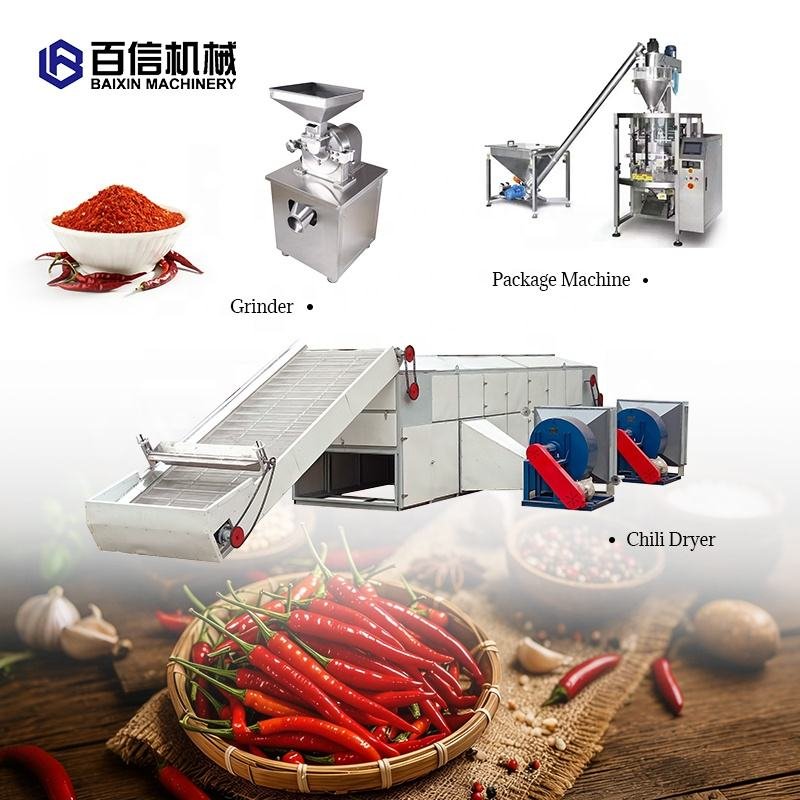
Production line and factory setup overview
A flexible line for Afghan fresh or partly sun-dried chilies, covering inspection, optional washing, stem removal, cutting, controlled drying, cooling, grinding or flaking, sieving and packing. The exact route depends on incoming moisture and whether whole dried chili, flakes or powder is sold.
Recommended lowest-entry line configuration For the lowest credible entry, use manual washing and stem removal, a 100-200 kg/batch cabinet or heat-pump dryer, 30-80 kg/h grinder with cyclone, sieve and semi-automatic pouch packer. Omit drying when validated sun-dried chili arrives below the buyer moisture limit.
Production process and implementation sequence
- Chili receiving, sampling and sorting
- Optional washing and surface-water removal
- Manual stem removal and controlled cutting
- Low-temperature batch drying
- Cooling and moisture equalization
- Grinding or flaking with dust capture
- Sieving, metal detection and inspection
- Weighing, sealing, coding and dry storage
Products, capacity and market fit
- Afghan chilies can be sold as whole dried pods, flakes or powder.
- A modular line accepts fresh, partly dried or fully dried seasonal supply.
- Local drying reduces post-harvest loss and transport weight.
- Powder and flakes support retail and food-service brands.
- Whole dried chili - Buyer-approved color, moisture, stem level, mold and foreign matter - Wholesale, retail and spice processors
- Chili flakes and powder - Declared particle size, heat, color, moisture and microbiology - Retail, restaurants and food manufacturers
Core production machinery and line specifications
| Machine / stage | Function / value | Production note |
|---|---|---|
| Sorting and preparation tables | Rejects mold and removes stems | Manual low-cost launch |
| Optional washer and drain rack | Removes field soil when wet processing is required | Potable final rinse |
| Chili cutter | Creates uniform pieces for drying | Guarded adjustable cut |
| Cabinet or heat-pump dryer | Reduces moisture under controlled airflow | 100-200 kg/batch fresh input |
| Cooling and equalization bins | Prevents condensation and balances moisture | Covered food-grade bins |
| Chili grinder with cyclone | Produces flakes or powder with dust capture | 30-80 kg/h dry feed |
| Sieve and metal detector | Controls particle size and metal risk | Two launch specifications |
| Semi-automatic pouch packer | Weighs, seals and codes released chili | Two or three launch formats |
Raw materials, utilities and factory requirements
- Traceable fresh, partly dried or dried Afghan chilies
- Potable water when washing is used
- Barrier pouches, labels and cartons
- Food-grade cleaning and sanitation materials
- Stable three-phase electricity
- Clean compressed air where specified
- Potable process water where required
- Washable food-grade processing room with dust control
- Dry segregated raw-material and finished-goods storage
Indicative low-entry investment and implementation plan
These planning ranges prioritize economical machinery, local labor and local civil works. Final pricing follows confirmed capacity, product specification, delivery terms and site conditions.
| Scope | Indicative range | Entry-plan note |
|---|---|---|
| Manual preparation and cutter | US$2k-5k | Local tables and guarded cutter |
| Batch dryer and heat source | US$6k-16k | 100-200 kg/batch entry |
| Grinding, cyclone and sieving | US$4k-11k | 30-80 kg/h dry feed |
| Packing and quality tools | US$3k-8k | Semi-automatic launch |
| Freight, installation and spares | US$4k-9k | Heat source and ducting confirmed |
| Indicative low-entry total | US$19k-49k | Building, fuel, chili stock and color sorter excluded |
Detailed proposal and next step
The proposal contains the complete line flow, machinery scope, raw-material and utility requirements, implementation stages and indicative entry planning. Final configuration follows confirmed products, capacity, site and budget.