
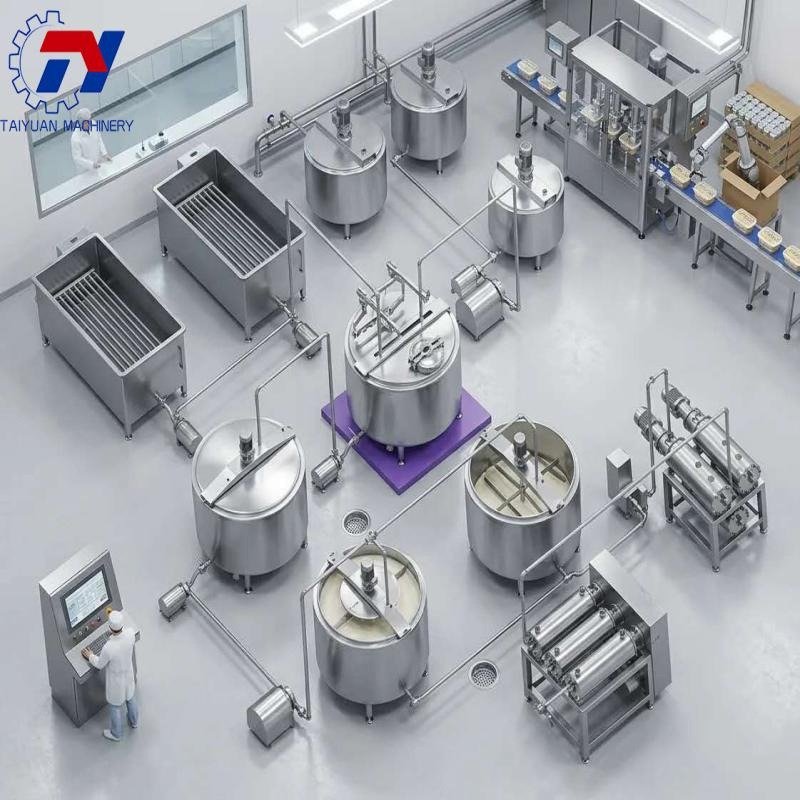
Production line and factory setup overview
A dairy-fat line that receives released cream or separates it from milk, pasteurizes cream, cools and physically ripens it, batch churns to butter grains, drains and works the butter, and either packs butter under refrigeration or melts and clarifies a separate portion into ghee before hot filling. Butter and ghee are related but distinct process branches.
Recommended lowest-entry line configuration For the lowest credible entry, buy released cream, use a 100-300 L cream pasteurizing/ripening tank, 50-100 kg/batch butter churn, manual butter working and wrapping table, and a separate 50-100 L jacketed ghee kettle with settling/filtering and semi-automatic jar filling. Launch either butter or ghee first, then validate the second branch.
Production process and implementation sequence
- Released cream receiving and tests
- Cream pasteurization and cooling
- Physical ripening at controlled temperature
- Batch churning and butter-grain formation
- Buttermilk drainage and butter working
- Butter forming and refrigerated packing branch
- Ghee melting, clarification and filtration branch
- Jar filling, coding, cooling and release
Products, capacity and market fit
- Afghan cream can be converted into familiar butter and shelf-stable ghee.
- Buying released cream avoids separator cost at the smallest scale.
- Ghee can reduce cold-chain dependence after validated clarification and packaging.
- Buttermilk is a distinct by-product requiring a safe outlet and cold handling.
- Sweet-cream butter - Declared fat, moisture and salt; clean flavor and refrigerated pack - Retail, bakeries, hotels and food service
- Dairy ghee - Clarified milk fat with controlled moisture, filtration, oxidation and sealed jar - Retail, restaurants and confectionery
Core production machinery and line specifications
| Machine / stage | Function / value | Production note |
|---|---|---|
| Cream receiving and pasteurizing tank | Receives, heats and cools released cream | 100-300 L entry |
| Cream ripening tank | Controls crystallization before churning | Recorded time and temperature |
| Batch butter churn | Breaks the cream emulsion and forms butter grains | 50-100 kg/batch entry |
| Butter working and forming table | Drains, works and portions butter | Manual hygienic launch |
| Butter wrapper or vacuum packer | Protects refrigerated butter portions | One launch size |
| Jacketed ghee kettle | Melts butter and removes moisture under control | 50-100 L/batch separate branch |
| Settling/filtering and hot filler | Clarifies and fills ghee jars | Heat-compatible one-size jars |
| CIP, cold room and quality tools | Supports cleaning and butter storage | Branch-specific controls |
Raw materials, utilities and factory requirements
- Released dairy cream or milk with separator only in expanded scope
- Food-grade salt only for declared salted butter
- Heat-compatible ghee jars, butter wraps, labels and cartons
- Approved dairy detergents and filter media
- Stable electricity matched to motors, controls and refrigeration
- Potable process and cleaning water
- Washable food-grade rooms with drainage and pest control
- Segregated raw-milk, ingredients, packaging and finished-goods areas
- Steam or hot water, chilled water and compressed air only where specified
Indicative low-entry investment and implementation plan
These planning ranges prioritize economical machinery, local labor and local civil works. Final pricing follows confirmed capacity, product specification, delivery terms and site conditions.
| Scope | Indicative range | Entry-plan note |
|---|---|---|
| Cream pasteurizing and ripening | US$6k-15k | Purchased released cream |
| Butter churn and working tools | US$5k-13k | 50-100 kg/batch |
| Ghee kettle, filter and filler | US$4k-10k | Added only for ghee branch |
| Packing, CIP and quality tools | US$4k-10k | One launch product |
| Freight, installation and spares | US$4k-10k | Heating and refrigeration confirmed |
| Indicative low-entry total | US$23k-58k | Cream separator, building and working stock excluded |
Detailed proposal and next step
The proposal contains the complete line flow, machinery scope, raw-material and utility requirements, implementation stages and indicative entry planning. Final configuration follows confirmed products, capacity, site and budget.