
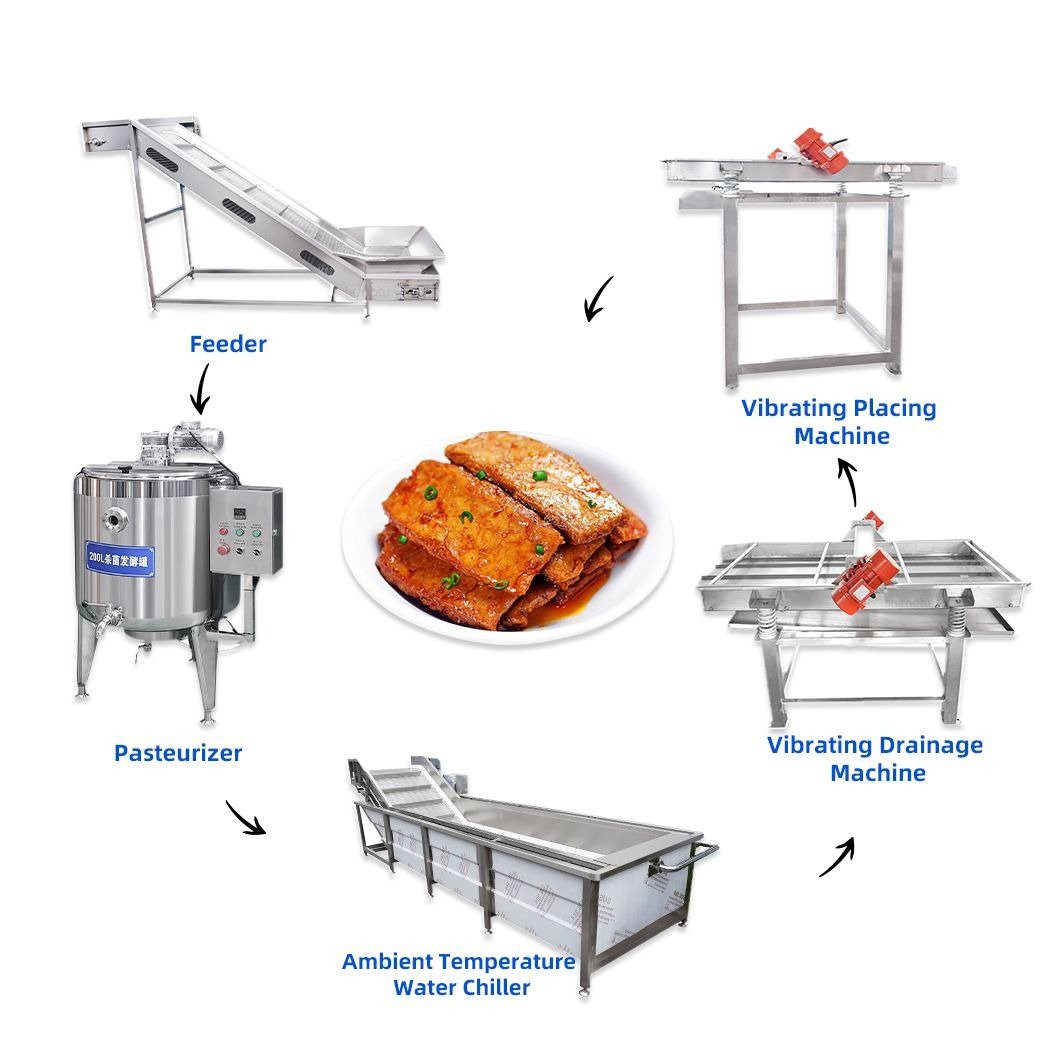
Production line and factory setup overview
This compact line converts released edible kernels into smooth or crunchy nut butter through inspection, optional recipe-specific roasting, cooling, coarse grinding, fine colloid milling, controlled blending, vacuum deaeration and filling. Almond, walnut and mixed recipes require separate validation because oil release and oxidation differ.
Recommended lowest-entry line configuration For the lowest credible entry, select a 50-100 kg/h line with inspection table, small batch roaster, cooler, coarse grinder, colloid mill, jacketed blend tank, vacuum deaerator and semi-automatic jar filler.
Production process and implementation sequence
- Kernel receiving, inspection and allergen control
- Recipe-specific roasting or raw approval
- Rapid cooling
- Coarse grinding
- Fine colloid milling
- Ingredient dosing and jacketed blending
- Vacuum deaeration and texture verification
- Jar filling, closing, coding and release
Products, capacity and market fit
- Afghan kernels can become higher-value branded spreads.
- A compact line supports almond, walnut and declared blends.
- Two-stage grinding gives controllable texture.
- Small batches reduce inventory and recipe risk.
- Almond butter - Smooth or crunchy buyer-approved texture and roast - Retail, bakery and hospitality buyers
- Walnut butter - Oxidation-controlled recipe with declared ingredients - Premium retail and bakery buyers
- Mixed-nut butter - Declared nut percentages and allergen label - Retail and institutional buyers
Core production machinery and line specifications
| Machine / stage | Function / value | Production note |
|---|---|---|
| Kernel inspection table | Rejects shell, rancid and defective kernels | Allergen-controlled clean area |
| Small batch roaster | Applies recipe-specific roast | Bypass for approved raw recipe |
| Cooling conveyor | Stops roasting before grinding | Filtered air |
| Coarse nut grinder | Prepares paste feed | Low-temperature contact |
| Colloid mill | Refines butter texture | Adjustable 20-80 micrometre range |
| Jacketed blend tank | Adds declared ingredients | Temperature and agitation control |
| Vacuum deaerator | Reduces entrained air and oxidation | Sized for paste viscosity |
| Semi-automatic jar filler | Fills and closes butter | One or two jar sizes |
Raw materials, utilities and factory requirements
- Released edible Afghan almond and walnut kernels
- Only declared food-grade ingredients
- Food-grade jars, lids, labels and cartons
- Allergen changeover materials
- Stable three-phase electricity
- Food-grade heat source where required
- Clean compressed air where specified
- Ventilated washable processing room
- Dry allergen-controlled packing and storage
Indicative low-entry investment and implementation plan
These planning ranges prioritize economical machinery, local labor and local civil works. Final pricing follows confirmed capacity, product specification, delivery terms and site conditions.
| Scope | Indicative range | Entry-plan note |
|---|---|---|
| Inspection, roasting and cooling | US$4k-10k | 50-100 kg/h entry |
| Coarse and colloid grinding | US$5k-12k | Two-stage texture control |
| Blending and vacuum deaeration | US$5k-11k | Small jacketed batch |
| Jar filling and quality tools | US$3k-8k | Semi-automatic launch |
| Freight, installation and spares | US$4k-9k | Confirm paste pumps and seals |
| Indicative low-entry total | US$21k-50k | Building, kernels and working capital excluded |
Detailed proposal and next step
The proposal contains the complete line flow, machinery scope, raw-material and utility requirements, implementation stages and indicative entry planning. Final configuration follows confirmed products, capacity, site and budget.