
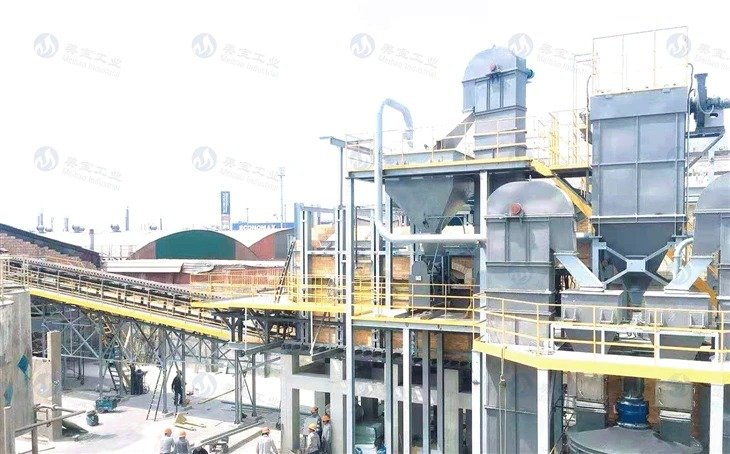
Production line and factory setup overview
A medium industrial dry-process plant producing solid sodium silicate from qualified silica sand and soda ash through laboratory recipe control, closed storage and gravimetric batching, intensive mixing, continuous feeding to a regenerative high-temperature furnace, fusion at approximately 1,350-1,450°C, combustion and flue-gas control, molten-glass discharge, enclosed air or water quenching, crushing and sizing, chemistry/modulus testing and bulk or bag packing. This is a furnace project, not a workshop mixer.
Recommended lowest-entry line configuration Do not publish a low-cost workshop offer. Begin only with a bankable pre-feasibility study for a 10 t/day dry-process furnace tied to independently characterized Afghan silica, reliable soda-ash supply, continuous fuel, cooling water, refractory service, emission permitting and a confirmed detergent, foundry or construction-chemical buyer. Require a complete installed-cost and guaranteed mass/energy balance before commitment.
Production process and implementation sequence
- Silica, soda ash and market qualification
- Closed storage and gravimetric batching
- Intensive dry mixing
- Regenerative-furnace feeding and fusion
- Combustion and flue-gas treatment
- Molten discharge and enclosed quenching
- Crushing, sizing and chemistry release
- Bulk or bag packing and traceability
Products, capacity and market fit
- Afghan silica may provide local feed value after chemical and mineralogical qualification.
- Sodium silicate serves detergents, foundry binders, construction chemicals and other industry.
- High furnace temperature makes fuel, refractory life and emissions decisive.
- A 10 t/day project needs assured buyers and specialist engineering before machinery purchase.
- Solid sodium silicate cullet or granules - Declared SiO2/Na2O modulus, solids, insolubles, iron, density, particle size and moisture - Qualified detergent, foundry or construction-chemical buyers
Core production machinery and line specifications
| Machine / stage | Function / value | Production note |
|---|---|---|
| Silica and soda-ash silos with batching | Meters controlled furnace batch | One modulus |
| Intensive mixer and enclosed furnace feeder | Homogenizes and delivers batch | 10 t/day basis |
| Regenerative reverberatory furnace | Fuses silica and soda ash | 1,350-1,450°C |
| Burner, heat recovery and flue-gas system | Controls energy and emissions | Guaranteed balance |
| Enclosed air/water quench and crusher | Solidifies and sizes glass | Safe molten handling |
| Chemical laboratory and packing line | Releases modulus and purity | Bulk or bags |
Raw materials, utilities and factory requirements
- Chemically qualified low-iron silica sand
- Certified dense soda ash
- Refractory, burner and filter consumables
- Bulk bags or moisture-resistant sacks
- Stable three-phase electricity with verified connected load
- Guarded machinery, lockout, ventilation and fire protection
- Covered segregated raw-material and finished-goods storage
- Maintenance tools, safe lifting and critical spare parts
- Continuous contracted furnace fuel and backup power
- Industrial cooling/quench-water system with treatment
Indicative low-entry investment and implementation plan
These planning ranges prioritize economical machinery, local labor and local civil works. Final pricing follows confirmed capacity, product specification, delivery terms and site conditions.
| Scope | Indicative range | Entry-plan note |
|---|---|---|
| Storage, batching and feed preparation | US$180k-420k | 10 t/day basis |
| Furnace, burners, refractory and heat recovery | US$700k-1.7m | Installed hot section |
| Quench, crushing, emission control and laboratory | US$280k-720k | Product and environmental systems |
| Freight, civil works, utilities and commissioning | US$350k-900k | EPC study required |
| Indicative project-screening total | US$1.51m-3.74m | Land, finance and working stock excluded |
Detailed proposal and next step
The proposal contains the complete line flow, machinery scope, raw-material and utility requirements, implementation stages and indicative entry planning. Final configuration follows confirmed products, capacity, site and budget.