
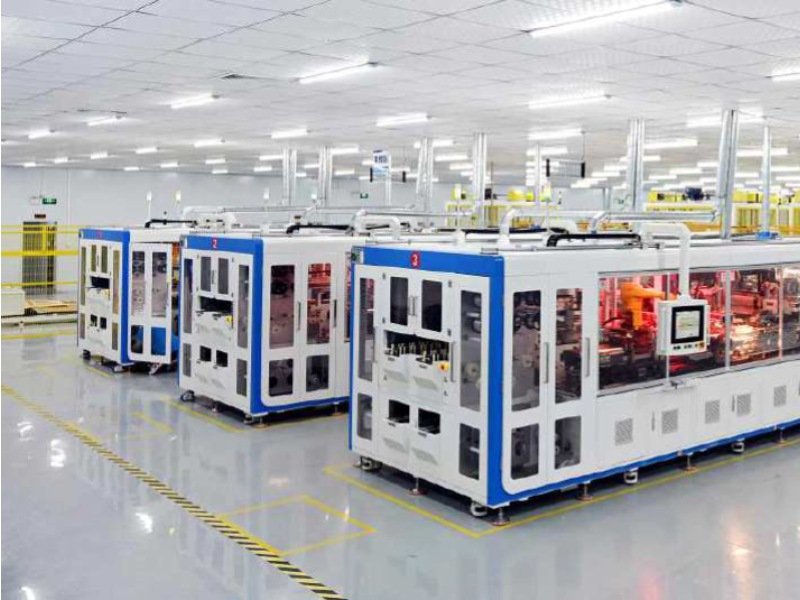
Production line and factory setup overview
A module-assembly factory converting purchased qualified cells, glass, EVA/POE, backsheets, frames, junction boxes and cables into a defined photovoltaic module family through cell sorting, stringing, lay-up, lamination, trimming, framing, junction-box potting, EL inspection, flash testing, hi-pot testing and packing. It does not manufacture solar cells.
Recommended lowest-entry line configuration Start with one 20-50 MW mono module format. Validate tier-qualified cell supply, clean dry assembly area, lamination recipe, EL/flash-test calibration, warranty reserve, traceability, IEC certification route and contracted distributors or EPC buyers.
Production process and implementation sequence
- Incoming cell and glass inspection
- Cell sorting, stringing and bussing
- Lay-up and vacuum lamination
- Trimming, framing and junction-box assembly
- EL, flash, hi-pot and visual inspection
- Serialisation, packing and warranty records
Products, capacity and market fit
- Module assembly can localise frames, labour and distribution while cells remain imported.
- Cell quality, lamination recipe and EL testing decide long-term warranty risk.
- One module format controls inventory and certification cost.
- Crystalline PV modules - Wattage, cell format, efficiency, EL defects, insulation, flash-test result and serial traceability - Afghan solar EPCs, distributors, telecom and commercial power buyers
Core production machinery and line specifications
| Machine / stage | Function / value | Production note |
|---|---|---|
| Cell tester, stringer and lay-up station | Builds repeatable cell strings | One module format |
| Vacuum laminator and trimming | Encapsulates module stack | Validated lamination recipe |
| Frame/junction-box assembly | Completes protected module | Approved frame and box |
| EL, flash and hi-pot testers | Releases safe rated output | Calibrated acceptance tests |
Raw materials, utilities and factory requirements
- Tier-qualified solar cells, tempered glass, EVA/POE, backsheets, frames and junction boxes
- Cables, sealants, labels, cartons and pallets
- Stable three-phase electricity with verified connected load
- Guarded machinery, lockout, ventilation and fire protection
- Covered raw-material and finished-goods storage
- Maintenance tools, safe lifting and critical spare parts
- Clean dry assembly, stable power, compressed air and test-equipment calibration
- ESD controls, glass handling, adhesive ventilation and serialised traceability
Indicative low-entry investment and implementation plan
These planning ranges prioritize economical machinery, local labor and local civil works. Final pricing follows confirmed capacity, product specification, delivery terms and site conditions.
| Scope | Indicative range | Entry-plan note |
|---|---|---|
| Stringing, lay-up and lamination | US$500k-1.5m | 20-50 MW/year |
| Framing, junction boxes, EL/flash testing | US$350k-1m | One module format |
| Clean area, certification, installation and spares | US$250k-800k | Warranty quality system |
| Indicative project total | US$1.1m-3.3m | Land and cell working capital excluded |
Detailed proposal and next step
The proposal contains the complete line flow, machinery scope, raw-material and utility requirements, implementation stages and indicative entry planning. Final configuration follows confirmed products, capacity, site and budget.