
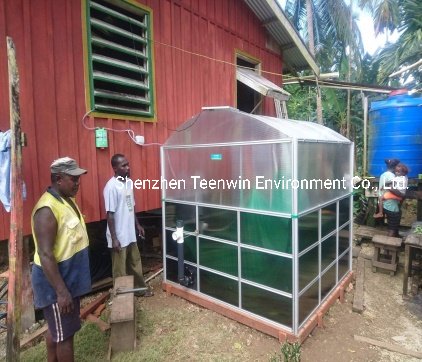
Production line and factory setup overview
A micro/small fabrication and kit-assembly line producing one flexible household biogas-digester size from certified reinforced PVC-coated membrane through incoming roll inspection, digital patterning, guarded cutting, high-frequency or hot-wedge seam welding, port and reinforcement welding, dimensional inspection, low-pressure inflation and soap/decay leak testing, valve-hose-stove kit assembly, serial marking, user instructions and compact packing. It manufactures the digester kit; it does not operate a biogas farm.
Recommended lowest-entry line configuration Start with one 4-6 m3 flexible household kit and buy certified membrane, valves, hose, desulfurizer, pressure relief and stove components. Use one programmable cutting table or templates, one suitable HF/hot-wedge welder with proven seam width, port fixtures, a protected inflation/leak-test bay and traceable kit packing. Field-pilot at least 20 units through an Afghan winter and summer before volume sales.
Production process and implementation sequence
- Membrane and component incoming inspection
- Pattern nesting and guarded cutting
- Panel seam welding
- Port and reinforcement attachment
- Dimensional and visual inspection
- Low-pressure inflation/leak test
- Valve, hose, relief and stove kit assembly
- Serial marking, instructions and packing
Products, capacity and market fit
- Livestock manure is locally available in many Afghan rural households.
- A compact kit can reduce transport cost compared with rigid digesters.
- Local membrane cutting and kit assembly can support repair and spare parts.
- Gas-tight seams, pressure relief, safe stove use and cold-weather performance are essential.
- Flexible household biogas-digester kit - Volume, membrane type/thickness, seam strength, leak rate, ports, relief, gas cleaning, hose, stove and installation manual - Rural households and small livestock farms after monitored field pilot
Core production machinery and line specifications
| Machine / stage | Function / value | Production note |
|---|---|---|
| Roll inspection and pattern system | Controls membrane identity and yield | One 4-6 m3 design |
| Guarded membrane cutting table | Cuts repeatable panels | Templates or digital cutter |
| HF or hot-wedge welding equipment | Makes gas-tight structural seams | Qualified weld recipe |
| Port/reinforcement fixtures | Attaches inlet, outlet and gas ports | Pull-tested |
| Protected inflation/leak-test bay | Tests every completed digester | Low-pressure decay and soap test |
| Kit assembly and traceability station | Completes safe user package | Valves, relief, hose and stove |
Raw materials, utilities and factory requirements
- Certified UV- and biogas-resistant reinforced PVC membrane
- Qualified ports, valves, pressure relief, hose and clamps
- Desulfurizer, condensate trap and approved low-pressure stove
- Repair patches, labels, manuals and cartons
- Stable three-phase electricity with verified connected load
- Guarded machinery, lockout, ventilation and fire protection
- Covered segregated raw-material and finished-goods storage
- Maintenance tools, safe lifting and critical spare parts
- Clean membrane workshop without sharp contamination
- Ventilated isolated low-pressure test bay; no ignition sources
Indicative low-entry investment and implementation plan
These planning ranges prioritize economical machinery, local labor and local civil works. Final pricing follows confirmed capacity, product specification, delivery terms and site conditions.
| Scope | Indicative range | Entry-plan note |
|---|---|---|
| Cutting, welding and port fixtures | US$12k-32k | One 4-6 m3 design |
| Inflation/leak testing and safety tools | US$6k-16k | Every-unit test |
| Kit assembly, manuals and pilot tooling | US$5k-13k | Purchased accessories |
| Freight, training and spares | US$5k-12k | 20-unit field pilot |
| Indicative installed low-entry total | US$28k-73k | Building, membrane and component stock excluded |
Detailed proposal and next step
The proposal contains the complete line flow, machinery scope, raw-material and utility requirements, implementation stages and indicative entry planning. Final configuration follows confirmed products, capacity, site and budget.