
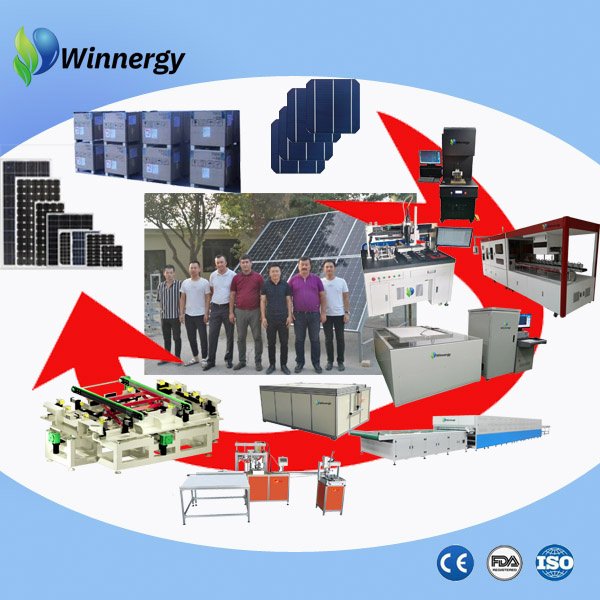
Production line and factory setup overview
A medium quality-controlled assembly line converting imported matched crystalline-silicon cells, solar glass, encapsulant, backsheet, frames and junction boxes into one photovoltaic module family through incoming electroluminescence and power binning, cell cutting only if specified, tabbing and stringing, manual layup, pre-lamination EL inspection, vacuum lamination, trimming, framing and junction-box bonding, curing, electrical-safety tests, final EL, solar-simulator flash classification, visual inspection and packing.
Recommended lowest-entry line configuration Launch one framed 144 half-cell module design at roughly 5-10 MW/year using imported matched cells and a semi-manual line. Include supported tabber-stringer, layup tables, two EL stations, vacuum laminator, framing/junction-box fixtures, curing, hipot/ground/bypass-diode tests and a calibrated AAA solar simulator. A soldering table without EL, lamination control and flash classification is not a bankable module factory.
Production process and implementation sequence
- Incoming BOM inspection and cell binning
- Cell tabbing/stringing
- Manual layup and interconnection
- Pre-lamination EL inspection
- Vacuum lamination and trimming
- Framing, junction box and curing
- Electrical safety and final EL
- Calibrated flash classification and packing
Products, capacity and market fit
- Afghanistan imports large quantities of solar modules.
- Local assembly can shorten delivery and customize module/branding only if quality is proven.
- One bill of materials and power class simplify traceability.
- EL, lamination, electrical safety and calibrated flash testing are essential for warranty credibility.
- Framed crystalline-silicon PV module - Cell/BOM, dimensions, nominal power, efficiency, insulation, wet leakage, EL acceptance, flash tolerance, mechanical load and traceability - Afghan solar distributors and project integrators
Core production machinery and line specifications
| Machine / stage | Function / value | Production note |
|---|---|---|
| Cell inspection and tabber-stringer | Bins and interconnects cells | One 144-half-cell design |
| Layup tables and bussing tools | Builds module circuit and sandwich | ESD/traceability control |
| Pre/post EL testers | Detects cracks and inactive areas | Two quality gates |
| Vacuum laminator | Encapsulates circuit | Recipe logged |
| Framing/J-box and curing stations | Completes mechanical/electrical assembly | Adhesive controlled |
| Safety testers and AAA solar simulator | Releases safety and power class | Calibrated reference module |
Raw materials, utilities and factory requirements
- Matched mono crystalline cells by power/current bin
- Solar glass, EVA/POE encapsulant and qualified backsheet
- Tinned ribbon, busbar, flux and approved sealants
- Aluminium frames, junction boxes, cables, connectors and labels
- Stable three-phase electricity with verified connected load
- Guarded machinery, lockout, ventilation and fire protection
- Dry segregated raw-material and finished-goods storage
- Maintenance tools, safe lifting and critical spare parts
- Clean temperature/humidity-controlled layup and material rooms
- ESD controls, compressed air and calibrated electrical laboratory
Indicative low-entry investment and implementation plan
These planning ranges prioritize economical machinery, local labor and local civil works. Final pricing follows confirmed capacity, product specification, delivery terms and site conditions.
| Scope | Indicative range | Entry-plan note |
|---|---|---|
| Stringing, layup and EL equipment | US$95k-220k | Semi-manual 5-10 MW/year |
| Laminator, framing and curing | US$85k-210k | One module envelope |
| Safety/flash laboratory and calibration | US$70k-180k | AAA simulator basis |
| Freight, clean-room services and spares | US$55k-140k | Pilot-lot commissioning |
| Indicative installed project total | US$305k-750k | Building, certification and BOM inventory excluded |
Detailed proposal and next step
The proposal contains the complete line flow, machinery scope, raw-material and utility requirements, implementation stages and indicative entry planning. Final configuration follows confirmed products, capacity, site and budget.