
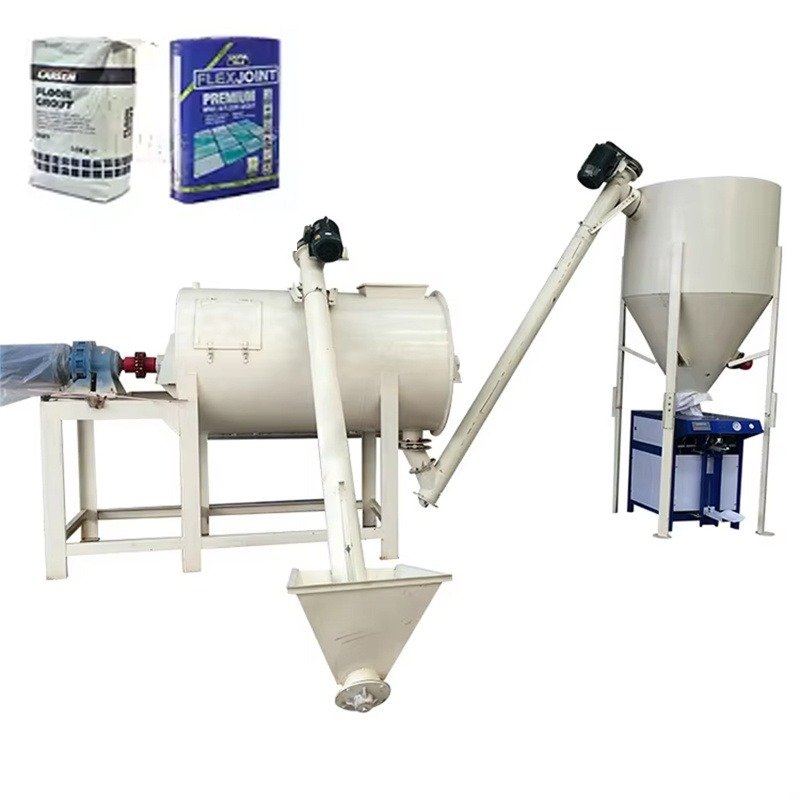
Production line and factory setup overview
A small dry-powder plant producing one validated interior wall putty or cementitious skim coat from released gypsum or cement binder, calcium-carbonate filler, controlled fine mineral powder and precisely weighed functional additives. The route covers dry receiving, screening, major and micro dosing, uniform mixing, dust-contained transfer, valve-bag filling, coding, palletising, laboratory release and dry storage. Gypsum and cement recipes are not interchangeable.
Recommended lowest-entry line configuration Launch one interior product after local wall-substrate trials. Screen a 1-3 t/h line with three major-ingredient scales, a locked micro-additive bench, 1,000-1,500 L ribbon mixer, finished bin, pulse dust collector, 20-25 kg valve packer and a small application laboratory. Buy dry screened minerals initially; add grinding or drying only after demand and feed tests justify it.
Production process and implementation sequence
- Dry binder and filler receiving and release
- Screening and foreign-matter control
- Calibrated major-ingredient batching
- Locked micro-additive weighing
- Controlled charging and ribbon mixing
- Finished-powder buffering and dust extraction
- Valve-bag filling, check weighing and coding
- Application testing, palletising and dry storage
Products, capacity and market fit
- Afghan gypsum and calcium carbonate can supply much of the product mass when purity and fineness are controlled.
- Factory micro-dosing improves consistency over site-mixed finishing compounds.
- One interior formula keeps additive stock, claims and laboratory work manageable.
- Adhesion, sanding, cracking and shelf life must be proven on local substrates.
- Interior wall putty - Approved binder route, fineness, water demand, workability, sanding, adhesion, shrinkage and colour - Painters, plasterers, contractors and building-material distributors
- Cementitious skim coat - Separate moisture-resistant formula and substrate validation - Masonry and concrete finishing after independent trials
Core production machinery and line specifications
| Machine / stage | Function / value | Production note |
|---|---|---|
| Major-ingredient bins and scales | Meters binder and mineral fillers | Three controlled streams |
| Locked micro-additive station | Weighs cellulose, polymer and modifiers | Recipe-specific precision |
| Ribbon or ploughshare mixer | Distributes low-dose ingredients uniformly | 1,000-1,500 L |
| Finished-product bin | Buffers powder without segregation | Anti-bridging design |
| Pulse dust collector | Contains respirable mineral dust | Dosing, mixing and packing extraction |
| Valve-bag packer and check scale | Fills controlled retail sacks | 20-25 kg launch |
| Application laboratory | Tests workability and wall performance | Local plaster/concrete panels |
Raw materials, utilities and factory requirements
- Released gypsum or cement binder for the selected formula
- Controlled calcium carbonate and other fine mineral filler
- Qualified cellulose ether, polymer and formulation additives
- Moisture-barrier valve bags, pallets, wrap, labels and spares
- Stable three-phase electricity and compressed air
- Dry humidity-controlled raw and finished storage
- Enclosed transfer and respirable-dust controls
- Laboratory water, curing panels and controlled test room
Indicative low-entry investment and implementation plan
These planning ranges prioritize economical machinery, local labor and local civil works. Final pricing follows confirmed capacity, product specification, delivery terms and site conditions.
| Scope | Indicative range | Entry-plan note |
|---|---|---|
| Dosing, conveyors and mixer | US$11k-28k | 1-3 t/h dry-mineral basis |
| Buffer, dust collection and packer | US$8k-19k | One bag format |
| Laboratory, utilities and pallets | US$5k-13k | One interior formula |
| Freight, installation, trials and spares | US$6k-17k | Local labour basis |
| Indicative installed low-entry total | US$30k-77k | Building and working capital excluded |
Detailed proposal and next step
The proposal contains the complete line flow, machinery scope, raw-material and utility requirements, implementation stages and indicative entry planning. Final configuration follows confirmed products, capacity, site and budget.