
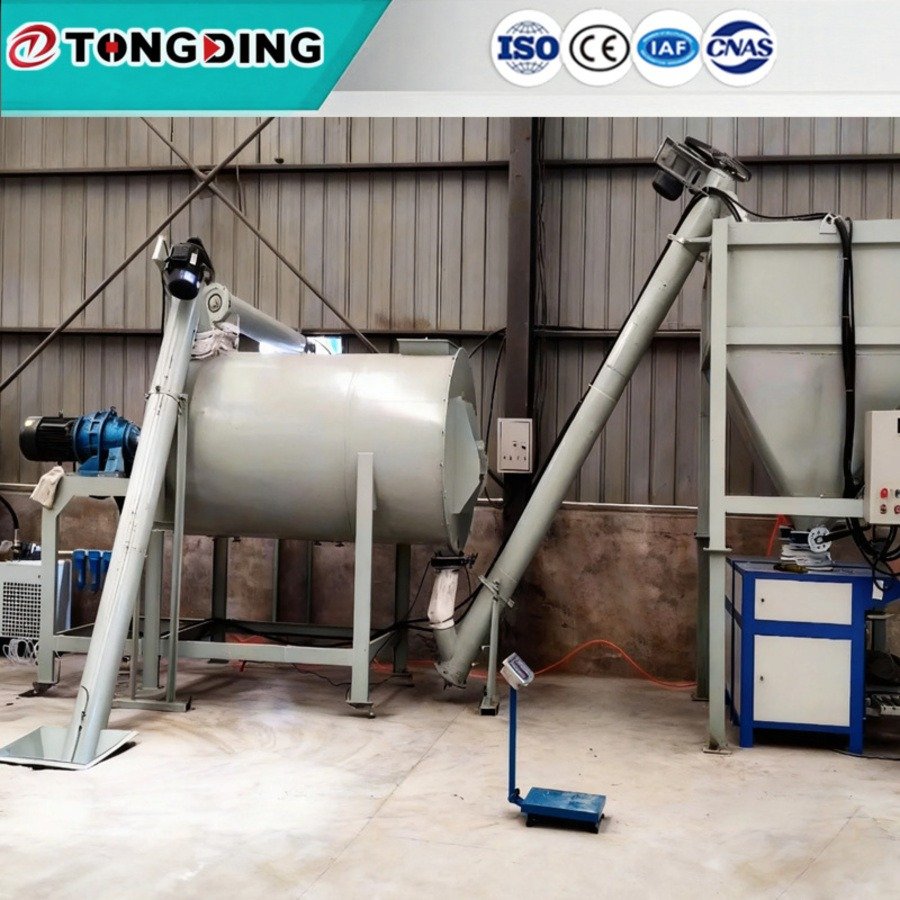
Production line and factory setup overview
A small/medium specialty dry-mix line producing cementitious tile adhesive from released dry graded sand, cement, calcium-carbonate filler and precisely dosed redispersible polymer, cellulose ether and approved functional additives. The process includes dry storage, calibrated major and micro batching, high-uniformity low-shear mixing, finished buffering, dust-controlled valve-bag filling, coding, palletizing, retention samples, bond-performance testing and dry storage. It does not produce liquid or epoxy adhesive.
Recommended lowest-entry line configuration Launch one economy cementitious adhesive for one common ceramic tile and substrate, formulated by a qualified dry-mix technologist. Screen a 1-2 t/h cell with sand/cement/filler scales, a locked 1-20 kg micro-dosing booth, 1,000 L ribbon mixer, finished bin, dust collector, 20-25 kg valve packer and a laboratory capable of open time, slip, tensile adhesion and water/heat conditioning. Imported additives must be budgeted as working capital.
Production process and implementation sequence
- Ingredient receiving, quarantine and release
- Dry sand, cement and filler weighing
- Locked polymer/additive micro-weighing
- Controlled charging and batch mixing
- Uniformity check and finished buffering
- Dust-controlled valve-bag filling
- Weight check, coding and palletizing
- Bond-performance release, samples and dry storage
Products, capacity and market fit
- Local sand, cement and filler can supply most of the product mass.
- Factory dosing makes polymer and cellulose additions more consistent than site-mixed bonding mortar.
- One tile/substrate claim keeps validation and warranty exposure controlled.
- Adhesion claims require laboratory and field evidence; the machine supplier cannot provide the final formula guarantee.
- Economy cementitious tile adhesive - Defined tile and substrate, water demand, pot life, open time, slip and tensile adhesion before/after conditioning - Residential ceramic-tile installers and distributors
- Improved adhesive expansion - Separate polymer level, tile size and conditioning tests - Only after laboratory and site validation
Core production machinery and line specifications
| Machine / stage | Function / value | Production note |
|---|---|---|
| Dry sand/cement/filler scales | Meters major ingredients accurately | Recipe-specific batching |
| Locked micro-additive booth | Controls expensive low-dose polymer and cellulose | 1-20 kg calibrated range |
| Low-shear ribbon mixer | Distributes powders without damaging additives | 1,000 L entry batch |
| Enclosed screw/elevator transfer | Moves mix with low segregation | Dust-contained route |
| Finished-product buffer bin | Feeds packer consistently | Anti-bridging design |
| Pulse dust collector | Contains cement, silica and polymer dust | Dosing/mixing/packing extraction |
| Valve packer and check scale | Fills 20-25 kg adhesive bags | Recorded net weight |
| Tile-adhesive laboratory | Tests application and tensile adhesion | Named standards and conditioning |
Raw materials, utilities and factory requirements
- Dry graded low-clay sand, released cement and calcium-carbonate filler
- Qualified redispersible polymer powder and cellulose ether
- Only formulation-approved starch ether, defoamer or other additives
- Moisture-barrier valve bags, pallets, wrap, labels and mixer/filter spares
- Dry humidity-controlled ingredients and finished-goods warehouse
- Stable three-phase power and compressed air
- Dust extraction and respirable-silica protection
- Laboratory mixing, tile/substrate conditioning and tensile-pull equipment
- Secure temperature-controlled storage for costly imported additives
Indicative low-entry investment and implementation plan
These planning ranges prioritize economical machinery, local labor and local civil works. Final pricing follows confirmed capacity, product specification, delivery terms and site conditions.
| Scope | Indicative range | Entry-plan note |
|---|---|---|
| Major/micro batching and 1,000 L mixer | US$13k-32k | One formula basis |
| Buffer, dust collection and valve packer | US$8k-20k | 20-25 kg bags |
| Adhesion laboratory and utilities | US$7k-18k | Essential product validation |
| Freight, installation, formula trials and spares | US$7k-18k | Dry-sand input basis |
| Indicative installed low-entry total | US$35k-88k | Building, additives and working capital excluded |
Detailed proposal and next step
The proposal contains the complete line flow, machinery scope, raw-material and utility requirements, implementation stages and indicative entry planning. Final configuration follows confirmed products, capacity, site and budget.