
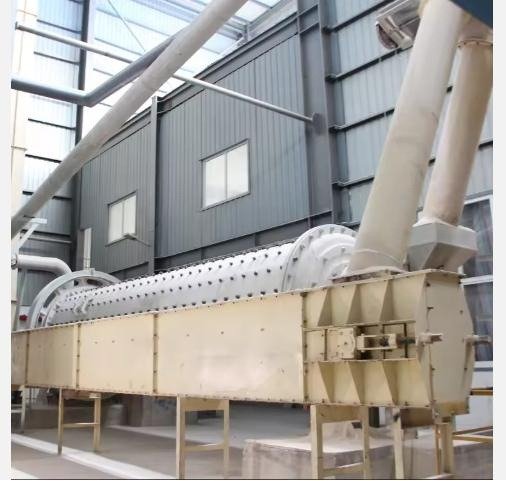
Production line and factory setup overview
A medium-industrial mineral-processing line converting tested natural gypsum rock into controlled plaster powder through covered receiving, primary crushing, drying where required, controlled grinding, calcination to remove chemically bound water, cooling and ageing, fine grinding and classification, optional recipe blending, dust-controlled silo storage, laboratory release and valve-bag packing. It is a calcined-plaster plant, not merely a stone mill.
Recommended lowest-entry line configuration Begin only after deposit sampling proves gypsum purity and harmful salts. Screen one 2-4 t/h line with jaw/hammer crushing, feed bin, Raymond or vertical mill, indirect or boiling-furnace calciner, cooler, ageing silo, classifier, dust collectors, one product silo, 25-40 kg valve-bag packer and a plaster laboratory. Contract product setting time and strength before equipment selection.
Production process and implementation sequence
- Gypsum receiving, sampling and covered storage
- Primary crushing and controlled feed
- Drying where feed moisture requires it
- Grinding and particle-size control
- Controlled calcination to plaster
- Cooling, ageing and final classification
- Recipe blending and laboratory release
- Silo storage, valve-bag packing and palletizing
Products, capacity and market fit
- Afghan gypsum deposits can support local wall-plaster, block and moulding industries when chemistry is consistent.
- Calcination control—not grinding alone—determines setting time, water demand and strength.
- A 2-4 t/h modular plant limits fuel and inventory exposure while building contractor confidence.
- Dust containment and sealed dry storage protect workers and preserve product quality.
- General building plaster - Buyer-approved fineness, setting time, water demand, strength, soundness and moisture - Plasterers, dry-mix producers and building-material distributors
- Gypsum-block or moulding plaster - Separate controlled setting and strength recipe after trials - Gypsum block and decorative-cornice workshops
Core production machinery and line specifications
| Machine / stage | Function / value | Production note |
|---|---|---|
| Receiving hopper, crusher and metal protection | Reduces tested gypsum rock to stable mill feed | Deposit-specific top size |
| Dryer or hot-gas feed system | Controls excess feed moisture where required | Install after moisture study |
| Raymond or vertical grinding mill | Produces controlled calciner feed | 2-4 t/h product basis |
| Boiling or indirect calcination system | Converts gypsum dihydrate to plaster hemihydrate | Temperature and residence control |
| Cooler, ageing silo and classifier | Stabilizes plaster and controls fineness | One launch grade |
| Baghouse and sealed conveyors | Captures fine combustible-free mineral dust | Negative-pressure transfers |
| Product silo and valve-bag packer | Stores and packs released plaster | 25-40 kg bags |
| Gypsum/plaster laboratory | Tests chemistry, setting and strength | Buyer-agreed methods |
Raw materials, utilities and factory requirements
- Tested natural gypsum rock with controlled purity, moisture, clay and soluble salts
- Fuel selected for calciner design and reliable local supply
- Approved setting-control additives only after formulation trials
- Valve bags, pallets, wrap, labels, filters, grinding parts and critical spares
- Stable three-phase power and transformer/motor-starting study
- Reliable calciner fuel, combustion controls and safe fuel storage
- Covered dry raw-material and finished-product storage
- Dust extraction at crusher, mill, silos and packing points
- Laboratory water, compressed air and fire/emergency systems
Indicative low-entry investment and implementation plan
These planning ranges prioritize economical machinery, local labor and local civil works. Final pricing follows confirmed capacity, product specification, delivery terms and site conditions.
| Scope | Indicative range | Entry-plan note |
|---|---|---|
| Crushing, drying and grinding section | US$180k-480k | 2-4 t/h mineral preparation |
| Calciner, cooler, classifier and dust control | US$260k-720k | Core plaster-quality section |
| Silos, packing, laboratory and utilities | US$120k-330k | One product grade |
| Civil works, freight, erection and spares | US$180k-520k | Fuel and foundation dependent |
| Indicative installed project total | US$740k-2.05m | Quarry fleet, land, building and working capital excluded |
Detailed proposal and next step
The proposal contains the complete line flow, machinery scope, raw-material and utility requirements, implementation stages and indicative entry planning. Final configuration follows confirmed products, capacity, site and budget.