
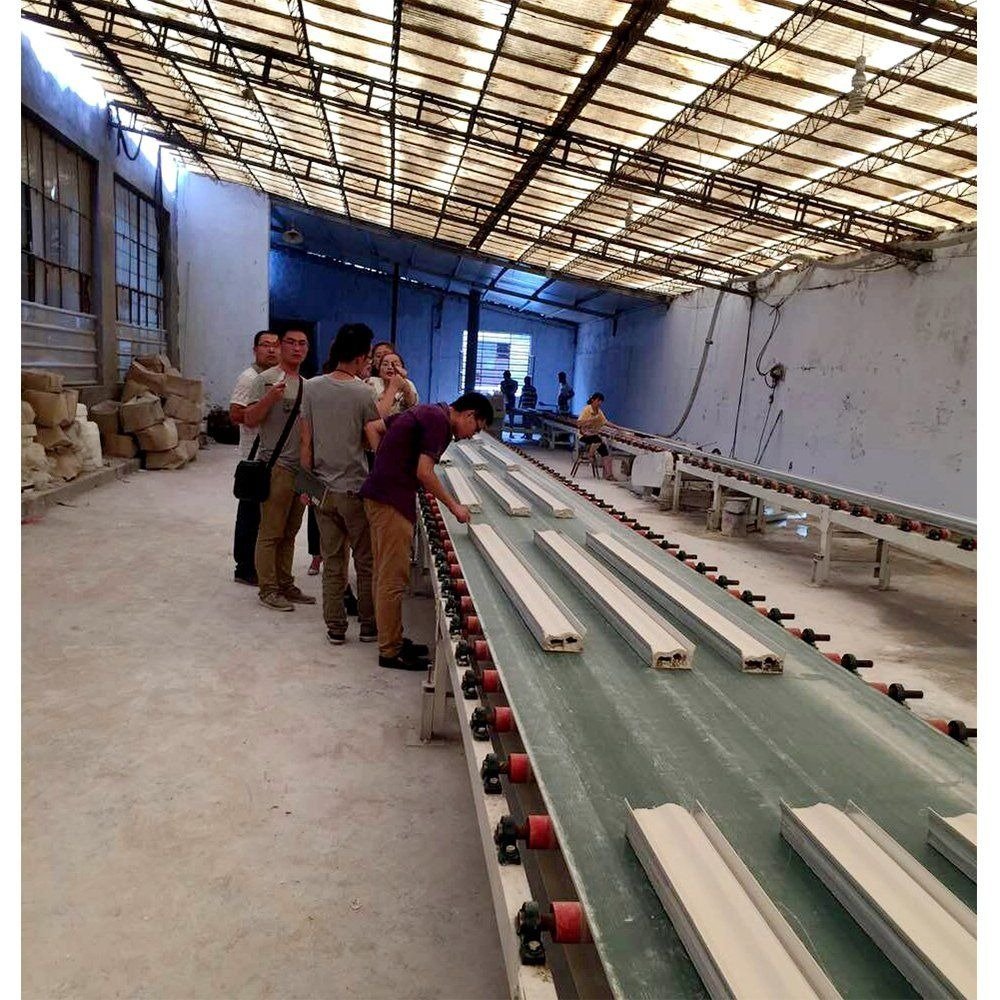
Production line and factory setup overview
A micro/workshop production cell converting released casting plaster into cornices, ceiling roses, frames and selected decorative elements through design and master-pattern preparation, silicone/FRP mould making, measured plaster and water dosing, mixing, optional glass-fibre reinforcement, manual or semi-automatic casting, vibration and deaeration, demoulding, rack drying, trimming, sanding, inspection and protected packing.
Recommended lowest-entry line configuration Start as a mould-led workshop with 8-12 proven designs, one dust-controlled plaster store, calibrated bench scales, two small mixers, vibration tables, reusable silicone/FRP moulds, straight drying racks, trimming/sanding extraction, inspection templates and padded packing. Add a continuous automatic cornice machine only after daily repeat orders justify its 30-60 metre footprint.
Production process and implementation sequence
- Design selection and master-pattern approval
- Silicone/FRP mould preparation and release
- Plaster, water and additive weighing
- Mixing and optional fibre placement
- Casting, vibration and deaeration
- Initial setting and careful demoulding
- Rack drying, trimming and sanding
- Inspection, padded packing and design-coded storage
Products, capacity and market fit
- Decorative plaster products use local design and labour while requiring modest imported machinery.
- Reusable moulds let the workshop expand designs without replacing the whole process.
- A curated 8-12 design collection is easier to sample and control than a large untested catalogue.
- Straightness, repeatable setting and careful drying determine installer acceptance.
- Gypsum cornice and coving - Approved profile, length, straightness, surface, moisture, strength and joint fit - Interior decorators, contractors and building-material shops
- Ceiling roses and decorative panels - Approved pattern depth, dimensions, finish and installation points - Residential, hospitality and ceremonial interiors
Core production machinery and line specifications
| Machine / stage | Function / value | Production note |
|---|---|---|
| Dry plaster store and bench weighing | Protects material and controls each recipe | Dust-contained manual entry |
| Two small high-speed mixers | Alternates repeat casting batches | Recipe-sized bowls |
| Silicone and FRP mould set | Forms 8-12 approved designs | Replaceable local tooling |
| Vibration/deaeration tables | Reduces trapped air and surface pinholes | Low-amplitude control |
| Casting benches and demoulding tools | Supports straight low-damage handling | Ergonomic working height |
| Level drying racks and air movement | Dries mouldings without bow or twist | Protected natural route |
| Trim/sanding extraction | Finishes joints while containing fine dust | Local exhaust |
| Inspection templates and padded packing | Controls fit and prevents transit damage | Design-coded packs |
Raw materials, utilities and factory requirements
- Fine casting gypsum plaster with stable setting time
- Clean water and validated retarders or reinforcing fibre only where required
- Silicone, FRP, release agent and master-pattern materials
- Foam separators, cartons/crates, labels, sanding consumables and mixer spares
- Single- or three-phase power according to mixer/extraction selection
- Dry humidity-controlled plaster and mould storage
- Level covered casting and rack-drying room
- Local exhaust for weighing, trimming and sanding
- Clean wash area with settled solids; no gypsum slurry to drains
Indicative low-entry investment and implementation plan
These planning ranges prioritize economical machinery, local labor and local civil works. Final pricing follows confirmed capacity, product specification, delivery terms and site conditions.
| Scope | Indicative range | Entry-plan note |
|---|---|---|
| Mixing, weighing and casting benches | US$4k-11k | Two-mixer manual cell |
| Starter moulds, vibration and drying racks | US$5k-14k | 8-12 design collection |
| Dust extraction, finishing and packing | US$3k-8k | Clean workshop scope |
| Freight, installation, training and spares | US$3k-9k | Local fixtures where suitable |
| Indicative installed low-entry total | US$15k-42k | Building, plaster stock and automatic line excluded |
Detailed proposal and next step
The proposal contains the complete line flow, machinery scope, raw-material and utility requirements, implementation stages and indicative entry planning. Final configuration follows confirmed products, capacity, site and budget.