
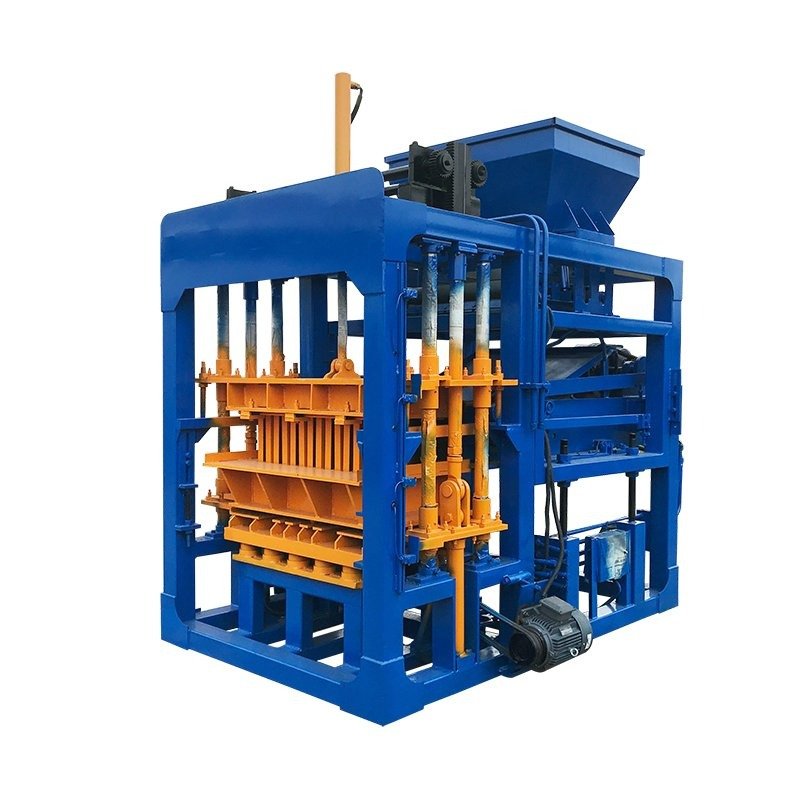
Production line and factory setup overview
A small concrete-products plant producing vibro-pressed interlocking pavers and selected curbstones from tested cement, graded sand, aggregate, water and approved pigment through aggregate storage, controlled batching, pan mixing, face-mix preparation where required, mould feeding, hydraulic vibration pressing, pallet transfer, protected curing, demoulding, dimensional and strength testing, stacking and dispatch.
Recommended lowest-entry line configuration Start with one common interlocking paver and one curb profile using separate proven moulds. Screen a semi-automatic QT4-15-class press with aggregate bins, calibrated batching, JS500 or pan mixer, conveyors, pallets, manual or simple stacker, curing racks/yard and concrete laboratory. Contract output by product dimensions and accepted pieces per shift, not theoretical machine cycles.
Production process and implementation sequence
- Aggregate and cement receiving and testing
- Calibrated dry batching and moisture correction
- Pan or forced-action mixing
- Optional coloured face-mix preparation
- Mould feeding and vibro-hydraulic compaction
- Green-product pallet transfer
- Protected moist curing and demoulding
- Dimensional, strength, abrasion and visual release
Products, capacity and market fit
- Local aggregate, sand and cement support road, compound and municipal products.
- Interchangeable moulds allow paver and curb production without duplicating the full plant.
- Controlled compaction and curing improve durability over informal casting.
- Mould quality, mix moisture and cured strength matter more than headline cycle speed.
- Interlocking concrete paver - Approved shape, thickness, colour, dimensional tolerance, strength, absorption and abrasion - Courtyards, walkways, parking and municipal paving
- Precast concrete curbstone - Approved section, length, strength, straightness, edge and finish limits - Road, drainage, landscape and compound projects
Core production machinery and line specifications
| Machine / stage | Function / value | Production note |
|---|---|---|
| Aggregate bins and calibrated batcher | Meters graded stone and sand | Moisture-corrected recipes |
| JS500 or pan mixer | Produces low-slump uniform concrete | Matched to press demand |
| Optional face-mix mixer | Prepares coloured wearing layer | Only for two-layer pavers |
| QT4-15-class block press | Vibrates and hydraulically compacts moulded products | Product-specific cycle |
| Paver and curb moulds | Defines geometry and surface | Two launch moulds |
| Pallet conveyor and stacker | Moves green products safely | Semi-automatic entry |
| Curing racks and yard systems | Maintains moisture and protects strength gain | Full daily production inventory |
| Concrete product laboratory | Checks materials, dimensions and durability | Named product standards |
Raw materials, utilities and factory requirements
- Released cement with consistent strength class
- Washed graded sand and aggregates with controlled moisture
- Potable mixing water and approved admixture/pigment
- Production pallets, mould wear parts, straps and labels
- Three-phase power and hydraulic service area
- Level reinforced machine foundation and covered production bay
- Aggregate drainage and dust control
- Protected moist-curing area with reliable water
- Forklift or pallet handling and safe finished-stock yard
Indicative low-entry investment and implementation plan
These planning ranges prioritize economical machinery, local labor and local civil works. Final pricing follows confirmed capacity, product specification, delivery terms and site conditions.
| Scope | Indicative range | Entry-plan note |
|---|---|---|
| Batching, mixer and material conveyors | US$15k-38k | Local aggregate route |
| Semi-automatic press and two moulds | US$20k-52k | QT4-15-class basis |
| Pallets, curing, handling and laboratory | US$10k-28k | Daily-output matched |
| Freight, foundation, installation and spares | US$12k-35k | Local civil works |
| Indicative installed low-entry total | US$57k-153k | Land, building and working capital excluded |
Detailed proposal and next step
The proposal contains the complete line flow, machinery scope, raw-material and utility requirements, implementation stages and indicative entry planning. Final configuration follows confirmed products, capacity, site and budget.