
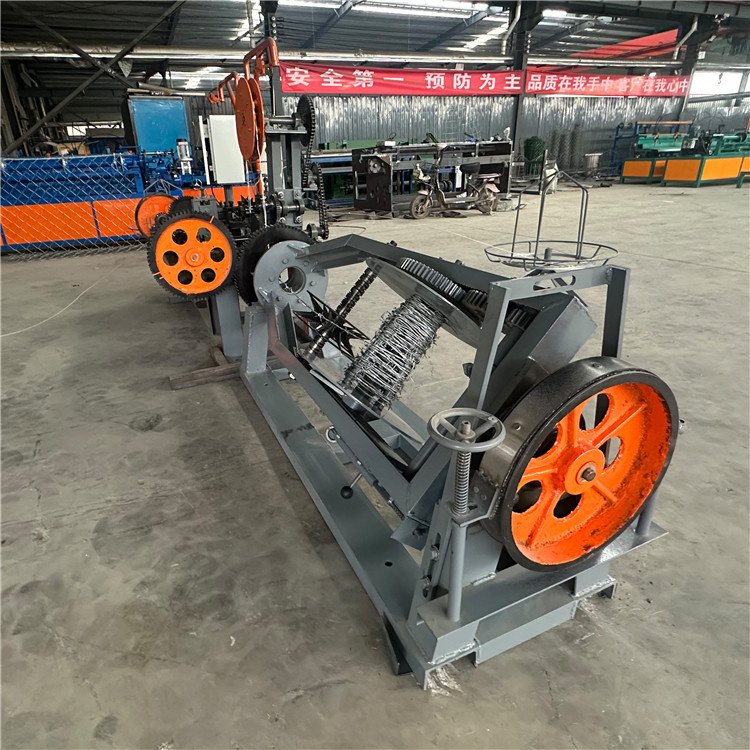
Production line and factory setup overview
A small wire-twisting line converting purchased galvanized or PVC-coated low-carbon steel wire into conventional double-strand barbed wire through coil receiving and coating inspection, four-coil payoff, controlled strand feeding, barb-wire cutting and wrapping, strand twisting, programmed barb-pitch and length control, coil take-up, edge/point inspection, weighing, binding and traceable dispatch. Razor wire and wire galvanizing are different processes and are excluded.
Recommended lowest-entry line configuration Start with one conventional double-strand specification using purchased hot-dip-galvanized wire: about 2.5-2.8 mm strand wire, 2.0-2.2 mm barb wire and one 102 or 127 mm barb pitch, subject to buyer approval. Screen one guarded CS-A/CS-C machine with four controlled payoffs, automatic length counter, coil take-up, scale and binding tools. Do not confuse this line with razor-wire punching or a galvanizing plant.
Production process and implementation sequence
- Coated-wire receiving and lot release
- Four-coil payoff and controlled feeding
- Barb-wire cutting and point formation
- Barb wrapping around the carrier strand
- Double-strand twisting and pitch control
- Programmed length counting and coil take-up
- Point, twist, coating and coil inspection
- Weighing, binding, warning label and dispatch
Products, capacity and market fit
- Farms, compounds and security projects consume conventional barbed wire in repeat coils.
- Buying finished coated wire avoids hazardous galvanizing at entry.
- One wire and barb-pitch specification minimizes setup and slow inventory.
- Sharp-point geometry, coating damage, coil length and safe handling determine acceptance.
- Double-strand galvanized barbed wire - One strand/barb diameter, barb count, pitch, point, twist, coating, coil length and mass - Farms, compounds, contractors and security merchants
- PVC-coated barbed wire - Separate core wire, finished diameter, colour and coating-adhesion approval - Selected corrosion/appearance applications after buyer trial
Core production machinery and line specifications
| Machine / stage | Function / value | Production note |
|---|---|---|
| Four controlled wire payoffs | Feeds strand and barb coils without tangling | Contracted coil size |
| Guarded double-strand barbed-wire machine | Cuts/wraps barbs and twists carrier wires | CS-A/CS-C class |
| Barb-pitch and length controller | Controls spacing and finished coil length | One launch pitch |
| Coil take-up and binding stand | Builds transportable coils | Buyer coil mass |
| Wire/coating gauges and scale | Releases geometry and quantity | Calibrated tools |
| Point inspection and safe handling tools | Protects product and workers | Gloves, guards, warning labels |
Raw materials, utilities and factory requirements
- Purchased hot-dip-galvanized or approved PVC-coated low-carbon wire
- Coil binding wire/straps, warning labels and protective wrap
- Cutters, gears, guides, bearings and critical wear parts
- Stable three-phase or supplier-confirmed electrical supply
- Dry coated-wire and finished-coil storage
- Full rotating-machine guarding and emergency stops
- Safe coil lifting, payoff clearance and pedestrian segregation
- Metal debris collection and fire-safe housekeeping
Indicative low-entry investment and implementation plan
These planning ranges prioritize economical machinery, local labor and local civil works. Final pricing follows confirmed capacity, product specification, delivery terms and site conditions.
| Scope | Indicative range | Entry-plan note |
|---|---|---|
| Machine, four payoffs and take-up | US$7k-18k | One double-strand specification |
| Guards, inspection and coil handling | US$3k-8k | Mandatory safety/release |
| Packing tools and starter wear parts | US$2k-6k | Cutters and guides |
| Freight, installation and training | US$3k-9k | Compact workshop |
| Indicative installed low-entry total | US$15k-41k | Wire coating, building and wire stock excluded |
Detailed proposal and next step
The proposal contains the complete line flow, machinery scope, raw-material and utility requirements, implementation stages and indicative entry planning. Final configuration follows confirmed products, capacity, site and budget.